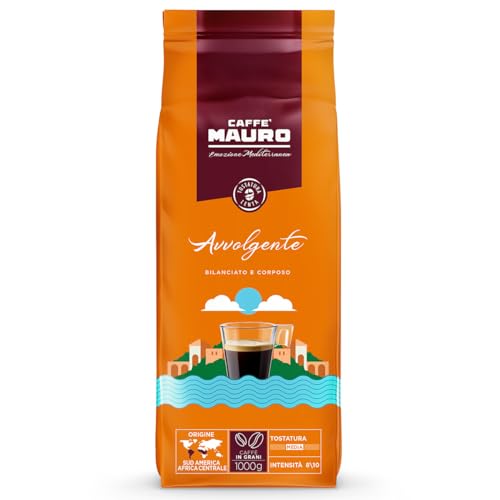
One kilo of whole beans in an orange bag, medium roast, intensity 8 out of 10: that is how Caffè Mauro presents the Avvolgente. On Amazon.de the pack has been listed since 17 June 2024 and costs approx. €21.46 (as of September 2026). In our coffee beans comparison that puts it in the upper midfield: of the 22 other beans there, 15 are cheaper per kilo and seven are more expensive.
The product page in the manufacturer’s shop consists of a single sentence, so the most reliable information is on the pack itself.
What the bag says
Under the Avvolgente lettering it reads “Bilanciato e corposo”, balanced and full-bodied. At the bottom right sits a block with “Tostatura media” and “Intensità 8/10”, in the middle “Caffè in grani 1000g”, and on the left the origin: “Sud America, Africa Centrale”. Directly below the logo the bag carries a round seal reading “Tostatura lenta”, slow roasting.
Roast level and intensity appear in the same way on the variety card that caffemauro.com shows in its Casa section, the range for home use. Both values are therefore the roaster’s claims. The Amazon title merely adopts them and adds the note “made in Italy”.
Translated, the one sentence in the shop reads: a full-bodied and round blend in which the chocolate notes are well balanced by the fruity acidity. The Amazon bullet point says the same with the word “full-flavoured”. We have not drunk the Avvolgente; the flavour profile is the roaster’s description.
According to the Amazon catalogue, the kilo is packed in a protective atmosphere to preserve the aroma of the bean. The catalogue gives the pack dimensions as roughly 29 by 14 by 8 centimetres at a weight of 1.0 kilograms.
In detail: what a medium roast and the eight tell you
An intensity number measures nothing. There is no standard for it, every brand sets its own scale, and Caffè Mauro explains its own nowhere. How little such numbers can be compared is shown by our own catalogue: Lavazza also gives the Espresso Italiano Cremoso as 8 out of 10, while Pellini lists the N.82 Vivace in the Amazon bullet point as 8 out of 9. The same eight is one step before the end of the scale at Pellini, two at Caffè Mauro.
The roast level says more, because chemistry can be tied to it. During roasting the fruit acids of the green coffee break down, above all citric and malic acid, and with them the chlorogenic acids, the largest acid group of the green bean. From the chlorogenic acids come lactones with a mild bitterness and, in dark roasts, phenylindanes, whose bitterness is harsher. A medium roast ends before the phenylindanes predominate. The fruity acidity that Caffè Mauro states fits this stage. With a very dark bar roast little of it would be left.
The Tostatura lenta seal describes a process used across the whole house. On its Saper fare page Caffè Mauro writes that each type of coffee is roasted individually and without haste, and only blended afterwards. There is a solid reason behind this. Arabica and Robusta differ in size, density and sugar content and take up heat at different speeds; in a shared drum one component would be finished while the other lags behind. Roasted separately, each gets its own profile.
Slow is a relative term here. Industrial fast roasting in hot-air plants takes only a few minutes, while drum roasters usually work between ten and twenty minutes. A longer roast at a lower temperature drives the heat more evenly to the core, and the surface does not burn while moisture still sits inside. Which times are behind the Avvolgente’s seal we list further down under the open points.
Arabica, Robusta and two continents
How much Robusta is in the Avvolgente, and whether there is any at all, Caffè Mauro does not say for this blend. Brand-wide, Saper fare says the company processes selections of Arabica and Robusta into its own profile for each blend. The home range on caffemauro.com includes six blends: Original, Classico, Avvolgente, Amabile, 100% Arabica and Deca. Only one of them names the coffee species in its name.
The roaster’s choice of words offers a clue. On the Casa page Caffè Mauro describes its range as a spectrum between the fruity aromas of Arabica and the full-bodied ones of Robusta. The Avvolgente calls itself corposo and at the same time claims a fruity acidity, so by this logic it would lie somewhere between the two poles. Nothing can be proven with that. If you avoid Robusta because of the caffeine, you are better served by a bean that declares its coffee species openly.
The origin statement does not help with the guesswork either. South America and Central Africa, as the bag says, gets you little: both species grow in both regions. Brazil is the world’s largest Arabica producer and at the same time grows Robusta on a large scale, called Conilon there. Coffea canephora, the botanical species behind Robusta, originally comes from western and central Africa, while in the highlands around Lake Kivu, on the Congolese as well as the Rwandan side, Arabica is grown.
From Via Florio to the Gimoka Group
The company history is told by the roastery itself, on its Storia page. In 1949 Demetrio Mauro set up his first roasting machine in Reggio Calabria, in a warehouse at Via Florio 101, a few steps from the harbour. From there, according to this account, he delivered three quintals of whole beans every day, that is 300 kilograms.
In 1997 the roastery chose a site of 32,000 square metres in the industrial area of Villa San Giovanni, north of Reggio on the Strait of Messina, for a new plant. In 2009 Capua Investments gradually took over all shares of Demetrio Mauro S.p.A., which was then renamed Caffè Mauro S.p.a., and the manufacturer is also listed under this name in the Amazon catalogue. Since 2022 the roastery has belonged to the Gruppo Gimoka. The website is now operated by Gruppo Gimoka S.p.A., based in Cinisello Balsamo near Milan. According to its own statement it exports to more than 60 countries.
According to Saper fare, the green coffees go through a tasting and chemical-physical analyses in the laboratory.
Two brands from one group are therefore in our catalogue. Under the parent company’s name are the Gimoka Classico at approx. €13.63 per kilo, the lowest kilo price in the whole comparison and €7.83 less than the Avvolgente, and the Gimoka Armonioso at approx. €15.34.
Is it worth ordering from the manufacturer’s shop?
On the kilo price yes, with one reservation up front: whether the shop delivers to Germany and what shipping costs below €49, we have not determined; only the shopping basket will show you. On 25 September 2026 the 1 kg pack cost €15.81 on shop.caffemauro.com, reduced from a list price of €17.00, which put it €5.65 below the Amazon.de price of 7 September. The shop only ships free from €49 of goods.
Three bags cost €47.43 there and stay just under this threshold. With the fourth the basket stands at €63.24, and from €59 the shop’s banner promises a further 5 per cent discount. If the discount applies to the already reduced price, you arrive at €60.08 for four kilos on paper, a good €15 per kilo. That is a large stock: at two double espressos a day, together around 36 grams of coffee, four kilos last a good three and a half months.
The shop’s pages are in Italian. On the day it was checked, the 1 kg variant was listed as available in the page source. A search engine at times reported it as sold out, but the Esaurito note is a hidden element of the page template and not the stock level.
Three beans to put next to it
| Blend | Roast and origin | Price per kg | Our rating | Choose this if |
|---|---|---|---|---|
| Caffè Mauro Avvolgente (this one) | Medium roast, intensity 8 out of 10, green coffee from South America and Central Africa | approx. €21.46 | 8.2 | you order from the manufacturer’s shop and use a moka pot or portafilter machine |
| Lavazza Espresso Italiano Cremoso | Medium roast, intensity 8 out of 10, Arabica and Robusta from South America and Southeast Asia | approx. €16.99 | 8.9 | you order from Amazon.de and want to see in black and white that Robusta is in the blend |
| Pellini N.82 Vivace | Medium roast, Arabica and Robusta, intensity 8 out of 9 | approx. €19.21 | 8.6 | it matters to you that the roaster explicitly names the bean-to-cup machine as a brewing method |
| 360° Rundum Ehrlich Bio Honduras | Long drum roast, low acidity, 100 % Arabica from Honduras, organic according to the seller | approx. €35.59 | 9.3 | you want a single country of origin and an organic seal and are willing to spend clearly more |
The obvious alternative is the Lavazza. On the label it carries the same values, but it declares its Arabica-Robusta blend and costs €4.47 less per kilo. The Pellini is €2.25 below the Avvolgente, the 360° Rundum Ehrlich €14.13 above it.
What the table is not good for: it says nothing about which of the four beans you will like. The ratings are our editorial assessment based on manufacturer claims, catalogue data and price, and the prices are the guide values of our price boxes and can change at any time.
What Caffè Mauro leaves open
We found the following information neither in the shop, nor on caffemauro.com, nor in the Amazon catalogue on 25 September 2026:
- the ratio of Arabica to Robusta for this blend
- individual growing countries, farms, altitudes and the processing method, washed or natural
- roasting time and temperatures behind the Tostatura lenta seal
- which values the laboratory analyses of the green coffees cover
- a recommendation for grind size and dose
- roast date and best-before date before purchase, plus a time limit for the opened bag
- storage instructions
- whether the bag has an aroma valve or a reseal
- a caffeine content
- certifications such as organic, Fairtrade or Rainforest Alliance
- the plant in which the Avvolgente is roasted; documented are the Villa San Giovanni site and the Amazon note “made in Italy”
In our view the blend ratio weighs heaviest (why is explained above under Arabica and Robusta). The best-before date is a mandatory label item for roasted coffee on the pack; you simply only see it after purchase.
A protective atmosphere usually means that the oxygen in the bag was replaced by an inert gas such as nitrogen during filling. With the first opening this protection is over. After that we would roll the bag up tightly and clip it, or transfer the beans to an airtight, light-proof tin, and store it cool and dry, but not in the fridge: when you take them out, moisture condenses on the cold beans. Only what goes through the grinder within a few days belongs in the bean hopper of a bean-to-cup machine, because air reaches the beans there.
Which brewing method suits the Avvolgente?
On its Saper fare brand page, Caffè Mauro names two ways for its blends, the moka pot and espresso, with equal rank in the same sentence. Our moka pot guide goes through the moka pot step by step; the most important points up front: grind slightly coarser than for a portafilter machine, fill the funnel loosely without tamping, and take the pot off the heat as soon as it starts to gurgle.
In a portafilter machine a medium roast is more forgiving than a light one, because the bean is more brittle and gives up its compounds more easily. It is not as tricky as a very dark one, which quickly turns bitter if the grind is too fine. As a starting point we would choose a ratio of 1:2 in 25 to 30 seconds and then only adjust the grind size. The brew calculator works out the dose and water amount for other ratios.
In a bean-to-cup machine the surface of the bean matters. Oil emerges mainly with dark roasts; it then gums up the grinder and bean hopper and goes rancid over time. A medium roast usually stays dry. This conclusion rests on the roast level alone; we have not seen the beans themselves.
For cappuccino and latte macchiato the coffee needs body so that it does not get lost in the milk. Caffè Mauro calls the Avvolgente full-bodied, and with a medium roast we see no reason to rule it out for milk drinks.
Who is it for?
The kilo is only available as whole beans, and how well it suits you depends mainly on your consumption. With the two double espressos a day from the shop calculation above, the bag is empty after just under four weeks. If you only drink a single one with 9 grams, it lasts a good three and a half months, which is how long the bag then stays open.
For the pour-over dripper we would take a different bean. Filter coffee lives on acidity and clarity, and the paper holds back some of the oils that carry the character of a body-driven blend. In the French press these oils stay in the cup; ground coarse and with about four minutes of steeping, such a profile suits it better there.
Without a grinder the kilo is the wrong choice. Then reach for the ground Avvolgente from the manufacturer’s shop (pack sizes in the FAQ). At 36 grams a day, 250 grams last just under a week, 500 grams just under two. Because ground coffee loses aroma faster than whole beans after opening, we would take the smaller pack if you use less.