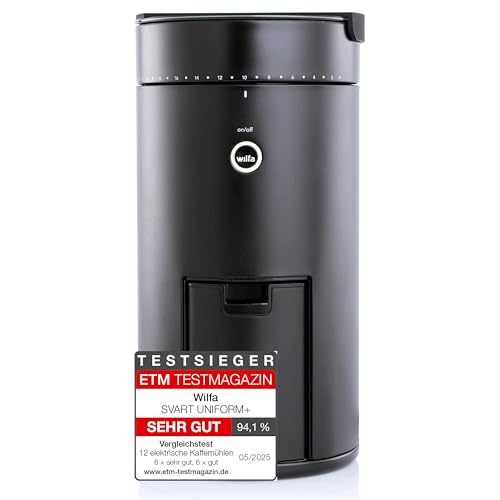
The Opus is Fellow’s electric conical burr grinder for every preparation from espresso to cold brew. Fellow calls it fine enough for real 9 bar espresso, and in that it differs from Fellow’s Ode: according to the manufacturer, the Ode is built for brewed coffee and unsuitable for espresso. On Amazon.de the Opus costs approx. €230 (as of September 2026).
It is built for single dosing. The manual advises against keeping beans in the Opus and recommends filling it only immediately before grinding.
Which Opus do you get on Amazon?
The first generation. The Amazon listing describes 40 mm stainless steel burrs and “41+” settings, and those are the specifications of the original Opus. The Opus 2 has 48 mm burrs, and Fellow describes a stepless dial with 48 settings for it, that is, an adjustment without click steps.
Fellow now sells the Opus 2 as the successor in the USA. The old product address redirects there, and the US shop only lists the first generation as refurbished, under the name “Opus - RF” for 199.95 US dollars. Whether and when the Opus 2 will go on sale in Germany could not be clarified, because Fellow’s European shop is behind a password.
You can identify the unit from two details. Amazon lists the part number “Opus White” in the colour matte white, and the German-language EU manual gives the model number APAAEU with the product name “Opus Kaffeemühle mit Kegelmahlwerk” (Opus coffee grinder with conical burr set). The grinder was designed in San Francisco and is made in China.
Design: a cylinder above the magnetic cup
In the product photo, a round body stands on a flat base plate, with the power button at the front right. The top band carries the grind scale with a marker in the middle. The photo does not show the blue inner ring; according to Fellow’s description it sits under the bean hopper. The grounds fall into a catch cup with a pouring spout, which a magnet holds in position. According to the Amazon description, the beans fall directly from the hopper to the outlet, which is meant to reduce leftover grounds.
On materials, Fellow stays with a collective statement: plastics made of ABS, PC and PP, burrs made of stainless steel. According to the manufacturer, the Opus contains no PFAS or Teflon, and all materials in the grounds path are food-safe and approved by the US authority FDA.
The outer dimensions are in the EU manual: 210 millimetres long, 129 wide, 268 high, at 2.27 kilograms. The earlier US product page rounds the weight to 2.3 kilograms. The EU model runs on 220 to 240 volts and draws 150 watts.
The lid of the bean hopper has a second job. Turned upside down, it shows compartments for 20 and 40 grams of beans, filled to the brim it holds 100 grams, and flipped up it reveals a grinding guide, according to the Amazon text. Two values are in circulation for the hopper itself: 100 grams of grinding capacity in the EU manual, 110 grams on the earlier US page.
Fellow’s Gear Guide lists the following as included: the grinder, the hopper lid, the catch cup with the insert for portafilter dosing, a safety manual with instructions for use and a “Get to Know You Guide”. There is no brush in this list, even though the instructions call for a brush for the burrs and the exit chute.
In detail: 41 clicks and the blue inner ring
Grinding is done with six-edged 40 mm stainless steel burrs, which Fellow calls C6-40 Burly Burrs. They turn at 350 revolutions per minute, and the motor delivers 6 newton metres of torque, according to the manufacturer. Fellow says the burrs are designed for the lifetime of the product, but wear is natural.
The outer ring carries the numbers 1 to 11, with 1 being the finest setting. Each gap between numbers is divided into four quarter-step clicks. Ten gaps times four, plus the starting position: that is how the 41 settings in the instructions come about. According to Fellow, one click moves the burr by 50 micrometres in height.
The plus after the 41 stands for the blue inner ring under the bean hopper. One click there corresponds to two thirds of a quarter step, that is, one sixth of a number, and the ring has six clicks in each direction. Together with the outer ring, this gives Fellow steps of 16.7 micrometres. The outer ring can also reach positions 0 (one number finer than 1) and 12 (one number coarser than 11).
The inner ring cannot be adjusted on the side. Fellow’s procedure: empty the hopper, set the outer ring to 6, remove the bean hopper anticlockwise, press the tabs of the blue ring, turn the outer ring, release, and put the hopper back. Because the inner ring shifts the zero point of the outer ring (otherwise positions 0 and 12 would not exist), every correction shifts the whole scale. This is our deduction from Fellow’s description, and it has a practical consequence: if you set the inner ring finer for espresso, the filter setting you have remembered also becomes finer by the same amount.
The ring is also intended to compensate for wear. If worn burrs grind coarser, Fellow’s plan is to turn it finer step by step, without tools.
Grind size, dose and timer according to the instructions
The German quick-start guide contains a table of grind size ranges. In the PDF the bars exist only as a graphic; we read them off:
- Espresso: 1 to 2
- Prismo: 2 to 3
- AeroPress: 2 to 5
- Pour-over: 5 to 9
- Cupping and electric coffee maker: about 7 to 9
- French press: 8 to 10
- Cold brew: 10 to 11
For darker roasts, Fellow advises a higher number within the range. According to the instructions, if the coffee tastes sour, go a little finer; if it is bitter, a little coarser. Our guide on setting the grind size explains how to home in on a grind size step by step.
That leaves five click positions on the outer ring for espresso: 1; 1.25; 1.5; 1.75 and 2. Between the finest and the coarsest there are arithmetically 200 micrometres of burr travel. If none of the five clicks hits the right value, only the inner ring is left, with the procedure described above. We would therefore not recommend the Opus as an espresso grinder to anyone who dials in a new bean every week.
The dose recommendations in the instructions, each with the coffee-to-water ratio: 18 grams for an espresso at 1:2, 20 grams for the Prismo at 1:2.5, 25 grams for the AeroPress at 1:15, 20 grams of pour-over for one person and 40 for two at 1:16, 60 grams of French press for three at 1:14 and 80 grams of cold brew at 1:8. The largest dose in the table is 100 grams for 12 cups. Our calculation: 18 grams of grounds at 1:2 gives roughly 36 grams of espresso, and 60 grams for the French press needs about 840 grams of water at 1:14. Other quantities are easy to work out with the same ratios.
Starting is done with a single button with timer presets. One short press grinds for 30 seconds, two for 60, three for 90, holding for one second gives two minutes, and another press stops early. How many grams run through in 30 seconds is not quantified by Fellow for this generation; for the Opus 2, the manufacturer gives about 9 seconds per espresso shot. For single dosing this is secondary in our reading: you grind the weighed amount through until the hopper is empty, so the timer step only has to be long enough.
Fellow also describes a manual mode. It is activated by unplugging the grinder and holding the button while you plug it back in; three short beeps confirm it. If you plug it in without the button held, the Opus beeps once and is back in normal operation.
Portafilter and replacement burrs
The Opus grinds directly into the portafilter via the included portafilter dosing cup. It goes into the catch cup as an insert and, according to the instructions, makes it compatible with 54 and 58 mm portafilters. The instructions show the sequence from placing the portafilter on the cup to tapping and tamping.
We did not find an insert for 51 millimetres or other diameters at Fellow. If you have a machine with a smaller basket, you grind into the catch cup and transfer from there. Before you reach for a third-party dosing cup: the safety manual warns that accessories Fellow neither recommends nor sells could cause fires, electric shocks or injuries.
For burrs, besides the standard C6-40 burrs Fellow mentions a replacement set called “Opus 40 DLC Brew Burrs” and also explains its installation in its FAQ. However, the set was not listed in the US shop when we researched it in September 2026. The Opus shares no parts with the Ode; according to Fellow, the components of one grinder do not fit the other.
The Opus or one of the other three?
| Model | The difference | Price | Our rating | Choose this one if |
|---|---|---|---|---|
| Fellow Opus (this one) | 40 mm burrs, 41 clicks plus inner ring, 100 g hopper for single dosing | approx. €230 | 8.6 | you weigh every portion and switch between espresso and filter |
| Baratza Encore ESP | also 40 mm burrs, steps 1 to 20 for espresso only, 300 g hopper, no timer | approx. €179.95 | 9.0 | you mainly want to fine-tune espresso and store beans in the hopper |
| Baratza Virtuoso+ | 40 mm burrs, timer with 0.1 s resolution, 300 g bean hopper | approx. €229.95 | 9.0 | you dose filter or French press by time rather than by scale |
| Eureka Mignon Specialita | 55 mm flat burrs, stepless adjustment, touch display | approx. €431.90 | 9.4 | you pull several espressos a day on a portafilter machine and have almost double the budget |
The prices are our reference values as of September 2026, and the rating is our editorial assessment based on the manufacturers’ data. The table does not show how the four grinders actually grind; none of them has been in our hands.
When the Opus fits and when another grinder does
Switching between espresso and filter on the Opus is one turn of the outer ring, from 1 to 2 for espresso to 5 to 9 for pour-over. As long as you do not touch the inner ring, both remembered values stay valid. You can find more conical and flat burr grinders in our overview of electric coffee grinders.
If you mainly make espresso and often change beans, the Baratza Encore ESP is the more convenient choice in our comparison. Its scale reserves steps 1 to 20 for espresso, four times as many click positions as the Opus has between 1 and 2.
If you prefer to control the amount by time, the Baratza Virtuoso+ has a timer with a resolution of a tenth of a second, at practically the same price. The Opus’s fixed timer in 30 second steps does not replace such a timer.
The Eureka Mignon Specialita costs €201.90 more. In our assessment that is only worth it if espresso on a portafilter machine is your daily main business and you rarely switch to filter.
That leaves the office kitchen. In our reading, the warranty lapses there: the manual names only household use as the intended use and ties any other use to loss of warranty. In addition there are the mandatory pauses between two grinding cycles; the figures are in the FAQ below.
Cleaning according to the manual
Before any cleaning you pull the mains plug, and the parts must be at a standstill. Fellow recommends running the empty grinder for 10 seconds beforehand. For the unit itself the rule is: “Clean the burr set only from the outside with a damp cloth” (our translation from the German manual). You wipe the housing and bean hopper with a soft, damp cloth, the catch cup likewise, and then you wipe it dry.
With daily use, the burrs should be cleaned at least every three months, with cleaning tablets or a stiff brush. For the brush you remove the burrs. The outer burr is firmly moulded into a plastic carrier with a wire handle and comes off via a twist lock; you should not take it apart any further, and Fellow warns that the burr ridges are sharp. You carefully brush off the coffee dust and put the burrs back. The manual says: “Do not immerse the burr set in water. The ridges must NOT be washed with water” (our translation from the German manual).
With cleaning tablets, for which Fellow gives Urnex Grindz as an example, you first run beans through for 10 to 20 seconds, set the grind size to 11, grind the tablets and then about 30 grams of coffee. The guide on cleaning a coffee grinder compares how often other grinder types need a basic clean.
According to the manual, scouring pads, harsh chemicals and chemical spray cleaners are excluded. No part of the grinder may go in the dishwasher.
Placement, warranty exclusions and open points
On location, the safety manual requires a dry, flat surface that is not at the edge of the worktop, because vibration can move the unit. The Opus should not be operated outdoors or near explosive or flammable vapours, and it must not come into contact with other heat sources, such as gas or electric burners, an oven or a microwave. There is a neodymium magnet in the base and in the catch cup; Fellow requires a distance of at least 10 centimetres from magnet-sensitive objects.
According to the manual, the warranty excludes: damage from accidents, improper use or errors in your own repairs, operation with the wrong type of current or voltage, failure to follow the cleaning instructions, disregard of the warnings and safety notes, and grinding anything other than whole roasted coffee beans or cleaning tablets. Anyone who opens the base also loses the warranty. According to the manual, there are no parts inside that you can service yourself.
Collected here is what Fellow does not quantify or explain anywhere for the first Opus: the noise level in decibels (the instructions only promise fast and quiet grinding), the year of market launch, the materials of individual parts beyond the collective statement, the capacity and material of the catch cup, the dead space in grams, where Fellow only speaks of low retention, the working principle of the anti-static effect, price and availability in a European Fellow shop, spare parts supply in the EU, a warranty extension for EU buyers, the cable length of the EU model (the US page gives 1 metre) and a grind size recommendation for Turkish coffee or the moka pot.