The Bodum Pour Over is a glass carafe with a cone of stainless steel mesh set on top. You put ground coffee in the cone, pour hot water over it, and the coffee drips straight into the carafe. No filter paper is involved. Bodum sells the model under article number 11571-109 as a coffee maker for 8 cups and 1.0 l, and the same number appears in the Amazon listing we link to. There the carafe costs approx. €58.38 on Amazon.de (as of September 2026). Amazon gives 1 September 2016 as the release date.
We have not handled the Pour Over and have not brewed coffee with it. The information comes from the German product page on bodum.com, from the 15-page multilingual instruction manual in version V2.20190212 and from Bodum’s service FAQ. Prices and ratings of the other devices come from our catalogue, their technical data from the respective manufacturers.
Glass, cork, a leather band and a stainless steel cone
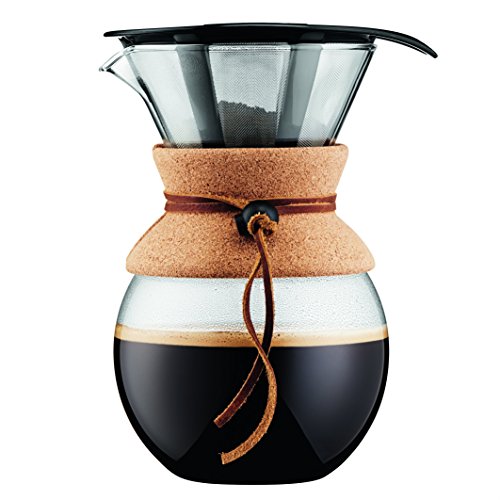
In the product photo, a round glass belly sits at the bottom. Above it, the carafe narrows to a waist with a wide cork sleeve around it. A leather band is wrapped around the cork, its ends hanging down with a dark bead. Above the sleeve, the glass widens again, with the spout on the left. The filter cone sits in the opening from above. Its rim is black and runs out on the right into a flat tab that you use to grip it.
Bodum gives the dimensions as 16.0 cm wide, 13.6 cm deep and 21.7 cm high. That the width exceeds the depth by 2.4 cm is probably due to the spout and the filter tab, which protrude at the sides, since the glass belly is perfectly round in the photo.
The glass is borosilicate glass. According to Bodum, it is non-porous and absorbs neither taste nor aroma. The data sheet on the product page also contains a line that is easy to overlook: shatterproof, no. Borosilicate glass expands less when heated than ordinary soda-lime glass and therefore copes better with hot water in a cold carafe. Against a knock on the sink it helps little.
On materials, the product page and the instructions contradict each other. On bodum.com the material line reads stainless steel, plastic, borosilicate glass, silicone. The instructions list borosilicate glass, plastic, stainless steel and cork, plus leather for version 109 and silicone for 109A. Our product photo shows a leather band and so matches the instructions. Which band is shipped today nevertheless remains open. It makes no difference to care, as the section on the dishwasher shows.
In detail: what a metal filter lets through and paper does not
Paper filters in two ways. The cellulose fibres form a dense, irregular web in which fine particles are caught, and on their surface they bind a large share of the coffee oils. A stainless steel mesh works purely mechanically. Whatever is smaller than a mesh opening runs through, and that applies to oil droplets just as much as to some of the finest ground particles, known in the trade as fines.
What this means for the cup follows from physics, even without a tasting. Suspended particles and emulsified oil make the coffee cloudier and give it a heavier mouthfeel, which in coffee language is called body. A fine sediment settles at the bottom of the carafe and the cup. Bodum describes the same effect from the other side: the natural essential oils of the coffee are retained, producing a full-bodied, smooth-tasting coffee with a robust aroma. That is marketing language. Whether you like this kind of coffee is decided by your palate, not by the data sheet.
A second point concerns health. Coffee oil contains the diterpenes cafestol and kahweol. The review article by Urgert and Katan (Annual Review of Nutrition, 1997) describes cafestol as the substance that makes unfiltered coffee raise cholesterol, and paper filters largely hold it back. A metal mesh does not, and in this the Pour Over resembles a French press more than a paper filter. If you need to watch your LDL levels, you should know this before buying.
With grind size, the two are linked. The finer you grind, the more fines are produced, and with a mesh a larger share of them ends up in the carafe. Our conclusion: a metal filter copes better with the coarser half of the filter range, so medium to medium-coarse. How to get your grinder there is described in our guide Setting the grind size.
Four steps, two tricky spots
Bodum describes the preparation in four steps. First, freshly ground filter coffee goes into the cone, one heaped teaspoon or one Bodum measuring spoon for every 1.25 dl cup. Then you slowly pour hot but not boiling water over it in circular movements until the grounds are evenly moistened, and top up to the maximum fill level. In the third step the water runs through the coffee grounds and drips into the glass carafe, which according to the product page takes about four minutes. Finally, you remove the filter and put the plastic lid on.
The first catch lies in removing it. Under the heading scalding hazard, the instructions require that the hot water has run completely through the filter before you lift it off the carafe. A cone that still holds water drips onto your hand and the worktop when lifted.
The second is the temperature. The German text stays at hot but not boiling. The Japanese part of the same instructions is more precise: it gives about 90 to 95 °C and advises against water that has only just stopped bubbling. The Specialty Coffee Association gives 195 to 205 °F for filter coffee, around 90.5 to 96 °C, so the Japanese figure lies largely within that range. Without a kettle with temperature selection, you let the water stand briefly after boiling.
The instructions do not call for a gooseneck kettle. In our assessment, though, the slow, circular pouring they describe is easier with one than with the wide spout of an ordinary kettle. If you want to work in grams rather than spoonfuls, the Brew calculator works out the quantities for your amount of water.
Is giving up paper filters worth it?
In euros, only slowly. A paper filter costs a few cents per brew, and the Bodum saves exactly those cents for as long as its stainless steel cone lasts. We consider waste the stronger argument: you buy no filters and throw away no paper.
A manufacturer that discloses its filter prices shows how small the amount is. Chemex charges $11.00 in its own US shop for 100 folded Bonded filters FS-100, around 11 US cents each. Anyone brewing one carafe a day uses 365 filters a year and ends up at about $40. Chemex describes these filters as compostable, so they go into the organic waste bin together with the grounds.
With the Bodum that cost disappears, but the coffee grounds remain. You empty the cone after every brew, and we would rinse the mesh straight away, before the grounds dry into the openings. If the cone is ever dented or clogged, Bodum lists in its shop a permanent stainless steel filter 1.0 l with handle under number 12110-01S for €19.90. That this cone fits the 11571-109 is, however, not stated anywhere on the page. The name with 1.0 l and handle suggests it, but it is not promised.
Dishwasher, cork and the safety notes
The instructions attach a condition to the dishwasher, in their wording: “separate the cork and the leather (109) / the cork and the silicone (109A) from the glass and wash it in the dishwasher.” On the symbols page it says Dishwasher safe with an asterisk, and the footnote reads “The leather and the cork are not dishwasher safe.” Before first use, the carafe should according to the product page be rinsed in warm soapy water and dried thoroughly. Out of our own caution, we would not soak the cork when washing by hand, and would only slide it back onto the glass once it is completely dry.
Already in step 1, the instructions call for a heat-resistant, non-slip surface, and the product page adds: flat. Under the heading safety instructions, the German part then lists these six points:
- Not suitable for use on a hob or in the oven.
- Use only ground filter coffee.
- The cleaning note about removing the cork and band, quoted verbatim above.
- Check the glass carafe for scratches, cracks or chips.
- Keep children away from the coffee maker while it is in use, because hot water is a danger to small children.
- Children must not use the coffee maker.
In addition there is the warning about scalding when removing the filter, which appears above under the four steps. The symbols page sums up child safety in one sentence: “Boiling water and children should be kept apart.” On the fourth point, the English part goes one step further than the German. There the checking is followed by the consequence: “Do not use a pot which is scratched, chipped or cracked.”
The Japanese part contains notes that are missing from the German one. It prohibits the microwave and standing the carafe next to an open flame, and it excludes abrasive scouring sponges, metal sponges and scouring powder. The glass is stated there as heat resistant with a permissible temperature difference of 120 °C. If you pour 95 °C water into a carafe at room temperature, the temperature jump is around 75 degrees, well below this limit.
What Bodum leaves open
Some details that buyers ask about are missing from all the Bodum sources we evaluated:
- the weight of the carafe and the footprint of the glass base (16.0 x 13.6 cm are outer dimensions, presumably including the spout and filter tab),
- the mesh size and number of layers of the stainless steel mesh (the filter is called multi-layer only in the Amazon title, the word appears nowhere on bodum.com),
- a list of what is in the box; the instructions assume carafe, filter, lid and sleeve, but whether the Bodum measuring spoon mentioned there is included in Germany is not documented,
- care instructions for the cork sleeve and leather band; Bodum only says that neither may go in the dishwasher,
- a warranty period in years for Germany,
- a note on descaling,
- a section on intended use.
The Amazon data does not help with these gaps; it even partly contradicts Bodum. The title gives 14 x 16.3 x 20.2 cm, the catalogue fields 10.75 x 7.38 x 9 inches, converted around 27.3 x 18.7 x 22.9 cm, plus 0.98 pounds, so around 445 g. What these values refer to is not clear from the listing, presumably the packaging. Amazon also speaks of 6 units without saying what is meant, and gives the colour as Transparent, while Bodum names the version Cork.
What else is worth considering?
| Model | The difference | Price | Our rating | Choose this if |
|---|---|---|---|---|
| Bodum Pour Over 1 l (this one) | Stainless steel permanent filter, 1.0 l in one pour | approx. €58.38 | 7.6 | you want to brew up to eight small cups at once without paper and without electricity |
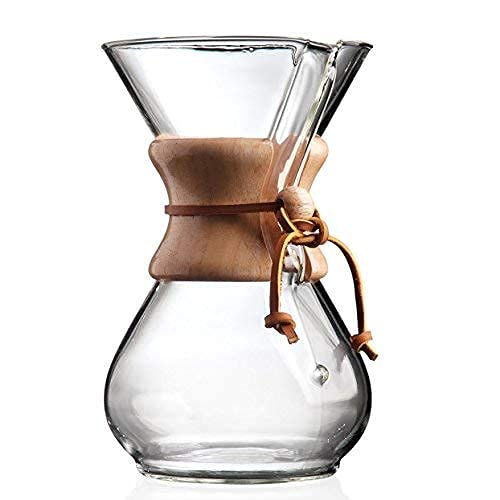
| Chemex 6-cup carafe | Bonded paper filter, 30 oz according to Chemex, around 887 ml | approx. €56.67 | 8.9 | you want a clear cup and are willing to keep buying filters for it |
| Hario V60 Starter Set | Plastic dripper size 02 with 600 ml server and paper filters | approx. €24.87 | 8.6 | you mostly brew one to four cups and want to spend little |
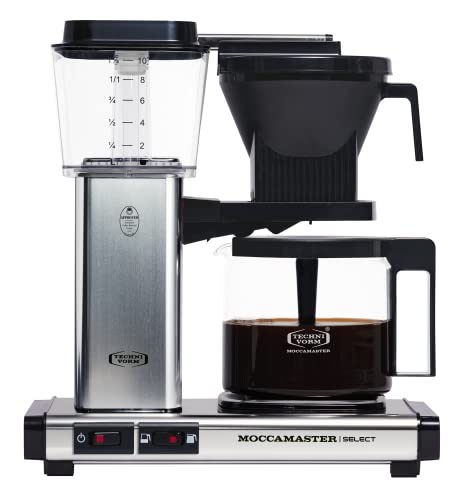
| Moccamaster KBG Select | Electric machine with 92 to 96 °C brewing temperature according to the manufacturer | approx. €259.00 | 9.5 | you do not want to pour by hand in the morning |
The prices are the guide values from the price boxes of the respective reviews and change constantly. The rating is our editorial assessment. The table does not answer which of the four makers produces the better coffee.
When the Pour Over suits you and when it does not
Quantity first. Bodum’s cup measures 1.25 dl, and eight of them make a litre. In 250 ml mugs, that is four. If you drink one or two mugs alone in the morning, you pay for capacity with the Bodum that you rarely use. According to Hario, the Hario V60 Starter Set is built for one to four cups and costs €33.51 less than the Bodum in our catalogue, although it works with paper.
Then the cup itself. If the coffee should be clear and without sediment, everything speaks for paper, and then we would reach for the Chemex 6-cup carafe. It costs €1.71 less than the Pour Over and, at 8.9, is well ahead of its 7.6 in our rating. According to Chemex, the Bonded filters are 20 to 30 per cent thicker than the paper of most competitors and hold back fats and sediments, exactly what the stainless steel mesh lets through. The same applies if you should drink filtered coffee because of the cafestol discussed in the detail section above.
Keeping warm is the third point. The Bodum carafe must not go on the hob (safety note 1). Chemex, by contrast, permits a small gas flame for its carafe, and the Moccamaster KBG Select keeps the pot at 80 to 85 °C on its own plate until it switches off 40 minutes after the start of brewing. If you drink a carafe spread over the morning, you will not be happy with the Pour Over in our assessment, unless you pour the coffee straight into a thermal jug.
On time budget, what counts is less the run-through than the hand on the kettle. With the Pour Over you stand beside it while pouring. The Moccamaster runs by itself, but costs €200.62 more and at 36 cm is a good 14 cm taller than the Bodum, which matters under a low-hanging wall cabinet. Further hand filters and their differences are collected in our Pour-over dripper comparison, and all makers in the category are listed under Filter coffee and pour-over.
The Pour Over is also the wrong choice for households where a glass pot breaks fairly often. We found no replacement glass for the 1 l carafe at Bodum, so after a fall you would probably have to buy the whole carafe again, going by the current state of the overview.