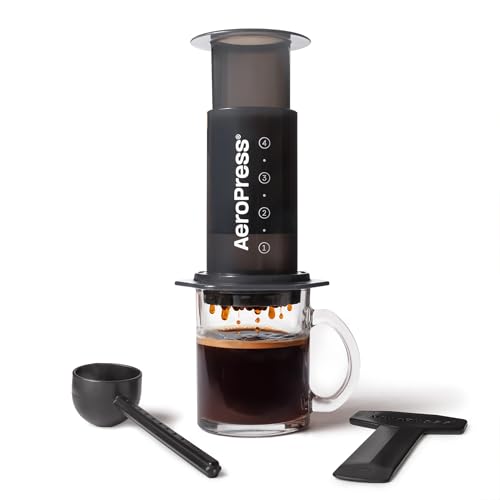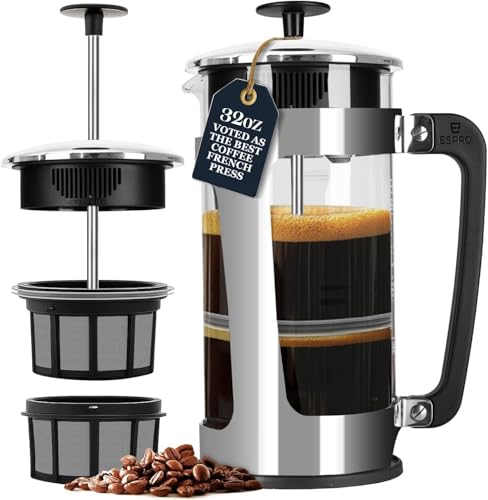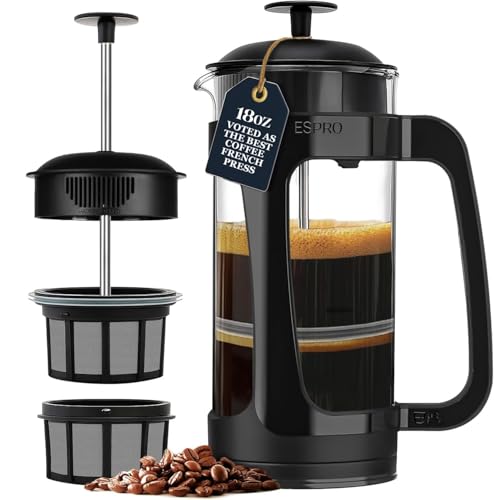
We have not handled this jug, and the sources for this product are particularly thin. Amazon Basics is Amazon’s own brand, no manufacturer page exists outside the sales listing, and we searched in vain for a manual or a PDF data sheet under the brand, the ASIN and the model number. What is written here about the product therefore comes from the Amazon catalogue, from the product photo and from two Amazon corporate pages that talk about the brand; this jug does not appear on them.
What kind of jug this is, and what it costs
In the catalogue the product is called “Amazon Basics French Press Coffee Maker, 1 L, Borosilicate Glass, Removable Dishwasher-Safe Parts” (translated from the German listing). Behind it stand the ASIN B0DYT2QL81 and the model number LN200278, which Amazon also lists as the part number. The brand is Amazon Basics, the record simply gives Amazon as the manufacturer, and the jug is filed under household goods in the product group Home and Garden.
The availability date given there is 7 January 2026. Taking the catalogue field at its word, the model has not yet been on the market for a year, which would explain part of the thin source material.
Our price box lists approx. €11.54 on Amazon.de (as of September 2026). There is no cross-check for this, because the price field in the Amazon catalogue is empty for this ASIN. Among the ten models in our category French Press and AeroPress, that is the lowest value; the Bodum Chambord, for example, costs €23.45 more in our price box, so roughly three times as much.
Glass, base and handle: what the catalogue photo shows
The carafe is made of borosilicate glass, which Amazon describes as extremely temperature-resistant. The catalogue gives the colour as transparent, black.
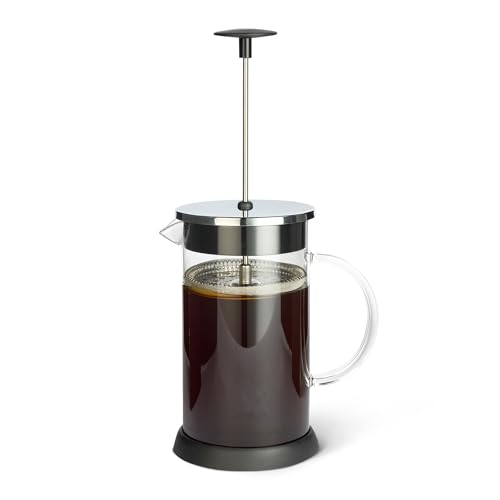
Beyond that, only the product photo helps. It shows a round glass cylinder standing on a black disc; the disc is slightly wider than the glass and forms the jug’s base. The cylinder stands free above it, without an enclosing frame, and that is exactly where it differs from the Bodum Chambord with its chrome-plated stainless steel frame. On the right, according to the catalogue photo, there is a handle that is transparent like the glass, attaches as a loop at the top edge and ends again on the glass below the middle. A spout projects on the left. On top sits a flat, metallic lid through which the plunger rod leads upwards, ending in a black disc as the push button.
The dimensions are given in inches and pounds, and the conversion is ours: 8.26 inches of height is about 21.0 centimetres, 6.4 inches about 16.3 centimetres, 4.4 inches about 11.2 centimetres, and 1.1155 pounds about 506 grams. The catalogue does not separate whether the dimensions and weight describe the jug itself or its packaging. If they are product dimensions, two different edge measurements suggest a rectangular footprint, which a round cylinder cannot have. Together with the photo, we read the longer edge as the distance from the tip of the spout to the outer edge of the handle and the shorter one as the diameter across glass and base. The proportions in the photo fit this reading.
If you take the weight as the empty weight, then when pouring in a litre of water you hold around one and a half kilograms by a transparent handle of unknown material. That is why, with a full jug, we would put the second hand under the base.
In detail: filter, spring disc, cross plate
Between the coffee grounds and the drink there is a filter in every press jug, and here it consists of three parts: a fine-mesh filter, a spring disc and a cross plate. Amazon calls this a triple filtration system and credits it with an even, sediment-free brewing process.
We derive the division of labour between the three parts from the usual construction. In press jugs of this kind, two plates clamp the mesh between them and hold it flat while you press from above. The fine-mesh filter does the actual separating. A springy rim presses against the glass wall and closes the gap between filter and glass, because otherwise part of the grounds would slip past there; the name spring disc suggests that it carries this rim. How much fine dust ends up in the cup in the end is decided by the mesh size of the fabric.
In the catalogue photo, the filter under the lid looks metallic, and it needs no paper, so it is a permanent filter. For the coffee, the design has a consequence that applies regardless of brand: a permanent filter holds back only what is larger than its openings, and the coffee oils pass through as well. A paper filter catches a large part of them. That is the design-related difference from an AeroPress, and it says nothing about the build quality of the two devices.
With this jug, then, everything hangs on the grind size, as with any press jug with a permanent filter. Coffee ground too fine clogs the mesh, builds up resistance when pressing and still pushes dust through. Ground coarse, roughly the size of sea salt, the grounds stay at the bottom under the filter when you press, and the coffee rises cleanly through the mesh. The usual values for the method are around four minutes of steeping time and water just below boiling point. Which setting on your grinder is coarse enough is shown by the table in the guide Setting the grind size.
Is one litre enough for your household?
In our assessment, one filling is enough for two to three people at the breakfast table; for a one-person household, a litre is a lot. Amazon states up to 5 to 6 cups, the glass holds a litre, and the catalogue gives the size as 1.0 l.
This figure has a limitation that applies to every press jug: the litre is the nominal volume of the glass, and less goes into the mugs. Air has to remain at the top so that the plunger has room at all, and the coffee grounds retain part of the water. The brew calculator works out the right amount of water for your number of cups.
A second point concerns heat. The glass is single-wall and built without insulation, so a full jug cools faster than a double-wall one. If you drink over the course of an hour, pour it into a thermos flask or go straight for a double-wall stainless steel press jug.
The catalogue expressly provides for the jug to be used for other drinks too, cold brews included. For cold brew, the litre is practical in our assessment, because one batch covers several days and the plunger unit does the final separation without an additional filter. Measure the height of your fridge shelf beforehand, because a litre jug does not fit under every shelf.
What Amazon does not state about this jug
The list is long, so it is gathered here rather than scattered. Because the manual and data sheet are missing, there is no wording at all on safety, intended use, cleaning and warranty, and nobody answers the question of whether the jug may go on a hob or in the microwave either. For the glass, the wall thickness and a temperature limit in degrees are missing. For base, handle, lid and plunger, the material is missing; stainless steel is not documented for any of these parts. For the filter, material and mesh size are missing. For the cup figure, the size in millilitres is missing, no fill-level marking is documented on the glass, and how much remains usable with the plunger inserted is stated in no source. In addition: no dosage recommendation in grams, no brewing temperature and no steeping time, no country of origin and no name of the manufacturer, no responsible person in the EU, no warranty period, no heat-retention time, no recommended retail price and no note on the right dishwasher compartment. As for the height, it also remains open whether it is measured with the plunger pushed down or pulled up.
None of this means that the jug lacks these properties. It means that nobody has promised them, and what is promised is what you have in hand in a dispute. For a glass jug without electricity that presses coffee in a private household, that is a manageable problem. For anyone buying for a café or a guesthouse who wants to keep documented manufacturer papers on use and cleaning, however, it is a real obstacle.
What running it costs
The jug needs no consumables. The plunger unit is a permanent filter, paper filters are not part of it, and a descaler is not needed because no heating element is installed. The running costs are therefore the coffee and nothing else, and in that it is ahead of any AeroPress, for which you regularly buy paper filters.
The calculation gets more interesting with wear. For the Amazon Basics, no spare parts offer is documented in our data; we found none, which is not the same as saying that none exists. In practice that means you buy new, and at €11.54 that hurts less than with the neighbours on the shelf. Bodum lists four wear parts individually for the Brazil: filter mesh and cross plate for €6.90 each, the spiral plate for €8.90 and the replacement glass for €18.90. The replacement glass thus costs more than the complete Amazon Basics and more than a new Brazil (€16.89); if the glass breaks, buying new is therefore cheaper for both jugs. The same goes for the filter once shipping is added: according to the Brazil product page, Bodum charges €11.50 standard shipping, so a filter mesh ordered on its own costs €18.40 and likewise more than a new Brazil. It only becomes cheaper than the new jug if your Bodum order reaches €65 anyway, because from there the shop delivers free of shipping costs according to the same page; all four spare parts together come to €41.60 and do not get that far. The calculation in detail is in our review of the Bodum Brazil. For a single repair, the spare parts therefore give no saving argument for the Brazil.
Who stands behind the Amazon Basics brand
Amazon announced AmazonBasics on 19 September 2009, at that time with audio and video cables and blank DVDs in the range, and in the same announcement described the line as combining quality and low prices with a focus on value for money. Coffee makers were not mentioned in 2009.
On product safety, Amazon gives its own figures in an undated newsroom article about the brand: up to 180 different safety, compliance and quality checks, up to 250 verified requirements, including chemical analysis, mechanical stress, flammability and labelling, and since the brand launch in 2009 two recalls across several thousand introduced items. Because the article carries no date, it remains open up to which year this recall figure runs. The figures describe the brand programme. Whether this press jug has been through such a check is stated in no source, and they say nothing about the glass in your kitchen.
This jug or one of the other three?
| Model | The difference | Price | Our rating | Choose this one if |
|---|---|---|---|---|
| Amazon Basics French Press 1 l (this one) | Single-wall glass, no manufacturer documentation | approx. €11.54 | 7.7 | you want to try the method before spending more |
| Bodum Brazil 1 l | Plunger and filter made of stainless steel according to Bodum, housing made of BPA-free plastic | approx. €16.89 | 7.9 | documented materials and an instruction manual are worth €5.35 more to you |
| Bodum Chambord 1 l | Frame and lid made of chrome-plated stainless steel | approx. €34.99 | 8.8 | you want the glass jug in a metal frame |
| AeroPress Original | Paper micro filter and pressure brewing, 1 to 2 cups per run according to the manufacturer | approx. €41.08 | 9.3 | you mostly brew for yourself and want no sediment in the cup |
The prices are the guide values from our price boxes in September 2026, and the rating is our editorial assessment from catalogue and manufacturer data. Which one makes the better coffee in the end is not something the table says; we have not brewed with any of the four. Further candidates are in the best-of list French Press and AeroPress.
When the Amazon Basics fits, and when you should spend more
For a second jug in a holiday home, for a shared-flat kitchen, or if you only brew French press occasionally, it is the obvious choice in our comparison. If you press every day, the section on running costs above shows what a worn filter costs with this jug and with the Brazil.
After that, quantity decides. A litre in one go is the strength of this design, and if you rarely need more than one cup, you either press small amounts repeatedly or go for a jug with half the volume. For the one-person household that wants exactly one mug in the morning, the AeroPress Original would be the more honest suggestion, even though it costs €29.54 more.
Measure the height under your wall cupboard before buying. According to the catalogue dimensions, the jug is around 21 centimetres tall, and you need room above that, because the plunger unit is pulled straight up out of the glass for filling and cleaning. In the catalogue photo, the plunger rod is shown extended and sticks out a good way above the lid, so leave generous clearance above the 21 centimetres.
You should factor in a grinder if you do not have one yet. If you buy pre-ground coffee, look for the label for French press or coarse ground, because the usual filter and espresso grinds are too fine for a permanent filter. With a hand grinder that can be set coarse enough, you make up for this: the cheapest grinder in our hand grinders category, the Hario Mini Slim Plus, stands at approx. €31.14 in our price box, a good two and a half times the jug.