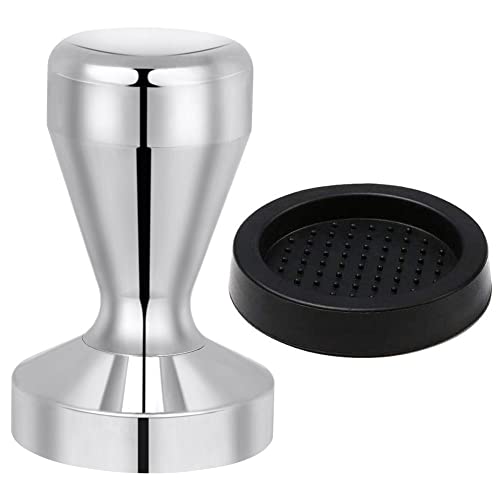
Under the Vicloon brand, this tamper is sold on Amazon as a set with a silicone mat: the base of the tamper is 51 millimetres according to the seller, and the mat is given as 58. The set costs approx. €10.79 (as of September 2026), which makes it one of the cheapest items in our barista accessories category.
We have not had it in our hands. What is written here comes from the listing text and the catalogue data that Amazon held on 7 September 2026, from the brand website vicloon.com and the US trademark register, for the fit from the dimensions given by the Italian accessories maker Motta, and, where it is about technique, from our guides.
What the listing says
The tamper consists of two parts, the handle and the base, which the seller calls the tamper head. The title and listing text give 304 stainless steel as the material, and the seller describes the handle separately as a stainless steel handle. The grade designation 304 comes from American standards; in Europe it corresponds to the chromium-nickel steel with material number 1.4301 (short name X5CrNi18-10), with 17.5 to 19.5 per cent chromium and 8 to 10.5 per cent nickel. The chromium forms a thin oxide layer on the surface that protects the steel from rust. The seller attaches a whole series of properties to the material: food-grade, non-toxic, odourless, rustproof, heavy-duty.
Handle and tamper head are screwed together. The base is flat, which the listing calls “Flacher Edelstahlboden” (flat stainless steel base), and has a diameter of 51 millimetres. It works “druckverteilt und arbeitssparend” (distributing the pressure and saving effort), the listing goes on.
According to the seller, the mat is made of food-grade silicone and is offered as a 58 mm mat. Inside there are studs, called convex dots by the seller, which are meant to make it non-slip. In the catalogue the item is listed as one piece, filed under household goods.
Correction of 15 September 2026: an earlier version of this page named a plastic handle, attributed a dishwasher warning to the manufacturer and promised that the mat gives the portafilter a firm hold while tamping. The listing refutes the first two statements, and the third does not come from it.
Vicloon: a brand with no tamper on its own website
On vicloon.com, Shenzhen Shenlei Technology Co., Ltd. presents itself, founded in 2016 and, in its own description, a small to medium-sized foreign trade company. The company lists baby products, children’s toys, household and kitchen items and lighting as its range. According to the company text, it has its own development team and mature product lines for children of different age groups.
The kitchen category of the website lists six items: silicone baking moulds, a set of silicone spatulas, a digital alarm clock, a stainless steel tap for barrels, mop pads and clips for beach towels, but neither a tamper nor a mat. The company has had the name protected in the USA. At the US trademark office, the word mark VICLOON was registered to Shenzhen Shenlei Technology on 25 April 2023, file number 97367150, though for children’s costumes, Halloween costumes and baby clothing. On 16 September 2026 the register recorded a change of owner, and since then it lists Shenzhen Shangqihui Technology as the owner (retrieved 24 September 2026).
In detail: flat base, small diameter
Tampers come with a flat or a domed underside. A flat base like this one presses the coffee bed into an even disc. A convex base stands out slightly in the middle and presses deeper there, so that the edge of the bed stays a little higher. Motta lists both shapes side by side, the flat 8100/M and the convex 8150/M, each at 58 millimetres. With the flat shape the check is simple: after tamping, the distance between the coffee bed and the rim of the basket should be the same all the way round. If it is not, the tamper was tilted.
With the small basket, a calculation is worthwhile. A base of 51 millimetres diameter has an area of around 20.4 square centimetres, while a 58 mm base comes to around 26.4. If you press with the same force, the pressure on the grounds in the smaller basket is therefore about 29 per cent higher. A force figure you know from 58 millimetre machines therefore does not apply one to one here.
Calibrated tampers, which limit the pressure to a fixed value, are placed by the guide to barista accessories essentials at the end of the shopping list. It cites two studies: Cameron et al. saw no appreciable change in shot time or extraction yield at different tamping pressures, and Kuhn et al. found no demonstrable influence of pressure on the extraction of caffeine and trigonelline. Neither examined a tamper placed at a slant, so whether tamping level helps is, according to the guide, an open question. If the pressed surface is tilted, the coffee bed is thinner on one side. That more water runs through there, and that over- and under-extracted coffee then end up in the same cup, is our assumption; it is not documented.
The screw connection has two sides. Taken apart, handle and base can be cleaned individually, including at the point where they meet. At the same time, every thread is a place that can work loose, and a handle with play tilts out of the vertical more easily when you press. A quick twist of the handle before tamping is therefore worthwhile, especially after washing.
Does the tamper fit your basket?
Only if your basket is built for a 51 mm tamper. You settle that with a calliper, not by the name of your machine. The seller sees it the same way: “Bitte messen Sie Ihren Kaffeefilter vor der Bestellung.” (Please measure your coffee filter before ordering.) Here, “coffee filter” means the basket.
In the same paragraph of the listing, however, it says the base is “geeignet für alle Arten von Espresso- und Kaffeemaschinen” (suitable for all types of espresso and coffee machines). The two do not add up. A fixed diameter fits baskets of one size, and our espresso machine buying guide names four sizes from manufacturer information and accessories: 51, 54, 57 and 58 millimetres.
Whether the base measures exactly 51.0 millimetres or slightly less, the seller does not say. According to the selection rule of the manufacturer Motta, a tamper should sit just under the inside size of the basket anyway, and Motta quantifies the gap: measure the inside diameter of the basket and subtract one millimetre. Motta gives no reason; our barista essentials guide assumes the tamper should not get stuck in the basket. One that is clearly too small does not reach a strip of grounds at the edge, and what that strip does is, according to the guide, not documented.
In practice this means: if your basket measures around 52 millimetres inside, a 51 mm tamper nominally matches Motta’s rule. At exactly 51 millimetres, the fit depends on that very tolerance, and from 53 millimetres the gap at the edge becomes larger than Motta intends. Motta’s own dimension table gives a clue as to which machines have such baskets: it lists De’Longhi in the column for 51 mm tampers, Lelit at 57, La Pavoni Europiccola at 49 and Krups at 41 millimetres. Small does not mean 51, then: of the small columns in the table, only one hits the Vicloon. It does not replace measuring, because different baskets can be fitted within one brand.
Cleaning: the wording of the listing
The seller expressly clears the tamper for the dishwasher. The relevant paragraph is headed “100% spülmaschinenfest” (100% dishwasher-safe), describes the tamper as easy to clean and dirt-repellent, and then describes the procedure: “den Edelstahlgriff und den Stampferkopf abschrauben und zum Reinigen in die Spülmaschine geben” (unscrew the stainless steel handle and the tamper head and put them in the dishwasher to clean).
For the silicone mat the statement is briefer. It is easy to clean and odourless, as its own paragraph says, separate from the passage under “100% spülmaschinenfest”, which refers to the handle and tamper head. Until the seller says otherwise, washing the mat by hand is the safe way.
The reason taking it apart is worthwhile at all is the coffee. Espresso grounds contain oils that settle as a film on the steel and can turn rancid over time. After the dishwasher cycle, handle and base are best dried separately before they are put back together, so that no water stays trapped in the thread.
What the seller does not state
We found an instruction manual or data sheet from the manufacturer neither on vicloon.com nor anywhere else.
Among the dimensions, the weight of the tamper without packaging and that of the mat are missing, as are the overall height of the tamper, the height and diameter of the handle, the thickness and shape of the mat and a tolerance for the 51 millimetres. For the material, there is no proof behind the word food-grade, such as a reference to the German Food and Feed Code (LFGB), nor a load limit behind heavy-duty, nor the surface finish of the base or the material of the thread. There is no mention of calibration or a spring, but neither is ruled out.
Around the product, the country of origin, warranty terms, spare parts for mat, handle or base, a list of matching machines, the year of market launch, dishwasher information and a colour for the mat are missing, as is any proof that the tamper comes from the company behind vicloon.com.
This tamper or one of the other items?
The only other tamper in our catalogue is the Motta 8100/M at 58 millimetres. The table sets it against the Vicloon, along with a set and a tool for filling and distributing that come into question alongside a tamper.
| Model | The difference | Price | Our score | Choose this if |
|---|---|---|---|---|
| Vicloon Tamper 51 mm (this one) | Tamper with flat 51 mm base | approx. €10.79 | 8.0 | your basket needs a 51 mm tamper and a metal handle is enough for you |
| Motta 8100/M Tamper 58 mm | 58 instead of 51 mm, wooden handle instead of stainless steel handle | approx. €23.97 | 8.7 | your basket needs a 58 mm tamper and you want a wooden handle |
| GdHaHSP 51 mm accessories set | same size, but WDT tool, dosing ring and puck screen instead of a tamper | approx. €19.99 | 7.8 | you already have a matching tamper and want to add filling and distribution |
| Normcore WDT tool V2.1 | Needle tool for distributing before tamping, no fixed basket size | approx. €25.99 | 9.4 | your espresso runs unevenly despite clean tamping |
The prices are guide values as of September 2026, and the scores are our editorial assessment based on the available data and features. You can find all items in the category under barista accessories.
Which item suits your basket and your setup
Basket first. For one that needs a 54 mm tamper, you will have to look outside our catalogue. If your basket needs a 58 mm tamper, the Vicloon is out; the Motta 8100/M costs around €13 more.
The second question is what you already own. If your machine comes with a tamper, measure it and the inside size of your basket. If the supplied one is two millimetres or more smaller than the basket and the Vicloon fits according to the calculation above, we consider it the obvious upgrade. If the one you have is already one millimetre under the inside size, we would put the money into a distribution tool first.
Between the GdHaHSP set and the Normcore V2.1, size decides again. The set is fixed at 51 millimetres, because the dosing ring and puck screen have to match the basket. The Normcore costs around €6 more, and because it stirs the grounds with needles instead of pressing a surface, it is, in our assessment, not tied to any basket size. We would therefore advise the Normcore for anyone who runs two machines with different baskets or is already planning the switch to 58 millimetres.
Who is it for?
If you are only now putting together the basic equipment for a machine with a basket for a 51 mm tamper, the Vicloon leaves room in the budget. Our guide on this gives, from the catalogue, approx. €10.79 to €23.97 for a tamper and approx. €25.99 to €29.95 for a WDT tool. With the Vicloon and the Normcore you come to approx. €36.78, which is the cheapest combination from these two ranges. With the Vicloon and the GdHaHSP set it is approx. €30.78.
The tamper brings less on machines with a crema basket, as our espresso machine buying guide describes for the price class under about €120. In such a double-walled basket, a small hole in the basket floor builds the resistance, not the pressed coffee bed alone, and exactly how you tamp matters less there. If you use such a basket and want better espresso, you are, in our assessment, better off spending the money first on a single-walled basket, if one exists for the machine, and on a grinder with fine adjustment. For this group, a new tamper is the wrong first purchase.