Metallurgica Motta is based in Omegna in the province of Verbano-Cusio-Ossola, at Via F. Turati 2, and by its own account has made stainless steel articles for catering and the home since 1967. In this range the 8100/M is not a product with its own page but a line in the Wood & Steel category: coffee tamper, flat stainless steel base, brown wooden handle, 58 millimetres. There is no product page with a data sheet for this article. What Motta publishes instead is a size table that assigns machine brands to the matching tamper diameters, together with the rule for working out the diameter. For a tool that fits or does not fit purely by its size, that is the more useful information.
We have not handled this tamper. Everything written here comes from the Motta catalogue, from Motta’s size table and from the seller’s catalogue data.
Price, origin and what Motta says about itself
The tamper costs approx. €23.97 on Amazon.de, as of September 2026. There is no recommended retail price from the manufacturer to compare it with, as Motta lists no price for any article on its own website. The guide value therefore comes from retail.
Made in Italy is what the catalogue says, and the company headquarters is in Omegna. About its own operations Motta also writes that steel and aluminium are one hundred per cent recyclable as raw materials, that the electricity for production comes from its own photovoltaic system, and that the company has removed 90 per cent of the plastic from its packaging. These figures concern the factory, they come from Motta’s own presentation, and they have nothing to do with the individual tamper.
Base, handle, dimensions and what Motta leaves open
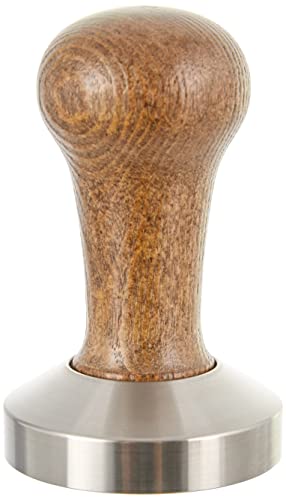
The base is stainless steel and flat, in the Italian catalogue text base piana. Flat means the surface that meets the ground coffee is level and not curved. That is the one shape detail Motta gives for this article, and for choosing it is the decisive one.
The handle is wood, brown. The seller calls it ergonomic in its product details, and describes the tamper as two-piece, that is, a base plus a fitted handle.
The dimensions come from the seller’s catalogue data and not from the manufacturer: 3.54 inches in height, converted around 9.0 centimetres, width and length 2.28 inches each, so around 5.8 centimetres, weight 0.765 pounds, converted around 347 grams. The part number is 8100/M, the model number 08100/M0.
The 347 grams contribute little to the tamping pressure. As a force that is around 3.4 newtons, and what you apply through your arm when compacting is many times higher.
What Motta does not publish for this article, gathered in one place: the steel grade, the surface finish, the wood species, weight and height, the manufacturing tolerance of the 58 millimetre dimension, the way base and handle are joined, care instructions for the wood, whether the handle is delivered oiled from the factory, proof of food safety or compliance with LFGB (the German food and feed code), any warranty or guarantee terms of its own, and a replacement handle as an orderable article number. In our assessment, a gap like this weighs less for a tool with no moving part than for a machine. If you still want to see a material number when buying, you will not get one here, and that is our reservation about the article.
What the base shape does in the basket
A tamper has exactly one job: to compact the ground coffee in the basket so that water flows through at the same speed everywhere. If that fails, channelling occurs. The water seeks the path of least resistance, part of the coffee is over-extracted and turns bitter, and the rest stays almost untouched and delivers acidity. The shape of the base helps determine where that path forms.
A flat base like that of the 8100/M presses the surface level, and at the edge a narrow gap inevitably remains between tamper and basket wall, because a tamper exactly as large as the basket would jam. Motta gives a selection rule for this: measure the inner diameter of the basket, subtract one millimetre. That leaves, by calculation, half a millimetre of clearance on each side. For a basket with a 59 millimetre inner dimension you land on the 58 millimetres of the 8100/M.
Motta carries the opposite shape in the same range: the 8150/M has the same 58 millimetres but a convex base, curved towards the centre. Both run in parallel in the same range.
For conical baskets, whose inner diameter increases with height, Motta specifies taking the measurement at the height at which you want to compact the puck. Measured at the top edge, you buy too large. For the dose and brew ratio to start with, see the brew calculator.
Does the tamper fit your portafilter?
If your basket measures around 59 millimetres inside: yes. If not: no. There is nothing in between, because nothing on a tamper can be adjusted.
The 58 millimetre column of Motta’s size table includes Gaggia, Rancilio, La Marzocco, ECM, Elektra, Bezzera, Rocket, Nuova Simonelli, Promac, Sanremo, Vibiemme and Wega, among others. These are the brands that Motta itself assigns to this size. Other brands appear in other columns, De’Longhi for example at 51 millimetres. Seven millimetres of difference you do not notice as jamming. The tamper then simply rests on the rim of the basket and compacts nothing. That is why you should measure rather than go by brand, especially as different baskets can be fitted within one brand.
Motta makes the same tamper with the same brown wooden handle in nine diameters between 44 and 58.5 millimetres, each size with its own article number. By the minus-one-millimetre rule, the range thus covers baskets with an inner dimension of 45 to 59.5 millimetres. If by this rule you need a 54 tamper, you do not order this article in another size but the 8130/M.
What else Motta lists under tampers
At the 58 millimetre diameter alone, the Wood & Steel category lists six variants of the same design idea: the 8100/M with a brown wooden handle, the 8100/B with a black one and the 8100/R with a red one, the 8150/M with a curved base, the 8500 Brown Wave and the 7900/M, which Motta lists as a tamper with a slim flat base. For each of these articles the catalogue gives number, dimension and material, but a handle colour only for the three variants 8100/M, 8100/B and 8100/R.
Of interest to buyers of a 58 is above all the Competition model 8102 at 58.4 millimetres. It is the only tamper whose base the catalogue lists as glossy, and its 58.4 millimetres lie between the 58 and the 58.5 millimetres of the Wood & Steel range. Four tenths sounds like nothing but shifts the calculation: in a basket with a 59 millimetre inner dimension, that leaves three tenths of a millimetre of clearance per side instead of half a millimetre.
Motta lists a matching holder under article number 8300 as a stainless steel tamper holder. It does not come with the tamper; the seller’s catalogue data give the quantity supplied as one piece.
The three alternatives from our catalogue
Two of the three articles that compete with the 8100/M in our catalogue are not tampers at all. In price the four lie between around €11 and around €26. That is down to the division of labour at the portafilter: a tamper compacts what is in the basket, it does not rearrange it, and it does not hold the portafilter steady.
| Model | The difference | Price | Our rating | Choose this one if |
|---|---|---|---|---|
| Motta 8100/M (this one) | Flat stainless steel base, 58 mm, no defined tamping pressure | approx. €23.97 | 8.7 | your basket measures around 59 mm inside and you want to tamp without any mechanism |
| Vicloon Tamper 51 mm | 51 mm instead of 58 mm, silicone mat included | approx. €10.79 | 8.0 | your basket measures around 52 mm inside, for example on the small De’Longhi portafilters |
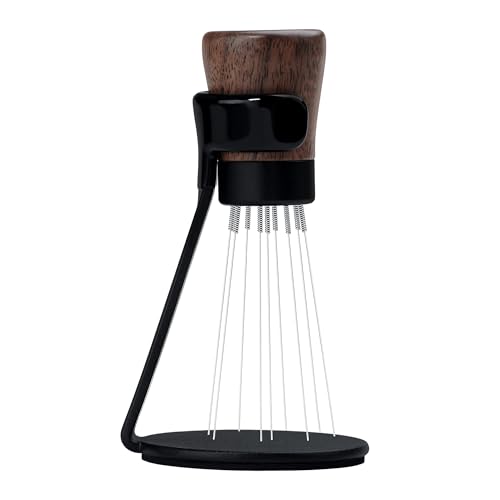
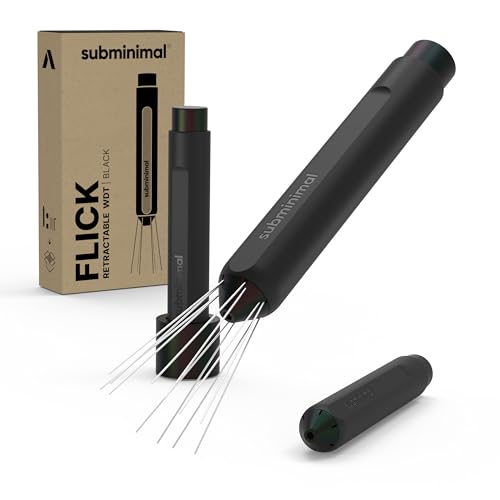
| Normcore WDT-Werkzeug V2.1 | Distributes the coffee with 50 mm needles instead of pressing it | approx. €25.99 | 9.4 | you have neither a distribution tool nor a tamper yet and want to buy only one |
| scarlet espresso Tampermatte M | Natural rubber mat that holds the portafilter steady while tamping | approx. €14.99 | 8.6 | your portafilter slides about on the worktop or the edge suffers |
The prices are as of September 2026 and can change at any time. The ratings are our editorial assessment and not a measurement result, and we handled none of the four articles. For the 8100/M, there is less behind the sub-score for build quality than the number suggests: what is documented is the material, the flat base shape, the dimension and the statement of origin. You can find the whole area in our best-of list Barista accessories.
When this tamper, when another
The diameter decides first, and on its own. If by Motta’s calculation you land at 51, 53, 54 or 57 millimetres, the 8100/M is out, and it has nothing to do with its quality. Motta does not solve this with an adapter but with its own article number for each diameter.
Once the diameter is settled, it is a question of order. Tamper and distribution tool do not replace each other, and if the budget stretches to only one, we would advise the distribution tool first. Clumps from the grinder remain clumps even under high pressure; a tamper presses them flat and leaves them where they are. If you have been working with the plastic tamper from the machine box and have no distribution tool yet, you get more out of the Normcore than out of the Motta, even though it costs around two euros more.
You have no choice of base shape with the 8100/M; it is flat. In our assessment no buying decision hangs on that as long as the diameter is right. With mechanics the case is different: how many shots it takes until your own routine settles in, nobody can tell you seriously, and at twenty shots an hour behind a bar the calculation looks different from two in the morning.
Cleaning, care and what else comes on top
Clean by hand, not in the dishwasher: that is the only care instruction that exists for this article at all, and it is in the seller’s product details. Everything else in this paragraph is general materials knowledge about wood and stainless steel. It is best to wipe the base damp straight after tamping, while the coffee oils have not yet dried on, because dried-on coffee fat can only be removed later with a cleaner. The handle should then dry in the open instead of lying there wet. For untreated wood you would usually use a hardening oil or food-safe paraffin oil, not ordinary cooking oil, because that turns rancid.
A tamper has no running costs in the strict sense. What comes on top comes once: a tamping mat is around €14.99 in our catalogue, a distribution tool around €25.99. With both you are at around €65 instead of €24. Which parts of a basic kit are worth buying in which order we have sorted in the guide Barista accessories: the essentials.
Who is it for?
In the category Barista accessories the 8100/M stands with a thin set of facts: diameter, base shape, material, statement of origin, and below that it stops. At the manufacturer it has no product page of its own, only a line in the Wood & Steel range.
It is wrong for two groups. The first sits at a machine with a different basket size, such as the De’Longhi portafilters, which Motta lists at 51 millimetres in its own table. The 8100/M will not even go in there, and build quality changes nothing about that. The second wants to get the even pressure from the tool rather than from their own arm: for them a tamper without a spring mechanism is the wrong choice whatever the diameter.
Anyone who falls into neither group gets a tool that consists of two parts and nothing else. The only component in it that will age is the wooden handle.