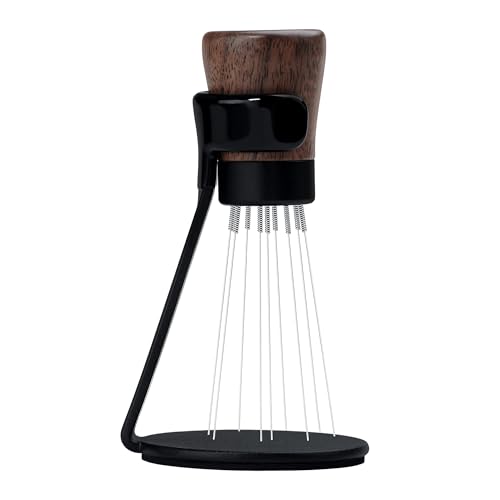
In the manufacturer’s shop, this tool is called “Normcore 0.25mm WDT Distribution Tool V2.1”. In the German Amazon listing, the same item is called “9 Zinken, 0,23 mm” (9 prongs, 0.23 mm). That is a deviation of two hundredths of a millimetre, and in the product name at that. For a tool whose most important technical figure is the needle thickness, this is not a minor detail.
WDT stands for Weiss Distribution Technique; the German Amazon title translates it as “Weiss-Verteilungstechnik”. Normcore describes briefly what such a tool does: break up clumps, loosen compacted ground coffee, and distribute the coffee more evenly before tamping. Less channelling and a more even extraction are supposed to follow. One feature bullet of the Amazon listing describes the same procedure from practice: you stir after the grounds are in the portafilter. That is as far as the statements of the manufacturer and the seller go. We have not held the tool in our hands, and nobody has measured for us whether an extraction comes out more even with it. Everything else comes from normcorewares.com and from the Amazon catalogue data, retrieved on 6 September 2026.
Dimensions, material and price
The tool is 90 millimetres long, the body measures 28 millimetres in diameter, and the needles are 50 millimetres long. For the body, Normcore states CNC-milled, anodised aluminium; for the needles, 304 stainless steel. Amazon’s catalogue data gives item dimensions of 3.4 x 1.1 x 1.1 inches, converted roughly 8.6 x 2.8 x 2.8 centimetres. They are slightly below the manufacturer’s figures but evidently describe the same tool. On handling, Normcore says a single sentence, and it is self-description: compact and balanced for daily espresso use.
On Amazon.de the item costs approx. €25.99 (as of September 2026). In the manufacturer’s shop, the same variant with stand is priced at 25.99 US dollars, there as a special offer price on the same retrieval date. The same number in two currencies: laid side by side, the two amounts do not make a comparison, because the exchange rate, shipping across the Atlantic and possible import charges stand between them.
Without the stand, the range in the manufacturer’s shop starts at 15.99 US dollars. That is a from-price across all variants, so the ten-dollar gap to the version with stand is the largest possible difference and not the price of the stand. The stand itself is magnetic and belongs only to the variant that carries it in its name. The German Amazon listing carries exactly this one.
In detail: what needle thickness does in the coffee bed
A needle moving through ground coffee does two things at once. It breaks up clumps, and it pushes coffee aside. The first effect is the point of the exercise; the second is the price for it. The thicker the needle, the more volume it displaces, and the sooner exactly those density differences arise that were supposed to disappear. The thinner it is, the less force it withstands before it bends.
Normcore justifies the choice of fine needles by saying they should improve puck preparation without disturbing the coffee bed excessively. That thickness is an adjustable parameter and not a law of nature is shown by the manufacturer itself: it supplies spare needles in either 0.25 or 0.3 millimetres. The thicker kind is stiffer and holds its shape longer when stirring densely dosed grounds; the thinner one works more finely.
The number of prongs matters less than it sounds. Nine needles draw nine tracks through the grounds in one turn; five needles need more turns for the same coverage. How thoroughly the bed is worked through in the end is decided by the movement of your hand, not by the prong count in the listing title.
Channelling has several causes, and clumps in the grounds are only one of them. The clumps themselves arise because fine espresso grounds become electrostatically charged during grinding and the particles stick together, visible as the strands hanging from a grinder’s outlet. A tamper placed at an angle affects the extraction in a similar way, and so does too large a dose in too small a basket. Which dose and which brew ratio suit your machine at all is worked out by the Brew Calculator.
Nine prongs, 0.23 millimetres, a wooden handle: what is documented
The nine appears in the German Amazon title and in one of the feature bullets below it. In the specification table of the V2.1, Normcore gives no needle count, neither as prongs nor as holes. For the larger V3, the manufacturer states it explicitly as nine holes, so there it is part of the specification.
On needle thickness, the situation is clearer than it first looks. Normcore lists the V2.1 on both current product pages at 0.25 millimetres and even writes the number into the product name. The 0.23 comes from the German Amazon title. Our assessment: for the work in the basket, two hundredths of a millimetre are irrelevant; for the question of which source you follow for this item, they are not.
On the handle, two lines of the same listing contradict each other. The title promises an American walnut wood handle; a feature bullet further down describes a handle in anodised, CNC-milled aluminium. Normcore stands on the aluminium side and lists Walnut among the colour options, not among the materials. A third material statement sits in the same listing as well: another feature bullet describes a machined, anodised stirring shaft in 304 stainless steel. Three lines, three materials, one item.
On its own About page, Normcore describes itself as a brand for people who care about the details of coffee, and names four guiding principles, the first of which is precision without overcomplication. In the material statements for this one item, little of that is visible. In our assessment this is not down to the tool, but to three listing lines that nobody has cross-checked.
The height-adjustable needle ring that is supposed to limit penetration depth belongs to a different tool: Normcore describes a penetration depth of 18 to 22 millimetres exclusively for the Needle Distributor Tool V2, which sits clearly higher in price in the same range. On the V2.1 the needles stick out at full length. As a reason to buy, this feature does not apply here.
What Normcore otherwise leaves open on the V2.1 is gathered here: the weight, a compatibility list for portafilter sizes, material and dimensions of the stand, whether the magnet sits in the stand or in the body, care instructions, a warranty period, information on the durability of the needles, usage instructions with duration or number of turns, plus country of production and founding year of the brand, a data sheet and an operating manual as PDF. The basis for the purchase decision is therefore a brief specification table and an Amazon listing whose own lines contradict each other.
Does the tool fit every portafilter?
Yes, that is our inference from the dimensions. Normcore has not published a compatibility list for 51, 54 or 58 millimetres for the V2.1. The tool does not rest on the basket but dips in from above, and at 28 millimetres of body diameter there is room for circling movements even in a 51 mm basket.
That is the difference from the tamper, where the diameter decides between fitting and not fitting. A distribution tool has no such tie to one size, because it has nothing to seal and nothing to compact across a surface. The 50 millimetres of needle length are well above the height of a coffee bed in an espresso basket; how deep you dip is up to you.
A feature bullet in the Amazon listing also mentions a funnel above the portafilter that is supposed to prevent spillage. The manufacturer’s delivery list names three things: the tool, the stand and a set of spare needles. A dosing funnel therefore has to be planned for separately.
What else is worth considering?
Three items from our catalogue realistically stand beside this purchase decision, and only one of them is a pure distribution tool: the GdHaHSP set does contain a WDT tool too, but together with a dosing ring and a puck screen and fixed at 51 millimetres.
| Model | The difference | Price | Our rating | Choose this if |
|---|---|---|---|---|
| Normcore WDT tool V2.1 (this one) | Fixed needles in 304 stainless steel, magnetic stand as a rest | approx. €25.99 | 9.4 | you pull espresso several times a day |
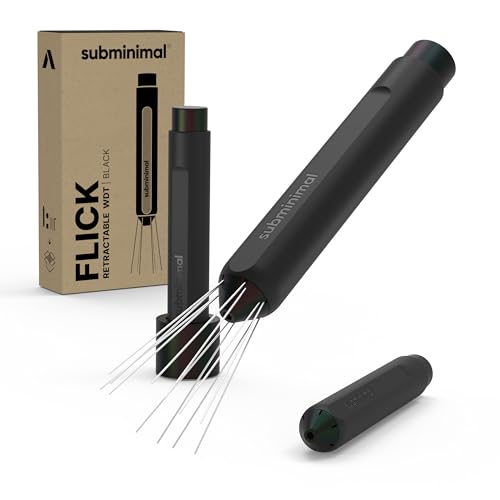
| Subminimal Flick | Needles extend at a click and retract into the housing with a hand movement | approx. €29.95 | 9.1 | you keep the tool in a drawer or take it with you |
| GdHaHSP 51 mm set | Fixed at 51 mm, but with dosing ring and puck screen | approx. €19.99 | 7.8 | your portafilter measures 51 mm and you lack a dosing ring and puck screen |
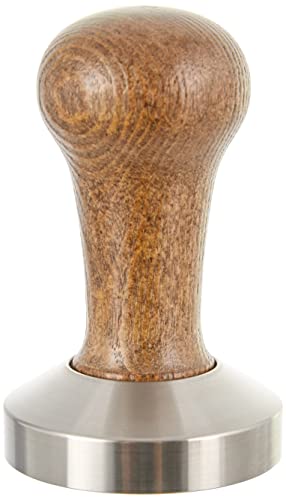
| Motta 8100/M tamper | Presses the grounds instead of loosening them beforehand | approx. €23.97 | 8.7 | you already have a distribution tool and still work with the plastic tamper from the machine box |
The prices apply as of September 2026. The ratings are our editorial assessment based on the available data and features, not a measurement result. What the table does not do: it says nothing about how finely your grinder grinds, and that is exactly what determines how much a distribution tool achieves for you. The whole area is covered in our best-of list barista accessories.
When this tool, when another
The first question concerns the grinder, not the tool. The tendency to clump grows with the fineness of the grind. Only Turkish coffee is ground finer than espresso, and that manages without a portafilter. With coarse grounds little sticks together, and then there is little to loosen.
The second point is storage space. The stand is the needle protection of this tool. If it ends up in a drawer instead, the fine needles lie unprotected between spoons and measuring cups, and then the Subminimal Flick is the more suitable solution, because its needles retract into the aluminium tube after use, even though it costs around four euros more and brings a moving interior that needs looking after.
Third, the needle thickness you want. The V2.1 comes with one thickness, full stop. Anyone who wants to switch between two thicknesses, for example because the same grinder runs for two very different beans, ends up at the larger V3, which supplies both sets.
And then the question of how often. At two espressos a week, the additional step hardly matters; at three a day it becomes a routine that either fits or irritates. We would only spend around 26 euros on a pure distribution tool once the grinder matches your own standard. If the plastic tamper from the machine box is still standing next to it, the order from our guide Barista accessories: the essentials applies: first the scale with 0.1 gram resolution, then the distribution tool, then the tamper in the right size. Which fault of the machine comes from where is sorted by the guide Espresso machine troubleshooting, and distribution and channelling are explained in Espresso basics.
What running it costs
The only wearing part is the needles. Normcore sells them in packs of twelve, in its own shop on 6 September 2026 for 9.99 US dollars instead of the regular 19.99, in 304 stainless steel, in either 0.25 or 0.3 millimetres, and suitable for both V2.1 and V3. Per piece that is around 0.83 US dollars. With nine prongs, one pack covers a complete set plus three in reserve. Whether the shop ships to Germany and at what shipping cost cannot be seen from the shop pages. That is the point where a reorder can become a nuisance.
How many spare needles are already in the box is answered differently by the two sources: Normcore speaks of five to eight, the German Amazon title of 16 additional needles. Which number is right only the opened box will show.
Otherwise running it costs nothing, no filter and no descaler. That distinguishes a distribution tool from almost everything else in an espresso kitchen, and it is the reason the purchase remains a one-off bill.
Who is it for?
The V2.1 is built for the step between grinder and tamper, and that exists only on a portafilter machine. On a bean-to-cup machine you cannot reach the grounds at all; the machine doses and presses in a closed process. For French press, pour-over and moka pot the same holds for the opposite reason: nothing is compacted there that would first have to lie evenly. Both groups would be buying a tool with nowhere to use it.
That leaves the portafilter machine, and there an argument that gets lost in the table above: because the tool is not tied to any basket size, it survives a change of machine. With the 51 mm set from our catalogue, the dosing ring and puck screen are tied to 51 millimetres and no longer fit after a move to 58 millimetres; the V2.1 carries on working there.
In our barista accessories category, it therefore stands as a specialist tool with no second purpose.