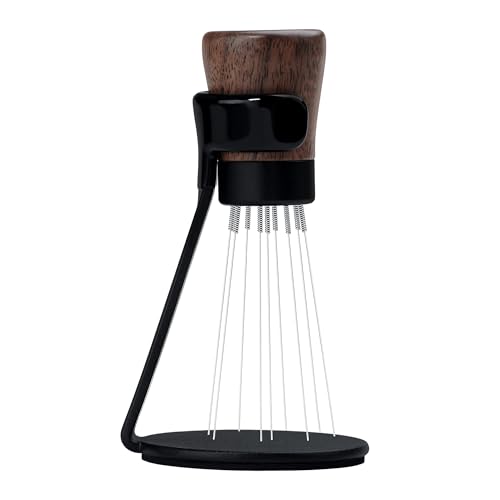
A distribution tool does one single job. It runs thin needles through the ground coffee in the portafilter, breaks up clumps and spreads the grounds evenly before the tamper presses them down. That is how Subminimal describes, on its own product page, what is behind the abbreviation WDT.
Why this step is needed at all has to do with the path the water takes. It looks for the point of least resistance through the pressed puck. If a loose pocket sits next to a dense clump, too much water runs through at one spot and too little at another. Loosening the grounds is meant to even out those differences before the tamper locks them in.
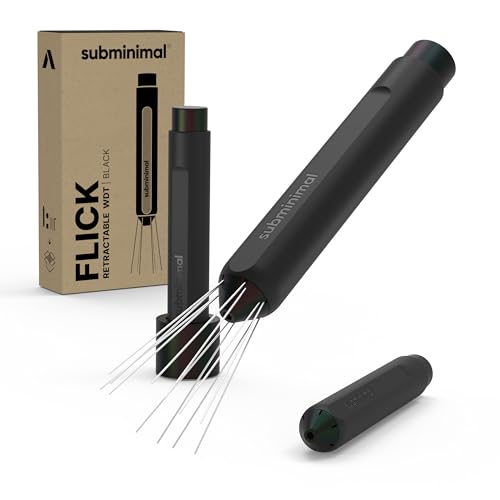
The Flick does one thing differently from the classic needle bundles in our catalogue: the needles do not stay outside. One click pushes them out of the aluminium tube, and according to the manufacturer a movement of the wrist is then enough to make them disappear again. Subminimal itself describes this movement as a flick of the wrist and, in the Amazon listing, advertises that it does away with the exposed needles of classic WDT tools.
We have not handled the Flick, and nobody has measured for us whether an espresso runs more evenly with it. Every figure for the Flick in this text comes from subminimal.com, from the manufacturer’s Help Center or from the German Amazon listing including its catalogue data, retrieved on 6 September 2026. The prices and ratings in the comparison table further down, by contrast, come from our own catalogue.
Dimensions, materials and the price in two currencies
Subminimal gives the tool as 110 x 18 millimetres, so roughly as long as a pencil and slimmer than the handle of a classic needle bundle. The catalogue data of the German Amazon listing confirm this: 4.33 inches in height and 0.71 inches in width and depth convert to the same 110 and 18 millimetres.
The tube is made of aluminium with a matte anodised coating, and the needles are stainless steel. The data sheet gives the needle length as 42 millimetres and the diameter as 0.35 millimetres. In the Amazon catalogue the item runs under the part number SUB-FK-01-BL.
On Amazon.de the Flick costs approx. €29.95 (as of September 2026). In the manufacturer’s shop it is US$29.00, in black and in silver at the same amount. The two figures look similar but are not suitable for comparison: exchange rate, shipping and possible import charges lie in between. By its own account, Subminimal is based in Singapore and wants to develop tools there that let you make café-quality coffee at home.
In detail: the magnetic slider and what blocks it
According to the Amazon listing, a magnetic mechanism triggers the extension. What happens inside is revealed, of all places, by a help article about bent needles: a magnetic slider sits in the tube, and a hard knock from above during shipping can trigger it. The needles then extend in transit and bend.
A second help article deals with the opposite case, needles that can no longer be retracted. Both faults have the same root: a tool with moving internals can jam, while a rigid needle bundle cannot.
The most common cause of jamming is home-made and banal. Each needle runs in its own very narrow channel. Fine coffee grounds collect in it, press together over time into hard lumps and block the way. Subminimal describes exactly this and recommends two countermeasures: grind a little coarser and clean regularly.
The first piece of advice collides with the purpose of the device. For espresso you grind fine, and how fine is decided by the brewing time, not by the distribution tool. How to work your way towards the right grind size is covered in the guide Adjusting grind size. In practice, that leaves mainly the second half of the advice, and that is manual work.
Needles: 0.5 millimetres from the factory, 0.35 as an upgrade
The data sheet says 0.35 millimetres, but the box contains something different. From the factory, Subminimal fits needles of 0.5 millimetres so that they survive transport without bending. The two spare sets that come with it have the finer 0.35 millimetres. If you want the thinner tips, you fit them yourself.
The difference is not hair-splitting. In the coffee bed a needle does two things at once: it breaks up clumps, and it pushes grounds aside. The thicker it is, the more volume it displaces and the stiffer it stays under load. The thinner it is, the finer it intervenes and the more likely it is to pick up a bend when it works against resistance.
Bent tips, incidentally, are not a repair case with this tool but a replacement case. Subminimal devotes a help article of its own to them and simply recommends the supplied spare needles. That is exactly why two sets are in the box, and the needles are the only part for which we found a spare parts page from the manufacturer at all.
Our assessment: the 0.5 mm needles are the sturdier basic setup and do the job. Switching to 0.35 is worthwhile if finer intervention matters more to you than stiffness. In return, the thinner tips bend more easily in dense grounds. Which dose suits your basket and your brew ratio at all is worked out by the brew calculator.
What is in the box and where the tool goes afterwards
According to the manufacturer’s page, the Flick comes with an aluminium base and a self-adhesive magnetic wall mount, both with every unit. The Amazon listing additionally lists two spare needle sets and a hex key. Subminimal adds access to its Masterclass at no extra charge.
That gives three places to store it, which the manufacturer itself lists: on the wall, magnetically on the espresso machine via the supplied disc, or upright in the stand. The stand measures 22 millimetres in width and 25 in height and so needs less space than an espresso cup.
The fourth option follows from the retracted needles: drawer or backpack. That is the real difference from an open needle bundle, whose tips have no business among spoons and measuring cups.
Does the Flick fit every portafilter?
For 54 and 58 millimetres, yes: the manufacturer’s blog names these two sizes. For 51 and 53 millimetres there is no statement from Subminimal. The tool does not rest on the basket but dips in from above, and at 18 millimetres in diameter there is room to circle even in a small basket. That is our inference from the dimension.
On the grinder, a second blog article from the manufacturer says only half a sentence: the tool works with any grinder. More interesting is the usage tip next to it, to stay gentle and not press the tips onto the bottom of the basket. The reason is obvious once you know what replacement needles cost and how to swap them.
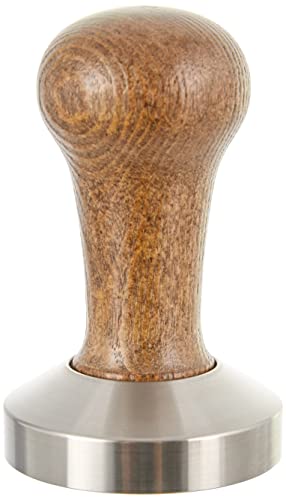
A tamper, incidentally, is the opposite case, even though the German Amazon title lists the Flick as a Retractable Needle Tamper. A real tamper sits just under the inside dimension of the basket, Motta recommends subtracting one millimetre, and so it is fixed to one diameter. If it is clearly too small, it does not reach a strip of grounds at the edge; what that strip does is not documented. A distribution tool has no such constraint, because it only moves through the loose grounds and does not have to compress anything over the whole surface. The Flick cannot press anything anyway: thin tips come out of the cap, not a flat face.
What Subminimal does not state
Some things remain open, and some of them matter for the purchase decision: whether the tool may see water and whether it can go in the dishwasher, at what interval to clean, what the wall mount is made of and how much its adhesive strip can carry, whether the stand holds the Flick magnetically or serves only as a rest, how far the tips protrude from the cap when extended (only the total length of 42 millimetres is documented), how many clicks the magnetic slider in the tube can take, which alloy the needles are made of and whether residual moisture in the body can harm them, in which country it is produced (only the company headquarters is documented), since when the Flick has been on sale, which colour is in the German listing, and whether there are spare parts beyond the needles, that is front cap, spring, slider, stand and mount. The last point weighs heaviest for a tool with mechanics.
What else is worth considering?
Three items from our catalogue realistically stand beside this one in the decision, and only one of them is a pure distribution tool: the GdHaHSP set does contain a WDT tool too, but together with a dosing ring and puck screen that fit only 51 mm portafilters.
| Model | The difference | Price | Our rating | Choose this if |
|---|---|---|---|---|
| Subminimal Flick (this one) | Needles retract into the aluminium tube, stand and wall mount included | approx. €29.95 | 9.1 | you want your accessory out of the way between shots |
| Normcore WDT Tool V2.1 | Needle bundle stays out in the open, but with 0.25 mm thinner needles | approx. €25.99 | 9.4 | the tool stays out next to the machine anyway |
| GdHaHSP 51 mm set | Tied to 51 mm, but with dosing ring and puck screen | approx. €19.99 | 7.8 | your basket measures 51 mm and you lack a dosing ring and puck screen |
| Motta 8100/M Tamper | Presses the puck instead of loosening it beforehand | approx. €23.97 | 8.7 | you already have a distribution tool and still work with the plastic tamper |
The prices are guide values as of September 2026, and the ratings are our editorial assessment based on the available data and features. What the table cannot do: it measures nothing. How much a distribution tool achieves for you depends on your grinder, and no line says anything about that. The whole area is gathered in the best-of list Barista accessories.
When the Flick, when another tool
The first question is about the place where the tool lies between two espressos. If it stays out next to the machine anyway, you use exactly one of four storage options and pay for a mechanism that then has nothing to do. The Normcore V2.1 costs approx. €25.99, comes with a magnetic stand and has the thinner needles from the factory at 0.25 millimetres.
Conversely, accessories that travel speak for the Flick. Office or holiday flat: there an open needle bundle will end up unprotected in a bag sooner or later, and bent tips mean a reorder or a rebuild.
The second point is the basket diameter. At 51 millimetres a manufacturer approval is missing, and if you also lack a dosing ring and puck screen, the GdHaHSP set at approx. €19.99 adds up differently from a single tool at approx. €29.95.
The third point is the order of priorities in the budget. If you already have a distribution tool, and the plastic tamper from the machine box is still on the shelf after grinding, a flat-ground tamper face does more for you than a second tool for distribution. If you lack both, the ranking from the guide Barista accessories: the essentials applies: first the scale with 0.1 gram resolution, then the distribution tool, then the tamper in the right size.
That leaves willingness to do upkeep. A rigid bundle has no channels in which anything could lodge. With the Flick, cleaning is part of the tool, otherwise the click turns into jamming over the months. If you lack that willingness, the simple design is the better choice.
Who is it suitable for?
On a bean-to-cup machine the Flick has no use. There the machine doses and presses in a closed brew unit, and you cannot get at the ground coffee at all. The same goes for capsule and pod machines. That leaves the portafilter machine, and there the question is whether your grinder produces clumps at all that need loosening.
The Amazon listing incidentally sells the click as a gimmick and explicitly cites the barista fidget spinner as a model. That is more honest than it sounds: part of the premium goes on mechanics that do not make the coffee better but solve storage.
The tool is wrong for anyone who wants to replace parts themselves when the mechanism fails: Subminimal documents spare parts only for the needles, not for the front cap, spring or slider. A tool without moving internals does not have this problem at all. In our Barista accessories category, the Flick is the tool for the tidy kitchen counter, not for the workbench.