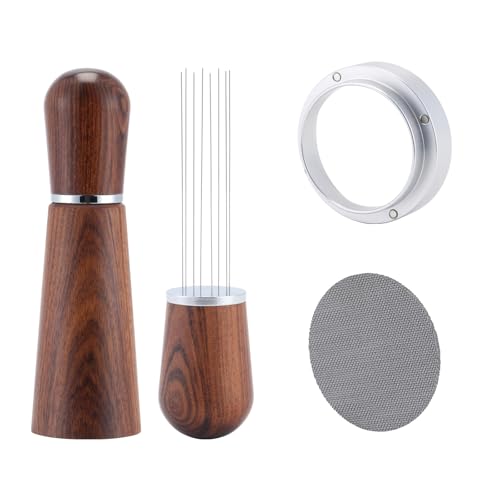
For portafilters of 51 millimetres, GdHaHSP packs three parts into one box: a WDT tool for loosening the ground coffee, a dosing ring that sits on top of the portafilter while you fill it, and a puck screen that is laid on the coffee bed before the shot. On Amazon.de the set costs approx. €19.99 (as of September 2026), and in our barista accessories category it is the only set.
Little can be found out about the seller itself. No server answers at gdhahsp.com, and a search for the brand name ends at Amazon listings, one retailer and price comparison sites. No product page of its own turns up. Everything below in the way of figures and materials therefore comes from the Amazon listing: from the catalogue data of 7 September 2026 and from the page title on amazon.de, retrieved on 24 September 2026. We have not handled the set ourselves.
What is in the box
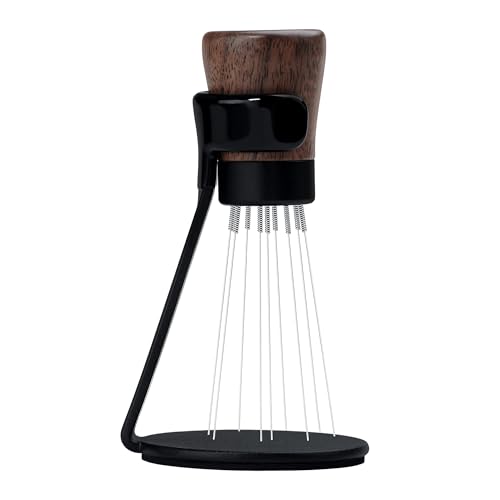
The WDT tool has eight needles of 0.3 millimetres thickness, made of stainless steel according to the amazon.de title. The handle is wooden, and a holder for the tool is included. The seller describes the tool as modular and writes that it can be adapted to different grind sizes.
According to the title, the dosing ring is made of aluminium and holds magnetically to the portafilter, advertised with 360° magnetic force. Its inner walls slope by 30 degrees so that the ground coffee slides into the basket instead of onto the rim.
The puck screen is a disc of food-safe stainless steel, 1.7 millimetres thick, with holes of 150 micrometres.
The catalogue field for the piece count says 3, although four parts are listed once the holder is counted. The product photo shows two wooden parts: a tall, slim one with a round knob and a silver intermediate ring, and a short one from which the needles point straight up. Next to them lie a silver ring and a grey disc with a fine perforated pattern. The catalogue dimensions are 5.12 x 1.55 x 1.55 inches, which converts to about 13 x 3.9 x 3.9 centimetres. They cannot apply to the whole set, because a ring for a 51 mm portafilter is wider than 3.9 centimetres; they fit the tall wooden part in the photo best. The catalogue gives the weight as around 160 grams.
In detail: three steps against three different faults
Espresso is sensitive to how evenly the grounds lie in the basket. The water arrives from above at high pressure and takes the path of least resistance. If the grounds are looser in one spot, or a clump with air around it sits there, more water flows through exactly that spot than elsewhere. The technical term is channelling. The coffee from the channel is over-extracted, the rest of the puck is under-extracted, and what ends up in the cup is a mixture of both.
The three parts act at different points.
The WDT tool works on the grounds themselves. The abbreviation stands for Weiss Distribution Technique: you move thin needles in circular motions through the freshly ground coffee before tamping, breaking up the clumps that many grinders produce. Needle thickness is a compromise. Thin needles push less coffee ahead of them, thick ones bend less often. The GdHaHSP tool sits between the two pure WDT tools in the table further down in terms of thickness.
The dosing ring has nothing directly to do with extraction. It extends the wall of the basket upwards. That helps with filling, and even more with stirring: if you run eight needles through the grounds in a 51 mm basket without a ring, you push some of them over the edge. That is why the two parts complement each other.
During the shot, the puck screen lies between the machine’s shower screen and the coffee bed. Its first purpose is mechanical: it keeps the shower screen free of grounds that are pushed upwards when you lock in the portafilter and during the shot. The second is water distribution, and this is where the listing gets grandiose: the screen supposedly eliminates channelling effects and improves the evenness of extraction. We treat that sentence as an advertising claim.
You should know two consequences of the screen. Its thickness is taken from the free space between the coffee bed and the shower screen, known as headspace. If you have so far chosen your dose so that the puck ends just below the shower screen, you may need to fill slightly less coffee with a screen, otherwise the shower screen presses on the disc when you lock in the portafilter. The brew calculator works out how a smaller dose affects the ratio to the yield. The second consequence concerns the holes. They are larger than the finest particles in espresso grounds, so the disc is not completely sealed.
What the seller leaves open
We found no instruction manual, data sheet or product page from the seller. Also open: a real model number (the catalogue only lists 51mm as the model), the length of the needles, the grade of stainless steel of needles and screen, such as 304 or 316, how the modular adjustment works and whether spare needles exist, material and shape of the holder, which of the two wooden parts in the photo is the holder, what the catalogue dimensions and weight refer to, height and weight of the dosing ring, number and type of its magnets, the exact diameter of the puck screen with tolerance, a list of compatible machines, a statement on dishwasher use for the tool and ring, warranty terms, country of manufacture and company seat, the date of market launch, and whether individual parts can be bought separately.
Two of these gaps weigh more than the rest. Without a diameter with tolerance, there is no saying whether the disc drops cleanly into the basket or sits on the rim, because 51 millimetres is a nominal size and you only know the actual inner measurement once you measure your own basket. The other concerns the wood: with no information on the surface treatment, the handle is left with only the careful care described further down.
Does the set suit your machine?
Only if your portafilter measures 51 millimetres. With a double-walled basket, two of the three parts also deliver less than the advertising promises.
Double-walled baskets, also called pressurised or crema baskets, can be recognised by a second floor with a single small hole in the middle. Some compact machines are supplied with them. With these baskets it is the small hole that builds up the pressure, not the coffee bed. How evenly the grounds lie above it therefore matters less, and that is exactly what the WDT tool and puck screen aim at. Our assessment: if you work with a pressurised basket, what you mainly need from this set is the ring, and compared with a dosing ring bought on its own, the added value then shrinks. A single-walled basket from the accessories trade would change more about the extraction than the other two parts together.
For the ring there is also a question of material. According to the seller it holds magnetically, and a magnet only attracts certain metals. Portafilters come in chrome-plated brass, stainless steel and aluminium, and by no means every one of these alloys responds to a magnet. How firmly the ring sits for you therefore depends on your portafilter and your basket, not on the ring alone.
Which basket size is common and in what order accessories are worth buying is sorted out by our guide to barista accessories essentials.
Care and running costs
The seller describes only the puck screen as dishwasher-safe (“Dishwasher-safe Design”). On top of that comes the undocumented advertising figure of 70 percent less cleaning time.
We would only wipe the wooden handle dry or with a barely damp cloth and clear the needles of coffee residue with a brush. Wood swells in the dishwasher and cracks when moisture and heat alternate often. Because it is open whether the ring is anodised or coated, we would also wash it by hand and dry it straight away. Strongly alkaline machine cleaners attack aluminium, and untreated aluminium turns grey and dull from them.
With the screen, the issue is less the dishwasher than the fine holes. Coffee oil settles there, and a layer is added with every shot. We would rinse it under hot water after every shot and hold it up to the light now and then: where the disc no longer lets light through evenly, there are residues. A soak in the cleaning powder you already use for the brew group dissolves oil films from stainless steel.
There are no other running costs: the set needs no filter paper or prescribed care product, and the cleaning powder for the machine is in your cupboard anyway.
The alternatives from our catalogue
Three items from our catalogue stand next to the set, and none does exactly the same thing. Two are pure WDT tools, and the third complements them.
| Model | The difference | Price | Our rating | Choose this if |
|---|---|---|---|---|
| GdHaHSP 51 mm set (this one) | WDT tool, magnetic dosing ring and puck screen, fixed to 51 mm | approx. €19.99 | 7.8 | you have none of the three parts yet and a 51 mm machine |
| Normcore WDT Tool V2.1 | WDT only, needles 0.25 mm according to Normcore (Amazon title: 0.23 mm), with stand | approx. €25.99 | 9.4 | you only want to distribute, or will soon change to another basket size |
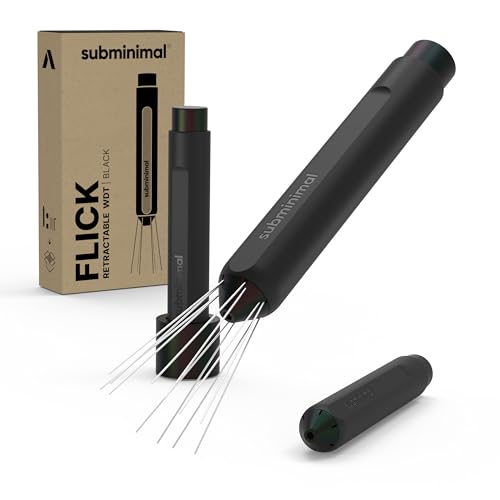
| Subminimal Flick WDT | WDT only, 0.5 mm needles from the factory, 0.35 mm as spare sets, retract into the housing | approx. €29.95 | 9.1 | you do not want exposed needle tips in the kitchen |
| Vicloon Tamper 51 mm | Tamper, so not a replacement but a complement to the set | approx. €10.79 | 8.0 | your 51 mm machine lacks a usable tamper |
Prices are as of September 2026. The ratings are our editorial assessment from the available data and features; we measured nothing. The remaining items in the category are in the barista accessories best-of list.
Set or single tool: which when?
First count what is already in your drawer. An existing dosing ring does not make the set useless, but you pay for it a second time.
Then the price. The Normcore V2.1 costs €6 more than the set and is only the distribution tool, and the Flick is around €10 above the set. The three-part set is therefore cheaper than either of the two branded tools alone. One difference that does not show in the price still counts for us: Normcore and Subminimal publish needle thickness, needle length and contents on their own product pages, while with GdHaHSP, as collected above, most of that stays open. Needle thickness itself is not a reason to buy. Normcore gives 0.25 millimetres, GdHaHSP 0.3, the Flick comes with 0.5 millimetres from the factory and 0.35 mm needles are included for converting. Which thickness suits you better is more a matter of habit.
The basket size also plays a part. If a larger machine is coming in the next year or two, we would go for one of the two single tools, because they move with you.
That leaves the tamper. It is missing from the set, and without an evenly pressed coffee bed the best distribution achieves little. If so far you only have the plastic tamper from the machine’s box or none at all, the Vicloon from the table belongs in the same order.
Who is it for?
GdHaHSP expressly advertises the set as a gift for home baristas. As a gift, though, it only works if you know the recipient’s basket size for certain. Ask beforehand, or measure the basket secretly.
The set is also wrong for any bean-to-cup machine, because the machine grinds and presses itself there and there is no portafilter a ring could fit. And if you have small children in the kitchen, look at the product photo: the needle tips point openly upwards there, and whether one of the wooden parts covers them at rest cannot be seen from the listing. In that case we would keep the tool in a wall cupboard rather than on the worktop.