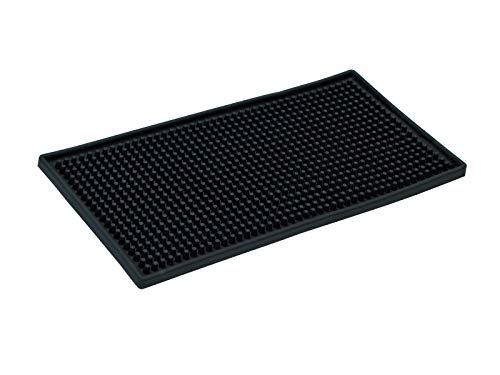
If you tamp by hand, you have to put the portafilter down somewhere. On the bare worktop, on a tea towel that slides away at the first push, or on the granite edge where the chrome spout leaves marks. The scarlet espresso Tappetino Professionale is the answer to this makeshift arrangement, and it is nothing more: a black natural rubber mat with a nub surface, for approx. €14.99 (as of September 2026). It changes nothing about the grounds or how they are distributed in the basket; it simply keeps the portafilter where you put it.
A black rubber mat and nothing else
In the manufacturer’s shop the product runs as the tamping mat and rest “Tappetino Professionale” for baristas; on Amazon the same title appears with “size M” added. According to the manufacturer, exactly one item is delivered: a natural rubber tamping mat in black. No tamper, no stand. Black is also the only colour; you choose only the size.
scarlet espresso describes the intended use as professional use in catering and the ambitious home barista. That is the supplier’s own description, not a verified seal. In our barista accessories category, the mat therefore sits with the protective equipment for the work area.
One more note on the name, because it helps when searching: brand and manufacturer field are not the same thing here. In the shop’s product table, scarlet bijoux is entered as the manufacturer, and the same brand appears in the Amazon candidate list from which we have the title and price for this ASIN. The espresso range runs under the name scarlet espresso.
The supplier behind the shop is not a pure espresso retailer. The same shop also stocks fashion jewellery, pet supplies, health items, kitchen bits, car accessories and games alongside the barista range, which on its own counts 74 products. That changes nothing about the mat itself, but it does change what you can expect in terms of advice and repeat purchases. The shop is registered to SAHDIA Enterprises GmbH for fashion jewellery, Bolongarostraße 88 in Frankfurt am Main.
Ten millimetres of rubber between portafilter and stone
For size M, the product description gives approx. 300 x 150 x 10 mm, rectangular. The product photo shows a flat raised border all round and, inside it, a densely packed nub surface, the design familiar from bar mats at a counter.
The manufacturer assigns the nubs two jobs. They stop the portafilter slipping while tamping, and they make it easier to dry equipment when it is not in use. Then there is the protective effect, which scarlet espresso describes like this: the mat protects utensils and work surface from scratches, damage and dirt. There is room on it for tamper, portafilter and dosing funnel, it says, and it can be fitted into even the smallest barista corner.
The manufacturer gives no diameter anywhere, neither for tampers nor for baskets. Only the surface area is documented. That still helps, because common baskets measure 51, 53, 54 or 58 millimetres, and 150 millimetres of depth is more than double the largest of them. In the usual tamping position, the basket stands in the middle of the nub surface while the handle sticks out over the front edge. How far the handle sticks out depends on the portafilter; scarlet espresso gives no length figure.
In detail: natural rubber versus silicone, and what nubs have to do with friction
Natural rubber is obtained from the latex of the rubber tree and vulcanised into an elastomer. On smooth, dry surfaces this material has a high coefficient of friction, which is exactly why bar mats, tool liners and non-slip underlays have been made from it for decades. Silicone, the rival material in the same price range, is a synthetic polymer and tolerates higher temperatures.
With this brand the difference is not theoretical. The three other tamper rests in the range are made of food-grade silicone, and that phrase appears in their description. For the natural rubber mat it is missing. Anyone who tips ground coffee directly onto the surface instead of keeping it in the basket should bear that in mind. A second point comes from the same material family. If you react to latex, this brand offers an alternative in the silicone rests on the same shelf, because natural rubber contains latex proteins.
Why nubs at all, rather than a smooth plate? When tamping, you press the grounds in the basket into an evenly dense puck. If the portafilter tips away or slides sideways, the puck is compacted on one side, and the brewing water later takes the path of least resistance through the looser half. This fault is called channelling, and the guide Espresso basics takes apart in detail what happens in the coffee bed. According to the manufacturer, the nubs on this mat are meant to stop the portafilter slipping while tamping. It does not say that the mat thereby prevents channelling. That is our inference, and it only applies if you tamp on the mat and the portafilter would otherwise slide away there. And drips and coffee residue fall between the nubs instead of forming a film on which the next item starts to slide.
Which of the four sizes suits your space?
In short: M if you want a work island next to the machine. The other three variants are not smaller or larger Ms but different shapes for different places in the kitchen, and anyone who goes only by the letter orders against their actual need.
L measures approx. 450 x 300 x 10 mm and so covers 1350 square centimetres, three times as much area as the 450 of size M. S, despite the letter, is the longest variant of all: approx. 600 x 80 x 13 mm, a narrow strip that fits across the front of the machine, and the only one that is 13 rather than 10 millimetres thick. XS is round at approx. 100 mm diameter and so is a coaster for a single item. All four were in stock on 08.09.2026.
A detail for anyone who measures before ordering: the shop lists two sets of dimensions side by side. In the description text, L is given as 450 x 300 millimetres, whereas in the shop system’s variant data record it is 500 x 300, and for M the two series also differ from each other. We go by the description text, because that is the visible statement on the product page, and read the second series as the shipping size.
What else you can get for around 15 euros
A mat rarely competes with other mats. It competes with whatever else ends up on the worktop for the same money. That is why this lists three items from our catalogue (prices on Amazon.de) that someone with an accessories budget of around 15 to 25 euros would actually weigh against each other.
| Model | The difference | Price | Our rating | Choose this if |
|---|---|---|---|---|
| scarlet espresso Tappetino Professionale M (this one) | Pure natural rubber underlay, approx. 30 x 15 cm | approx. €14.99 | 8.6 | the worktop and tamper matter more to you than another tool |
| Vicloon Tamper 51 mm | Tamper with a silicone mat included instead of a mat alone | approx. €10.79 | 8.0 | you do not have a tamper yet and run a 51 mm portafilter |
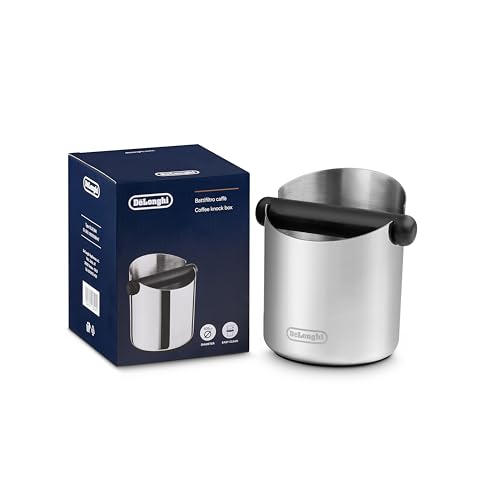
| DeLonghi Abklopfbehälter DLSC084 | Catches the wet puck instead of keeping surface free | approx. €20.99 | 8.8 | the used grounds bother you more than the marks on the worktop |
| Normcore WDT-Werkzeug V2.1 | 50 mm needles loosen the grounds and change the extraction | approx. €25.99 | 9.4 | an accessory purchase is meant to change the espresso in the glass |
What the table is not good for: it says nothing about how long the four items last, as we have no data on that. The rating column is our editorial assessment from the data comparison, not a measurement result, and the prices refer to the state as of September 2026. Our best list Barista accessories gathers the whole area.
When the mat is worth it and when to spend the money elsewhere
The toughest condition comes first: you have to tamp by hand. On a bean-to-cup machine or a capsule machine the mat has no job, as nobody handles a portafilter there and the puck drops out of the brew unit already pressed.
Next comes space. Where nothing is left free next to the machine, the 60 centimetre strip S is the more realistic variant, and if you cannot fit even that, you save yourself the purchase. For M, on the other hand, you have to clear 30 by 15 centimetres permanently, and in a full kitchen that is already a decision against something else.
The surface underneath deserves a close look. An oiled, textured wooden board that tolerates signs of use anyway gains the least. On granite, varnished wood or solid-surface material, by contrast, the metal spout hits hard, and coffee oil seeps into light-coloured joints.
The build height is almost always overlooked. If you tamp at the edge of the worktop and let the handle hang freely over the edge, you are not pressing on the surface underneath at all; for that position, the mat remains a rest between two covers. Ten millimetres of material thickness barely lifts the portafilter, and the surface stays flat. scarlet espresso lists a holder for the portafilter during tamping in two other places in the same range, namely the silicone rests “Barista” at €12.99 and “Professionale” at €11.99. Their descriptions are word for word identical apart from the dimensions, and besides the holder they mention a recess in which a tamper or distributor up to 60 millimetres has room. In return they are smaller: the Barista measures approx. 12.5 x 17.5 x 3.0 cm, the Professionale approx. 13.0 x 14.0 x 3.0 cm, so both keep free less than half the area that size M covers. A word on the risk of confusion: the brand uses the addition Professionale twice, for the mat and for the rest. When ordering, the article number helps: 990231 is the mat, 990144M2 the silicone rest.
That leaves the budget. For around 15 euros you get protection and grip. On extraction the mat acts at most indirectly, through a secure stand while tamping; it changes nothing about the grounds or how they are distributed in the basket. If the one accessory purchase of the year is meant to improve the espresso, a distribution tool or a tamper of the right diameter is the more effective purchase. In return, the mat has no running costs afterwards: there is nothing to refill and nothing to replace. Our assessment: on the shopping list, it comes near the end. In our guide Barista accessories: the essentials, the tamping mat is in fifth place, behind the precision scale, WDT tool, tamper and knock box, and the reasoning there applies here too: the guide counts knock box and mat as comfort items that work neither on the grounds nor on the cover and keep the kitchen tidy. Scale, WDT tool and tamper therefore come before them.
Two groups go wrong here. Anyone who already has a non-slip mat, a plastic board or a tamping station in front of the machine is buying the same function a second time. And anyone who wants to read user reports before spending 15 euros will find none: the manufacturer’s shop still lists the item with zero reviews, and the two silicone rests from the same brand show the same number.
Cleaning and drying
For care, the manufacturer gives exactly one instruction, and on the product page it reads like this: simply hold the mat under running water and all coffee residue can be removed easily. Nothing more is stated there, neither a temperature limit nor an approval for the dishwasher. We would therefore rinse it by hand, let it drain, and only put it back in its place once it has dried through, because water stays longer between the nubs than on a smooth surface.
What is missing on the manufacturer’s page
For a product in this price class the data is thin, and that deserves to be stated before anyone reads a promise into it. The shop lists neither Shore hardness nor density of the rubber, neither height nor number of nubs, no heat resistance, no statement on the food safety of this mat, nothing on the smell of new goods, nothing on behaviour in sunlight, nothing on colour transfer to light-coloured worktops, no country of manufacture, no warranty terms and no spare parts. No instruction manual or data sheet exists, and the product safety tab on the product page is empty in the delivered source code. It is also open whether the mat itself stays put on the worktop: the promise about grip applies to the top surface and to what stands on it.
The second source we otherwise cross-read does not help here either: for this ASIN, our data holds neither feature bullets nor product information from the Amazon catalogue. Apart from title, brand and price from our Amazon candidate list, everything documented about the mat and the supplier therefore comes from the manufacturer itself, from its shop and from its legal notice.
For a rubber mat this is mostly forgivable. Exactly one point is annoying, namely the material question from the section above.