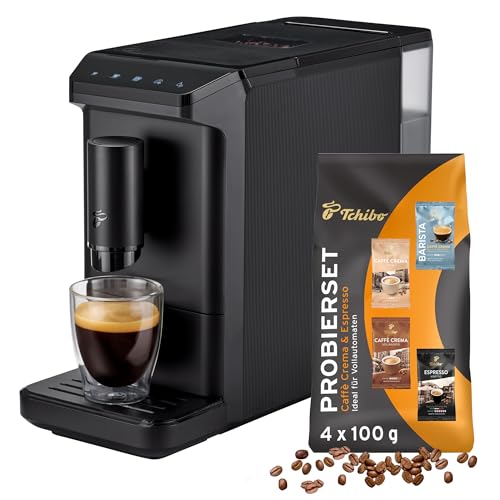
The Esperto mini is Tchibo’s bean-to-cup machine for kitchens where an ordinary one will not fit. It grinds whole beans and brews espresso and caffè crema from them; it cannot do milk. In the instruction manual it is model MSA23107, the black version carries Tchibo article number 648480, and the same part number appears in the Amazon catalogue. Tchibo advertises it as the smallest bean-to-cup machine in the world. We could not verify that.
In our price box it stands at approx. €229 on Amazon.de (as of September 2026). In the Tchibo online shop the black version cost €299 on 1 October 2026, the grey one €279, and a Limited Edition in Lovely Red is also on offer there. Tchibo Austria announced the machine in a press release on 21 August 2025, at that time for €289. In our bean-to-cup machine comparison it scores 8.0 points.
We have not had a unit in our hands. What is written here comes from Tchibo’s product page, from the 27-page instruction manual of August 2024, from the Austrian press release and from the Amazon catalogue. Where these sources contradict each other, we say so at the relevant point.
How much space does the Esperto mini need?
About 46 centimetres of width and 55 centimetres of depth on the counter. According to Tchibo the machine itself measures approx. 16 x 40 x 30.5 centimetres (width, depth, height), and the manual additionally requires 150 millimetres of clearance to walls.
We added up the 46 and 55 centimetres ourselves. The illustration in the manual applies the 150 millimetres on the left, right and rear and describes the whole, including the inserted drip tray with drip grid, as the space required for operation. In operation the machine is to stand free, by no means directly against a wall or in a corner, in a cupboard, by a curtain or the like. Tchibo requires at least 1 metre from hot, flammable surfaces such as a hob, oven or radiator. The power cable is approx. 80 centimetres long, so the earthed socket has to be close.
Upwards, the 30.5 centimetres is not quite enough. According to the manual you pull the water tank out upwards, and you should not fill in water while it is in the machine. The product page and the Amazon text, by contrast, speak of a tank that can be removed from the side. Under a wall cupboard we would measure before buying whether the tank can be lifted out there.
Tchibo gives approx. 7.4 kilograms, the Amazon catalogue 7.3 converted. To move the machine, always hold it by the outer housing. The feet are non-slip, and the manual warns: varnishes, plastics and care products on worktops can contain components that attack and soften the machine’s feet. The residual water tray contains magnets. Cards with magnetic strips, magnetic storage media and any devices that can be affected by magnetism do not belong there.
Five buttons, three coffee sizes
The product page talks about a touch display. The manual, however, nowhere shows a screen with text or a menu. It shows something plainer: next to the on/off button, five white control buttons with symbols that are only visible when the machine is switched on, and six orange indicator lights that only light up when action is needed. The indicators stand for refill water, refill beans, empty grounds, brew unit or cover flap, descale and empty system.
The buttons are called Espresso, Caffè Crema, XL Caffè Crema, Intense+ and Hot water. From the factory they dispense approx. 40 ml of espresso, approx. 125 ml of caffè crema and approx. 180 ml of XL caffè crema. According to the product page, each drink button can be programmed to 25 to 250 ml, and this works without a menu: press the button, wait until coffee is flowing after grinding, then hold the same button and release it at the desired volume. Two beeps confirm the new value.
You press Intense+ before the drink button, and the machine then prepares the coffee with more beans. According to the manual, the brew starts with a pre-infusion, recognisable by a short stop: a small amount of coffee is brewed first before the rest runs through. The hot water button has a narrowly defined purpose, more on that below in the questions.
You set the spout with cup lighting steplessly to the cup size, and the product page gives 8 to 15 centimetres of height. For taller glasses you remove the drip tray.
After about 10 minutes without a button press the machine goes into standby, and 2, 10, 20, 30 or 120 minutes can be selected. Switched off, it draws less than 0.5 watts according to the data sheet. When switching on, it rinses from the factory only if it is cold; if you hold on/off and hot water for about 5 seconds, it will rinse every time you switch on in future. It is ready as soon as all the buttons light up steadily.
In detail: conical burr grinder, stepless grind size, 19 bar
Grinding is done in a stainless steel conical burr grinder. In this design a cone-shaped grinding element turns inside a fixed ring, and the gap between the two decides how fine the powder is. You adjust this gap with a dial in the bean hopper, steplessly according to the product page. The dial is marked with dots of different sizes: clockwise to a larger dot means coarser, and the coffee flows faster; anticlockwise to a smaller dot means finer, and it runs more slowly. From the factory the dial is set to setting 2. On the product page Tchibo gives a tip that applies to all Tchibo bean-to-cup machines: grind setting 2 for caffè crema, grind setting 1 for espresso.
You may only adjust it while the grinder is running, and only in small steps, otherwise it can be damaged according to the manual. In practice that means: you start a brew and turn the dial while grinding is under way.
The data sheet gives a pump pressure of up to 19 bar. That is the maximum value the pump can build up. Espresso is classically extracted at around 9 bar at the coffee grounds, and how much pressure actually arises there is determined by the resistance of the coffee bed, that is grind size and amount of powder. A higher number on the data sheet therefore says little about the cup.
The bean hopper has a lid with a viewing window and an aroma-protection seal, which the product page describes as silicone. On the inside of the lid is a QR code that leads to Tchibo’s service web app Helping Bean. How much fits in the hopper is stated differently by the sources: approx. 150 g according to the manual, 130 g according to the press release, 130 to 150 g according to the product page.
How many cups a day is the Esperto mini good for?
By our calculation, for one or two people with two or three cups a day each, without the grounds container being reported full in between. Beyond that it gets tight, and less because of the tank than because of the grounds container: according to the manual, its indicator lights up after 9 brewing cycles.
The technical data of the same manual give approx. 10 portions for the container, the product page 9. We work with the indicator, because it decides when you have to empty it.
According to the product page the water tank holds approx. 1.1 litres, and the manual shows only a MAX marking. Purely arithmetically, one filling is enough for just under nine caffè crema of 125 ml, six XL of 180 ml or 27 espressos of 40 ml, minus the water for the rinse cycles. With caffè crema, the tank and the grounds container therefore fill and empty at roughly the same pace. For four people with two caffè crema each in the morning, by our calculation that would mean: filling the tank at least once and emptying the grounds once every day.
If the water runs out in the middle of a brew, the machine stops and continues as soon as the refilled tank is back in place. You change the water in the tank daily, as Tchibo requires, to prevent germs forming. Only fresh, cold tap or drinking water belongs in it, no carbonated mineral water and no other liquid.
Cleaning and descaling according to the manual
Tchibo divides care into a schedule with the columns daily, weekly and as needed. Daily you rinse out the water tank and empty and clean the grounds container, residual water tray and drip tray. Weekly the housing, a thorough tank clean and the brew unit are added.
You wipe the housing with a soft, damp cloth. You clean the tank in warm water with a little washing-up liquid, rinse it under running water and dry it; trays and the grounds container you also wash with washing-up liquid and dry well. According to the manual, none of this is meant for the dishwasher: the machine itself and all removable parts must not be cleaned in the dishwasher. Before every cleaning you pull out the mains plug. You never immerse the machine, plug or cable in water or other liquids, Tchibo likewise forbids a jet of water, and harsh chemicals and aggressive or abrasive cleaning agents are off limits. For the Empty grounds indicator to go out, the container must be out for at least 5 seconds while the machine is switched on.
The brew unit can be taken out, but only once the machine has cooled down. You press the cover flap at the bottom, grip it at the top and pull it off, hold the two orange buttons down and pull the unit straight out. It is cleaned under running warm water, after which it should dry well. You remove coffee powder residues in the receiving compartment with the supplied cleaning brush and wipe the compartment out. You push the unit back in straight to the stop with some force, this time without the orange buttons, until it clicks into place.
You descale as soon as the symbol lights up, at the latest within the next few days. A water filter and hardness setting do not appear in the manual, so the indicator is the only pacemaker. Tchibo requires a standard liquid descaler for coffee and espresso machines, expressly not one based on formic acid; other products can damage materials in the machine or be ineffective.
The procedure: descaler into the empty tank, water up to MAX, remove the drip tray, place a container of at least 500 ml underneath. Then you hold on/off and Espresso for about 5 seconds and afterwards press the Espresso button. The machine pumps the solution through at intervals of 40 seconds. Afterwards you clean the tank, fill it with cold tap water up to MAX, and the rinse phase starts by itself. It takes about 15 minutes and cannot be interrupted. If the process is interrupted anyway, for instance by a power cut, it runs to completion the next time you switch on, and the machine stays locked until then. You should not leave it unattended during this. How descaling works on other machine types is covered in the guide Descaling and cleaning.
What is in the box, running costs, service
According to the manual, the box contains the machine with water tank and lid, the bean hopper with cover, the brew unit with cover flap, grounds container, residual water tray, drip tray, drip grid, power cable and cleaning brush. On the product page, 400 g of coffee are added free of charge. With the Amazon offer this is a sample set of Caffè Crema mild, Caffè Crema vollmundig, Barista Caffè Crema and Espresso kräftig Sizilianer Art, and the product photo says 4 x 100 g.
Running costs come from beans and liquid descaler; the manual does not provide for filter cartridges or cleaning tablets. We still do not draw up an annual bill, because two variables are open: the amount of beans per brew and a descaling interval. You do not need a separate coffee grinder, however, as the grinder is built in.
Tchibo sells spare parts through an online form or directly in its own shop. The product page also advertises a free video inspection by Tchibo’s machine specialists. For repairs that have to be paid for, the manual refers to the repair centre, which carries them out at cost price where still possible. You keep the packaging for transport and sending in for repair. Before sending it in, you clean all containers, the drip tray, the brew unit and the interior where it sits, so that the machine suffers no additional damage in transit. Municipal collection points or the take-back points set up by Tchibo accept a discarded appliance from a private household free of charge.
We searched the product page, manual and press release for the following details, without result:
- Brewing temperature and heat-up time in seconds
- Amount of beans per brew in grams, with and without Intense+
- Number of grind settings and size of the grinding cones
- Material of the housing, water tank, brew unit and drip tray
- Capacity of the drip tray and residual water tray
- Descaling interval in weeks or litres and the rule by which the indicator is triggered
- Prices of individual spare parts such as the brew unit or water tank
- Brewing time per cup
- Which process the sound pressure level of <70 dB(A) in the data sheet applies to, grinding or brewing
- Place of manufacture; Tchibo only writes “Made exclusively for Tchibo GmbH”
- A source for the energy efficiency class A+ in the Amazon catalogue
What else is worth considering?
| Model | The difference | Price | Our rating | Choose this if |
|---|---|---|---|---|
| Tchibo Esperto mini (this one) | 16 cm wide, no milk function, XL button | approx. €229 | 8.0 | you want the body as narrow as possible and drink coffee without milk |
| Melitta Solo | 20 cm wide, brewing temperature in three steps | approx. €268.98 | 8.2 | you want to choose the temperature yourself and can do without hot water |
| Grundig KVA 6230 | Steam wand and chute for pre-ground coffee, 27.5 cm wide | approx. €229.99 | 7.8 | you want to froth milk on the machine or use pre-ground coffee |
| DeLonghi Magnifica S | Steam wand, 1.8 l tank, 24 cm wide | approx. €319.90 | 8.3 | three or more people drink from it every day |
The prices are guide values from our price boxes and may look different on the day you buy. The rating is our editorial assessment from data sheets and manuals; we have not measured any of the four machines.
When the Esperto mini fits, and when another bean-to-cup machine does
It fits if you drink espresso or caffè crema without milk and at most two people regularly draw coffee from it. The XL button also fills a large mug in a single brew. It is mainly its body that is narrow: because the manufacturers require different amounts of clearance, two of the alternatives below manage with less width on the counter.
For cappuccino the Grundig KVA 6230 is closer. It has a built-in steam wand and in our price box is only 99 cents above the Esperto mini. In return it is, according to the manual, 27.5 centimetres wide, 11.5 more. Its tank holds 2.0 litres, the bean hopper 250 grams, and the chute takes a single portion of up to 12 grams of pre-ground coffee. Which types of frother exist as an addition is sorted out in the guide Milk frother buying guide.
85, 90 or 95 °C: these are the three brewing temperatures Melitta gives for the Melitta Solo. It is 20 centimetres wide, but according to the manual requires only at least 10 centimetres of free space to the sides and so manages with around 40 centimetres of width, 6 less than the Esperto mini. In our price box it is just under €40 above it. It cannot do milk either, and it has no hot water button at all.
The DeLonghi Magnifica S has more capacity: its tank holds 1.8 litres, 0.7 more than on the Esperto mini, and the bean hopper 250 grams. The manual gives 24 centimetres of width, the safety booklet at least 3 centimetres of clearance to the side walls and rear wall, together around 30 centimetres. In our price box it costs about €91 more than the Esperto mini, but it has a steam wand that also dispenses hot water for tea.
Who is it suitable for?
According to the manual, the machine is intended to be used in households and household-like settings, such as in shops, offices or similar working environments, on farms, and by guests in hotels, motels, bed and breakfasts and other residential accommodation.
Two restrictions apply everywhere. The machine is not intended for continuous operation, and it should never run unattended; if it is used commercially, trained staff must supervise and clean it. For a tea kitchen where a whole team helps itself, we therefore consider the Esperto mini the wrong choice.