The KVA 6230 is a bean-to-cup coffee machine from Grundig. It grinds whole beans, brews five coffee drinks from them and has a steam wand for milk that you guide by hand. On the product page its full name is KVA 6230 Delisia Coffee Series DC6000, and the model number is GMS6070. It is listed under exactly this number in the Amazon catalogue too.
In our price box it is listed at approx. €229.99 on Amazon.de; in the Amazon catalogue it was exactly €222.00 on 7 September 2026. In the bean-to-cup machine comparison it scores 7.8 points with us.
We have not had the machine in our hands. What follows comes from Grundig’s product page, the German instruction manual (edition 01M-GMS6070-5124-06, German part on pages 35 to 71), the product brochure, the English-language EU data sheet and the Amazon catalogue. Where two sources contradict each other, we say so on the spot.
Is the KVA 6230 the cheapest bean-to-cup machine?
Not quite. The Tchibo Esperto mini is 99 cents cheaper in our catalogue, but it cannot froth milk. Among our bean-to-cup machines with a steam wand, the KVA 6230 is the cheapest; the next one, the DeLonghi Magnifica S, costs around €90 more.
At Grundig itself it is one of three bean-to-cup machines. The German website also lists the KVA 7230 (DC7500) and the KVA 8230 (DC7500+), plus three espresso machines with portafilters. In the category list the KVA 6230 appears twice, both entries with the same EAN 4013833065265.
Space, capacity and placement
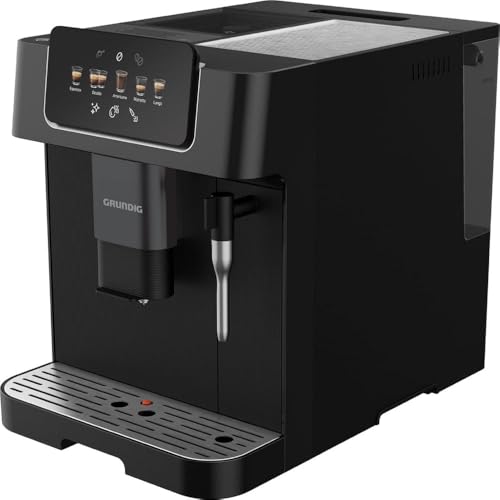
According to the manual, the KVA 6230 measures 27.5 centimetres in width, 35.9 in height and 41.2 in depth. The brochure, EU data sheet and Amazon arrive at the same values. The product page differs and gives 34 centimetres in height, 40.5 in width and 18.6 in depth. The product photo shows a housing that is clearly deeper than it is wide, which fits poorly with a depth of 18.6 centimetres. We go with the manual.
Grundig requires a minimum clearance at the sides; the illustration shows 150 millimetres. With 15 centimetres each on the left and right, we arrive at 57.5 centimetres of worktop width. The surface should be stable, flat, clean, dry and non-slip. According to the manual, the KVA 6230 is not a built-in appliance, and while it is running it must not stand inside a cupboard.
It is connected with 1350 watts to 220 to 240 volts. The power cord is 95 ± 5 centimetres long and plugs into a socket under the machine. Grundig requires an earthed socket and forbids extension cords; the plug must remain accessible after installation.
The manual gives 9.68 kilograms, with a tolerance of half a kilogram either way. The Amazon catalogue lists 12.0 kilograms when converted. That is close to the 11.72 kilograms Grundig gives for the packed machine, so we suspect that Amazon took over the shipping weight.
With two coffee drinkers, how often you refill and empty is decided mainly by the grounds container. Its indicator lights up after every 10 coffees; if the two of you drink two cups each per day, that happens after two and a half days. The drip tray holds up to 0.6 litres and has a floating indicator: as soon as it becomes visible, you empty the tray. Both sit behind the front cover.
The removable water tank holds 2.0 litres and the bean hopper 250 grams, both with a tolerance of 5 per cent. With the powder quantities given further below under the control panel, the beans arithmetically last for 31 coffees on the standard setting or 25 on the intense one. With water it gets less precise. On paper, 2 litres give about 13 Americanos or 66 espressos at factory quantity, but the machine rinses automatically with every brew, so the real number is lower.
According to the manual, you must not put warm or hot water, sparkling water or any other liquid into the tank, nor food, and you do not fill above the maximum mark. Grundig also advises against pouring water from another container directly into the machine. We read this to mean that you take the tank out to fill it.
According to the troubleshooting table, you pour away the first coffee after setup; the following cups will improve.
Control panel, five drinks, three operating modes
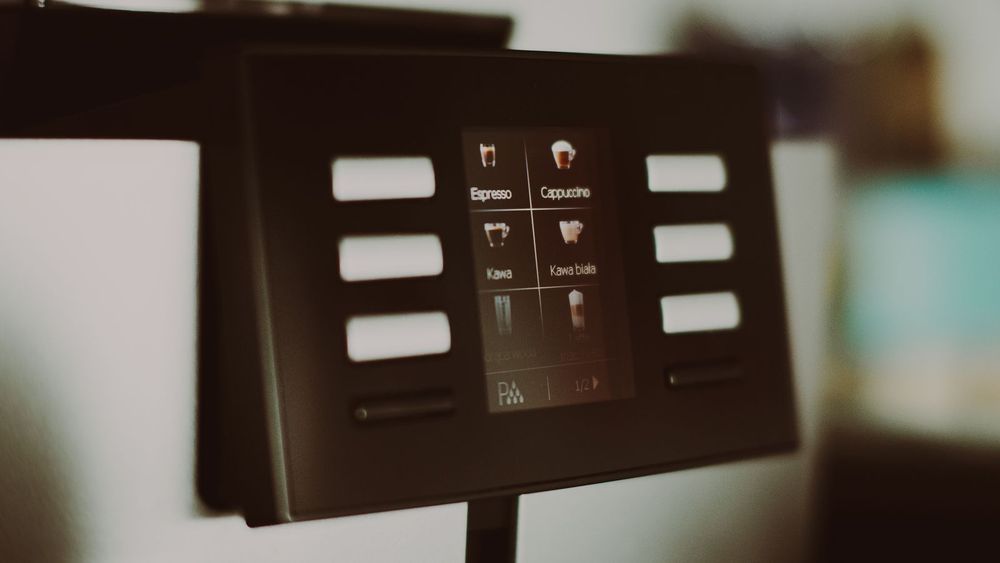
The brochure and the manual describe the operation differently. The brochure advertises a colour touch display and refers to the HomeDirect app with over 30 coffee recipes. The manual shows a control panel with touch keys in symbol form and LEDs for warnings and faults, including a dedicated one for descaling. For the touch keys, the troubleshooting table has a simple hint: press the lower part of the symbol from the front.
Five keys are for coffee, a sixth for hot water. These quantities run from the factory; the tolerances come from the manual:
- Ristretto 20 ± 5 ml
- Espresso 30 ± 10 ml
- Lungo 60 ± 10 ml
- Double 60 ± 10 ml
- Americano 150 ± 20 ml
You can store a new quantity for each drink and for the hot water, between 25 and 250 ml; for a double brew, twice that applies. There are three options for strength: standard bean coffee with 8 ± 2 grams of ground coffee, intense bean coffee with 10 ± 2 grams, or ground coffee from the machine’s own powder compartment. If you hold the on/off key and the bean key together for 3 seconds, you restore the factory settings.
On top of that there are the operating modes Standard, ECO and Speed. In the first two, a pre-brew runs before every brew, which according to the manual moistens the coffee in the brew unit with a small amount of water before full extraction begins. Speed mode skips it. According to the technical data, the machine is heated up in under 50 seconds.
The cup warmer works passively with heat from inside the machine; you place the cups on it upside down. If your coffee is not hot enough, the troubleshooting table has two suggestions: pre-warm the cup on the cup warmer or rinse it with hot water. According to the manual, a manual rinse before the brew also makes the coffee hotter. While a brew is running, the cup indicator light is on.
In detail: 13 grind settings and 19 bar
According to the brochure, the grinder is made of stainless steel and has 13 grind size settings. Only the Amazon listing text speaks of a conical burr grinder. In this design, a conical burr runs inside a fixed ring, and the gap between the two determines how fine the powder becomes.
It is adjusted with the setting knob on the bean hopper, and a larger number means a coarser grind. You may only turn it while the grinder is running. The manual phrases this as a warning: “Never adjust the grinder setting when the grinder is not running. This could damage the grinder.” If the coffee runs through too slowly, the troubleshooting table advises a coarser setting.
For the grinder, the product page advertises a freshness seal, a quiet motor and an insulation system. These are promotional claims without measured values. According to the manual, you should not use the bean hopper for storage, “to achieve better results”. We understand this as advice to fill in only as many beans as you will need in the next few days.
The 19 bar come from the product page. This means the maximum pressure the pump can build up. Espresso is usually brewed at around 9 bar at the coffee bed, and how much pressure actually arrives there depends on the resistance of the powder, that is, on grind size and quantity. The figure on the data sheet therefore hardly lets you predict the cup.
Milk froth and hot water from the same wand
As the product photo shows, the steam wand sits to the right of the coffee spout. You place a cup or a jug of milk underneath and start and stop the steam with a button. You decide how deep the wand dips in and how long it works. To make it easier to reach with a jug, it can be swung to the right.
So you assemble cappuccino and latte macchiato yourself. Grundig fixes the order, espresso first, then milk: “Otherwise the espresso may burn.” At Grundig, only the KVA 7230 has a built-in milk frother, and according to the product page its CreamyPro function can be set to the desired froth density. How to get fine-pored froth with a steam wand is explained in the guide How to froth milk.
Hot water comes from the same wand, via its own button. According to the manual, the machine is intended only for preparing coffee and for heating milk and water.
After frothing, you wipe the wand with a damp cloth. According to Grundig, you remove milk residue at the tip by briefly running the hot water function. For thorough cleaning, you pull the metal tube down and turn the wand cover to the left; you wash the tube out under running warm water and clear the hole with the cleaning needle or the bristles of the brush. According to the manual, you should avoid direct skin contact with escaping steam and with hot rinsing, cleaning and descaling water.
Cleaning and descaling according to the manual
Before every cleaning you pull the mains plug; for the bean hopper the manual gives a special reason, the “danger from rotating coffee grinder!”. Then you empty the drip tray and the grounds container. You remove liquid stains on the housing with a damp cloth or a non-scratching cleaning agent. You should never use abrasives, vinegar or descalers that are not part of the scope of delivery. According to the manual, the machine and accessories do not belong in the dishwasher, and you never immerse the machine, the power cord or the plug in water or other liquids.
You take out the brew unit, wash it with water and dry it afterwards. You clean the coffee powder chute and the grinder outlet with the cleaning brush.
Before and after every brew, the KVA 6230 rinses itself automatically. This can be switched off, but Grundig recommends actively using the automatic cleaning “to ensure healthy use”. If the machine has stood for a longer time, you start a manual rinse with the key when idle. For longer periods of non-use and for frost protection, the manual provides the function “empty system”, which counts for a holiday flat in winter, for example.
A dedicated LED signals when descaling is due. According to the manual, descaling is “required after the predefined brew cycle”; how many brews or litres that is remains open. Alongside it stands a rule of thumb: the machine stays in the best condition if the function is run at least once a month or more often, depending on the water hardness used.
To descale, you fill the tank up to the descaling mark, put one pack of descaler into the box in the water tank and let two cycles run. The warning can also be reset without descaling, though Grundig advises against it. How to find out your water hardness and what it has to do with limescale in the machine is covered in the guide Water hardness and coffee.
Accessories and service
According to the manual, the box contains a cleaning brush, a cleaning needle, a cleaning cloth and a spoon for pre-ground coffee. The brochure lists the accessories somewhat differently, more on that in the FAQ. The water filter KVA 8000 WF is available separately as a spare part and, according to the brochure, fits the KVA 6230.
According to the manual, specialist retailers or the service centre of Beko Germany give information on spare parts and accessories; on the warranty page, the Beko Germany GmbH in Eschborn is named. Only the Russian-language part of the manual names Arçelik A.S. from Turkey as the manufacturer, and according to the same section it is made in China. Beko also appears in the German text: the section on intended use begins with “The fully automatic coffee machine Beko”, presumably a leftover from a template.
We searched the product page, manual, brochure and data sheet for the following details, without result:
- brewing temperature, neither as a figure in degrees nor in levels
- type of pump
- water quantity of the automatic rinse cycles
- whether the machine can be controlled via the HomeDirect app
- design and diameter of the grinder in Grundig’s own documents
- noise level in decibels
- material of the housing, water tank and drip tray
- temperature and power consumption of the cup warmer
- maximum cup height under the spout
- power consumption per cup
- whether Americano and Lungo also run double
- year of market launch and recommended retail price
- since when Grundig has sold bean-to-cup machines
- how long spare parts remain available
- price of the descaler, price and service life of the water filter
Because of the last point, we do not draw up an annual cost calculation for the running costs.
What else is worth considering?
| Model | The difference | Price | Our rating | Choose this if |
|---|---|---|---|---|
| Grundig KVA 6230 (this one) | Steam wand, five drink keys with quantity memory | approx. €229.99 | 7.8 | you froth milk yourself and want to spend around €230 |
| Tchibo Esperto mini | no milk function, approx. 16 cm wide according to Tchibo | approx. €229 | 8.0 | you only drink black coffee and have little width to spare |
| DeLonghi Magnifica S | coffee temperature LOW or HIGH, grounds container for 14 portions | approx. €319.90 | 8.3 | you want to choose the powder quantity more finely than standard or intense |
| Jura E8 | milk by tube straight into the cup, adjustable water hardness | approx. €1,049 | 9.4 | you want several milk drinks a day without manual work |
The prices are the guide values from our price boxes and can look different on the day you buy. The rating is our editorial assessment based on data sheets and manuals; we have not measured any of the four machines.
When the KVA 6230 fits, and when another bean-to-cup machine does
It fits a household with one or two coffee drinkers who want espresso or Americano at the press of a button and now and then froth a cappuccino themselves. If you want to fix the cup size, you store it per key, and if you occasionally drink decaf, you use the powder compartment for it.
If you drink only black coffee and worktop space is tight, the Esperto mini is the obvious alternative at practically the same price. Tchibo gives it as approx. 16 centimetres wide, which is 11.5 centimetres less than the KVA 6230.
The DeLonghi Magnifica S also has a steam wand; according to the product page its tank holds 1.8 litres, 0.2 less than the KVA 6230. De’Longhi does list a programmable water hardness, but the manual describes no way to get there; for hard water it is therefore only a partial solution.
If you have hard water (under the German Detergents Act, this range begins above 14 °dH, German degrees of hardness) and drink several milk drinks a day, you end up in a different price class. With the Jura E8 you set the water hardness from 1 to 30 °dH, it works with the CLARIS Smart+ filter and draws the milk by tube from an external container straight into the cup. In our price box it costs around €819 more than the KVA 6230.
We would not buy the KVA 6230 for a guesthouse or a doctor’s surgery, because Grundig’s own texts diverge here. The safety chapter permits use in households and comparable settings and, in essence, counts staff kitchens in shops and offices, agricultural holdings, guests in hotels and motels and smaller guesthouses among them. The section on intended use, by contrast, says the machine is not meant for commercial use. Finally, warranty condition 8 treats use in hotels, guesthouses, restaurants, doctors’ surgeries or communal facilities as not intended use. If you put the machine out for guests or patients, you therefore cannot count on the manufacturer’s warranty in case of damage. In an office kitchen with many coffee drinkers, the small grounds container adds to this, as it would need emptying several times a day.