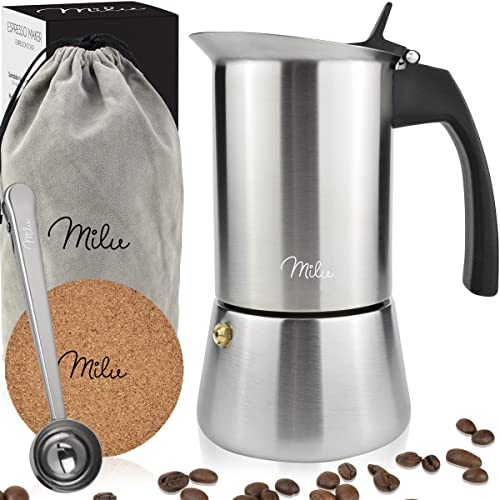
Milu sells this pot under a heading that is not right for this particular size. The product page in the Milu shop is called “Milu Espressokocher Edelstahl Induktion” (stainless steel induction moka pot), and only in the description text does the sentence that matters appear: the 2-cup variant may be too small for induction hobs. The Amazon catalogue is clearer and puts “2 Cup No Induktion” right in the title.
What remains is a small stainless steel moka pot for gas, electric, ceramic hobs and the camping stove, sold as a set with accessories. In our price box it stands at approx. €25.45 on Amazon.de, an Amazon figure from July 2026. In the comparison of moka pots it scores 7.9 out of 10, which puts it behind all three pots we set against it further down.
Trivet, scoop, brush: what is in the set
The body is stainless steel. Milu becomes more specific on the page for the personalised version of the same range, which says rustproof 430 stainless steel. The manufacturer also promises that steel and coffee get along: it calls the pot odour- and taste-neutral and advertises convenient one-handed operation.
The colour description “black” is easily misleading. In the product photo the pot is bare steel; only the handle and a tab that sticks up on the lid above the handle are black, and the second colour variant in the shop is called wood look. Black therefore refers to the add-on parts.
On what is in the box, the sources differ. The Amazon title lists three items: trivet, scoop, brush. The product page in the Milu shop lists more: moka pot, carry bag, measuring scoop, spare gasket, trivet, brush and reducer filter. The page for the personalised pot leaves out the reducer filter, but describes the trivet as cork and the pouch as protection for transport. The product image we took over from Amazon shows, next to the pot, a grey drawstring pouch, a dosing scoop with a clip and the cork trivet. A brush is as little to be seen in the image as a reducer filter. For the Amazon order, only the trio from the title is therefore documented.
In detail: why the smallest Milu should stay off the induction hob
Milu justifies the exception by size and not by material, and that fits the metallurgy. 430 is a ferritic chromium steel, and ferritic steel is magnetic. That is exactly what an induction hob needs: the coil under the glass ceramic builds up an alternating magnetic field, eddy currents arise in the ferromagnetic base above it, and these heat the metal itself. A pure aluminium pot stays cold on an ordinary induction hob, whereas a base made of 430 steel in principle does not.
It can fail on surface area. Induction hobs only switch a zone on once the pan detection finds enough metal above the coil, and below this threshold the zone stays off, whatever steel the base is made of. Where the threshold lies is stated in your hob’s manual, and it differs from appliance to appliance. The base diameter of the pot, which you would have to hold against it, is not given on any Milu page. “May be too small” therefore means exactly that: on a hob with a small minimum size it may work, but the manufacturer is unwilling to promise it for any hob.
That is why the magnet check is misleading for this pot. A fridge magnet should stick to the base of a 430 pot, and the hob can still overlook it. The check answers the material question, but here the surface area decides.
The instructions for use are confusing. The Milu PDF, created on 19.03.2021 according to its file properties, says across the board that the moka pot can be used on any type of hob, and lists induction, gas and electric. However, the drawings in it show a pot with a transparent top section. We read the document as general instructions for Milu moka pots and, on the question of the hob, stick to the product page and the Amazon title, which both exclude the 2-cup size.
Are 100 millilitres enough for two people?
For two small espressos yes, for two breakfast cups no. Milu gives 100 millilitres for the 2-cup size, which is around 50 millilitres per cup, the usual measure of a mocha cup.
It remains open whether the figure describes the filling or what arrives at the top. With a pot this small that is not unimportant: a little water is still left in the boiler under the funnel after the run, and the wet coffee grounds hold back another part.
Anyone who often needs more than two small cups stays within the same range and, according to Milu, gets 200 millilitres with 4 cups, 300 with 6 and 450 with 9. In the Milu shop the black version costs €34.95 with 4 cups, €36.95 with 6 cups and €42.95 with 9 cups, and the 2-cup pot itself €29.95, all as of 24 September 2026. The 4 cups in black were not in stock on that day. In the shop, then, €7 lies between 2 and 6 cups for three times the amount, and from 4 cups the induction exception falls away. On Amazon, the small pot stands €4.50 below the shop price in our price box.
Brewing according to the Milu instructions
The instructions manage with five steps. The boiler is filled with water up to the bottom of the valve. Then the filter goes in, filled completely to the top edge with coffee powder and levelled off. Milu expressly forbids pressing it down, and an espresso tamper as well.
There is a technical reason for this. A moka pot has no pump; it pushes the water up out of the boiler through the grounds with steam pressure. A compacted puck puts up more resistance to this pressure: the pressure in the boiler rises, the water runs through haltingly, and in the extreme case the valve has to blow off. According to the instructions, the powder should also be somewhat coarser than for an espresso machine, which lowers the same resistance; where that lies on the scale is explained by our guide to grind size. This method hardly needs a gram figure, as the brimful filter is the measure. Anyone who still wants to know roughly how much powder that is can work it out in the brew calculator.
The pot goes on the hob at medium heat. The instructions justify this by saying that too high temperatures burn the coffee and make it bitter. The run is finished when it hisses: then, according to Milu, all the coffee is at the top, and the pot should come off the hob at once so that nothing burns.
The fifth step is the one that is easily overlooked. It reads, word for word in German: “Bitte beachte dass du den Kocher nach dem aufkochen min. 20 - 30min abkühlen lässt, bevor du den Kocher aufschraubst. Verbrennungsgefahr!” (Please note that after boiling you should let the pot cool for at least 20 to 30 minutes before unscrewing it. Risk of burns!) The instructions therefore do not provide for a second filling straight afterwards. The process for moka pots in general is described in our guide to moka pots.
What else comes into question?
| Model | The difference | Price | Our rating | Choose this one if |
|---|---|---|---|---|
| Milu moka pot 2 cups (this one) | Stainless steel, 2 cups, accessories in the set, excluded for the induction hob | approx. €25.45 | 7.9 | you cook on gas, electric or ceramic and want to buy a trivet and brush along with it |
| Bialetti Moka Induction | Boiler steel on the outside, aluminium inside, built for induction, not for the dishwasher according to Bialetti | approx. €26.14 | 8.7 | you cook on induction and wash by hand anyway |
| Coffee Fox moka pot 4 cups | Stainless steel, induction-suitable according to the manufacturer, double the amount, only the pot and the manual in the box | approx. €17.95 | 8.0 | you need more coffee per run and can do without accessories |
| Bialetti Moka Express | Aluminium, 6 cups, on induction only with the Bialetti adapter plate, no dishwasher | approx. €28.87 | 9.4 | you cook on gas or electric for several people |
The prices come from our price boxes and were not all collected on the same day; the rating is our editorial assessment. The table says nothing about the coffee in the cup; what we compared were manufacturer claims, not espressos.
When the Milu, when one of the others?
The hob first. If there is an induction hob in your kitchen, the question of the 2-cup Milu is settled. The Bialetti Moka Induction costs €0.69 more in our price box and is built for exactly this kind of hob. Foreseeable moves belong in the same calculation: according to Bialetti, the Moka Induction also runs on gas and electric, whereas the 2-cup Milu does not run on induction.
Then the amount. If two small cups are enough for you, size no longer matters. Anyone who needs a proper portion each for two people in the morning ends up with the Coffee Fox with 4 cups: it costs €7.50 less in our price box, is induction-suitable according to the manufacturer, and in return the box holds only the pot and the manual. Our assessment: with the Milu you pay the extra for the accessories in the set. For even more amount on gas or electric, the Moka Express with 6 cups, for €3.42 more, is the pot with our highest rating in this round.
At the washing-up, the four split into two camps. Milu and Coffee Fox approve their stainless steel pots for the dishwasher, while Bialetti rules out the machine for both models. Anyone who generally loads the dishwasher therefore has the choice between Milu and Coffee Fox, and then the hob decides again.
On the material, the situation is less clear than it looks. The body of the Moka Express is aluminium, and the Moka Induction is steel only on the outside of the boiler: inside the boiler and in the top section, where the coffee arrives, it has aluminium. Anyone who wants to avoid contact with aluminium should therefore look at the Milu and the Coffee Fox, which both have a stainless steel body.
Dishwasher, limescale and storage
The pot may go in the dishwasher. The product page calls it fully dismantlable and dishwasher safe, and the instructions say that all parts can be cleaned by hand or in the dishwasher. The page for the personalised version even advertises that the parts can be cleaned in the machine, saving time. In the cleaning section of the instructions, however, Milu recommends cleaning by hand under running water and gives the taste as the reason, as the coffee should not be impaired. Our advice: by hand as the rule, the machine when you are in a hurry. The manufacturer covers both.
The brush supplied is meant for the riser tube. Now and then, say the instructions, you take out the gasket and filter and clean the tube from below. Afterwards the pot should dry thoroughly and be stored open, to avoid mould. Screwed together in the cupboard, the residual moisture would stay trapped between the boiler and the top section.
On descaling the instructions say not a word. Limescale matters all the same, because of the warranty section. Excluded there are replaceable parts, unless there is a manufacturing defect, as well as faults caused by improper use contrary to the instructions and by non-original spare parts, and finally damage from impact, falls and limescale deposits. How quickly limescale settles in the boiler depends on the carbonate hardness of your tap water, which you can classify in the guide to water hardness. How to descale a moka pot without manufacturer instructions is covered under descaling and cleaning.
What Milu does not state
For storage space and luggage, the basic data are missing. External dimensions, height and weight of the 2-cup pot are given neither in the Milu shop nor in the instructions, and the shop system records a weight of 0 grams. For the materials, the documentation ends at the body; the handle, lid tab, funnel, filter and gasket remain open, and whether the gasket is made of rubber or silicone cannot be told from the word gasket.
The valve appears in the instructions only as a fill mark; there is not a single sentence on its design or testing. Brewing time and heating time are unknown, as is the filling quantity with the reducer filter inserted. The instructions contain no notes on positioning or intended use beyond the heat and the cooling pause. A year of market launch is stated nowhere; the shop page has existed since 31.10.2025, a date that concerns only the shop listing and not the market launch.
One last gap concerns the assignment itself. The ASIN B08CNGK3KK does not appear anywhere in the Milu shop, and no product page there links to Amazon. That our Amazon pot belongs to the stainless steel range of the shop, we infer from the matching title with material, number of cups, colour and the four sizes of the range.
Who is it suitable for?
For one or two espresso drinkers with gas, electric or ceramic, and for the camping stove: Milu expressly lists camping among the hob types of the range, and the pouch is meant for transport, if it is in the box. As a gift, the pot comes in the Milu shop also with a name engraving, for €35.99, and in wood look without engraving for €32.95 (both as of 24 September 2026).
It is wrong for anyone who likes to leave the hob alone while making coffee: the instructions want the pot off the hob at the first hiss, there is no automatic shut-off, so you stay standing next to it.


