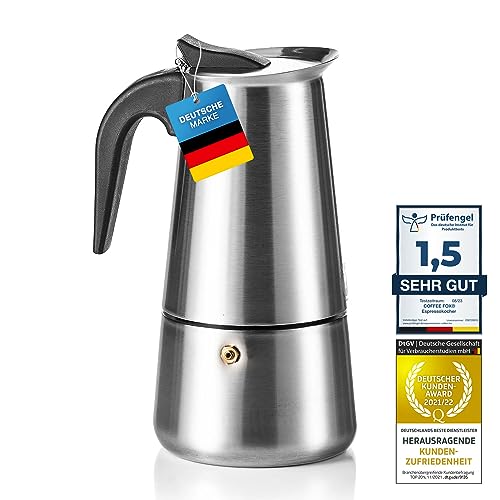
Coffee Fox is the brand of Goods & Gadgets GmbH in Nuremberg. The manual names the company as customer service, and according to the German legal notice (Impressum) the same company runs the online shop geheimshop.de, where the moka pot comes in four sizes: for 2, 4, 6 and 9 cups. This review is about the pot for 4 cups. The manufacturer calculates approx. 50 ml per cup and states approx. 200 ml for this size.
Our price box lists approx. €17.95 on Amazon.de. We recorded the value at Amazon in July 2026; the catalogue query of 7 September 2026 came back without a price, so we have no more recent figure. Of the 17 pots in our moka pot category, only two are listed lower in the price box, and in our rating the Coffee Fox scores 8.0 out of 10 points. The oldest customer review in the former manufacturer shop is dated 14 August 2018, so Coffee Fox moka pots have existed since then at the latest.
Does the Coffee Fox work on an induction hob?
Yes, going by everything the manufacturer writes. The manual expressly lists induction hobs among the intended hob types, and the FAQ on the product page gives a “special, ferromagnetic base” as the reason.
The product text of the Amazon listing we link to reads differently: it lists ceramic hobs and gas hobs, and induction is not mentioned. An earlier version of this text followed that and treated induction as unclear. That was wrong, because the manual and the manufacturer’s shop both name it.
On the material, the manufacturer’s pages are less consistent. The current product page speaks of stainless 18/10 steel, the older shop site of the same operator of food-grade 304 stainless steel. That sounds more contradictory than it is: in the trade, both designations usually mean the same steel family with around 18 per cent chromium and 8 to 10 per cent nickel. Such austenitic steels are hardly magnetic in their normal state. An induction hob, however, generates heat through a magnetic field in the base of the pot, and so with this pot everything depends on the base, which the manufacturer specifically highlights as ferromagnetic. Its product page also advertises an “optimised boiler base” that conducts heat well on induction, gas and electric hobs, so that the espresso is ready “in a few minutes”.
The manufacturer itself makes one restriction, though for a different size. The older page says the 2-cup pot is suitable for induction only to a very limited extent or not at all, because it “simply lacks mass”. For the other sizes, this one included, it says the opposite. What remains open is the base diameter of the 4-cup pot, and that is exactly what you would need at the hob: many cooking zones only detect cookware from a minimum size.
Construction, handle and dimensions
The manual divides the pot into three main parts. At the bottom sits the water container with the safety valve, in the middle the funnel insert for the coffee grounds, and at the top the upper part of the pot with a reinforced handle and integrated filter. The Amazon text speaks of two parts that can be unscrewed. Both fit together, because the funnel is only inserted.
In the catalogue photo the body is round and narrows from the base towards the lid, with a narrow shoulder at the screw joint. The brass-coloured valve sits at the side of the bottom part.
According to the manual, the pot is made of “100% stainless steel”. For the handle this is not the case according to another manufacturer statement: the older shop site describes it as black, heat-resistant plastic, the current product page as sturdily riveted. In the photo the handle and the lid knob are black, which would fit the plastic statement. A photo does not show the material itself.
The manual gives the dimensions as 10 × 10 × 20 centimetres, and the product page repeats them in the description of the 4-cup size and adds 0.45 kg. Whether these are the outer dimensions of the pot with handle or packaging dimensions, the manufacturer does not say. It is puzzling that the manual gives the same values across the board for all four sizes, although the largest pot holds nine cups and the smallest two. In the shop’s variant data, the 4-cup pot also has a weight of 0.35 kg instead of 0.45 kg.
According to the manual, the box contains the moka pot and the user manual. The product page also advertises an improved sealing system that prevents leaks at the base and burr-free interior finishing; the Amazon text describes the spout as “precisely shaped” so that every drop lands in the cup. These three advertising claims could only be verified with the pot in hand, and we did not have it.
In detail: steam pressure, valve and why nothing is pressed down
A moka pot works with steam. The water in the closed bottom part gets hot, the steam above it builds up pressure and pushes the water up through the riser tube of the funnel, through the coffee grounds and the filter into the upper part. With this design the pressure is roughly 1 to 1.5 bar, whereas an espresso machine with a portafilter works at around 9 bar on the coffee grounds. What comes out of the Coffee Fox is called espresso in the manual, but technically it is moka: more concentrated than filter coffee, yet without the firm crema, which needs a brewing pressure of around 9 bar.
The rules in the instructions follow from this mechanism. The safety valve opens when the pressure in the boiler gets too high. If the water stands above it or grounds block the opening, it cannot do this job, which is why the fill limit sits just below the valve. Pressed-down grounds put up more resistance to the water than the low steam pressure can cleanly overcome. Too much heat, in turn, makes the pressure rise faster than the water gets through the coffee bed. The medium hob setting from the instructions is the answer to this.
The fixed fill quantity is also linked to the pressure. The funnel filter should be full so that the water has to pass through an evenly dense coffee bed. A half-filled filter leaves it room to run through faster at loose spots. Pots with a reducer filter solve this with an insert that makes the filter smaller. The Coffee Fox comes with only the one funnel insert, and it is designed for four cups. You can fill in less water, but then the coffee bed no longer matches the quantity.
For the grounds, the manual speaks of “ground espresso powder”. For moka pots people usually grind a touch coarser than for a portafilter, because very fine grounds slow the flow at low pressure. How to set this on your grinder is explained in the guide to grind size, and the brew calculator works out the ratio of grounds to water for you.
Preparation and safety according to the manual
Six steps, in this order: you unscrew the pot and take out the funnel insert. You fill the lower container with water, at most to just below the safety valve. You fill the funnel with ground espresso powder, without pressing it down, and insert it. Then the upper part goes tightly onto the lower part, the pot goes on the hob, and you heat on a medium setting. As soon as the espresso rises into the upper part with a hiss, you take the pot off the hob. The same order applies to every stovetop pot, explained in more detail in our moka pot guide.
The Coffee Fox is intended “exclusively for the preparation of espresso on gas, electric and induction hobs as well as for outdoor use (e.g. camping)”. The sentence after it reads: “Intended for private use only.”
We reproduce what the safety section says without omission. Never use it without water in the lower container. The safety valve must not be blocked by either water or coffee grounds. The housing gets very hot during operation, so you only touch the pot by the reinforced handle. And the pot must be kept out of the reach of children.
Dishwasher allowed, steel wool forbidden
According to the manual, the moka pot is dishwasher safe, but for a longer service life it still recommends washing by hand with warm water. The Amazon text also says dishwasher safe.
Abrasive cleaning agents and steel wool are forbidden; both attack the bare surface. All parts must be completely dry before reassembly. If you wash the pot in the evening and need it again in the morning, leave it disassembled on the rack overnight.
How often limescale becomes an issue with your tap water and what dissolves it in a stovetop pot is explained in our guide to descaling and cleaning. At the end of its life, according to the manual, the Coffee Fox does not belong in normal household waste but is disposed of under local recycling rules for metal and stainless steel.
What the manufacturer does not state
For the pot itself, besides the base diameter, the body diameter, size-specific dimensions and an unambiguous weight are missing, as are the wall thickness and the construction of the base (single or multi-layer), the maker of the safety valve and the materials of the funnel and filter plate. For the brewing time there is only the wording “in a few minutes”, a coffee quantity in grams per fill is nowhere to be found, and the manual has neither a section on set-up nor a word about descaling.
The points that decide service life are missing when buying. We found no spare parts offered by the manufacturer for the gasket, filter plate, funnel or valve. A warranty is stated neither in the manual nor on the product page. Also open are the country of origin and place of manufacture, food-law certificates such as LFGB conformity (German food and consumer goods law), and the year in which the series came to market. Without spare part prices, no running costs can be calculated either.
Three pots that suggest themselves as alternatives
A buyer of the Coffee Fox is most likely to compare it with these three pots from our catalogue.
| Model | The difference | Price | Our rating | Choose this one if |
|---|---|---|---|---|
| Coffee Fox Moka Pot 4 Cups (this one) | Stainless steel, approx. 200 ml, only the pot and the manual in the box | approx. €17.95 | 8.0 | you want a pot without aluminium for under €20 |
| Groenenberg moka pot | Reducer filter and spare gasket in the box, induction from a 9.5 cm hob according to the manufacturer | approx. €32.99 | 8.5 | you sometimes need two cups and sometimes four |
| Bialetti Venus | Bialetti lists spare part sets with gaskets and filter plate in its own shop | approx. €28.00 | 8.8 | you want to use the pot for years and buy gaskets from the manufacturer |
| Bialetti Moka Express | Aluminium, 6 cups, on induction only with Bialetti’s adapter plate | approx. €28.87 | 9.4 | you cook on gas or electric and have no problem with aluminium |
The prices come from the price boxes of the respective reviews and were not all recorded on the same day; the Coffee Fox’s was recorded in July 2026. The rating is our editorial assessment based on data sheets and manufacturer statements; we did not brew with any of the four pots. More models are listed in the best moka pots list.
Who the Coffee Fox suits and when another pot is better
At the hob there is little to weigh up. Gas, electric, ceramic and induction are covered according to the manufacturer. It only gets tricky with a large induction zone under a small pot, and for the reason given above, only trying it on your own hob will settle that, while you can still send the pot back.
Quantity matters more. If you sometimes drink alone and sometimes with another person, the Groenenberg moka pot with its included reducer filter is the better choice. According to our price boxes you pay around €15 more for it. If you regularly need more than four cups, rather go straight for the 6 or 9 cup size of the same series: two runs in a row mean unscrewing the hot boiler, knocking out the grounds and refilling it.
On material, the question is whether aluminium bothers you. The Amazon text of the Coffee Fox puts exactly this point first and advertises “without aluminium”. If the metal does not bother you and you cook on gas or electric, the Bialetti Moka Express with 9.4 points is the highest-rated pot in our category. According to the price box it costs just under €11 more, holds six cups and needs an adapter plate on induction.
If you want to use the same pot for many years, more speaks for the Bialetti Venus. In the Italian Bialetti shop, a set of three gaskets and a filter plate (article number 0800401) for the 4-cup size costs €4.90 and is expressly meant for the Venus. The extra cost for the pot itself is around €10.
None of these pots makes milk foam; for that you need a separate device. The grounds come either from the pack or from a grinder that grinds fine enough for moka. Which preparation suits your morning at all is something the coffee finder clarifies.
There are two groups for whom the Coffee Fox is the wrong purchase. Anyone who expects espresso with crema like from a portafilter machine gets moka here, for the reasons in the section on steam pressure. And anyone who wants to use the pot commercially, for example in a café or the breakfast room of a guesthouse, is operating outside what the manufacturer intended it for, according to the sentence from the manual quoted above.


