Graef no longer offers the CM820 in its own online shop. Its product address in the Graef shop answered with a 404 error when retrieved on 25.09.2026, and the shop search no longer recognises the item number CM820EU either. On Amazon.de the grinder is still listed, for approx. €157 (as of September 2026). An archived version of the manufacturer’s page from March 2025 shows a list price of €219.99, the same as in September 2021.
Graef called it “Kaffeemühle CM820 mit Edelstahl-Gehäuse” (coffee grinder CM820 with stainless steel housing) and in 2021 assigned it to the FAMILY LINE product range. It grinds with a conical burr set and can grind straight into the portafilter via a contact switch, which Graef calls “Grind on demand”. As preparation methods the product page lists espresso, filter coffee and French press. The manual we rely on is dated September 2018.
In our overview of electric coffee grinders it sits next to the CM800. Both have 40 grind settings and a 128-watt motor, and Graef sells the upper burr as the same spare part for both.
Design: round hopper on an angular base
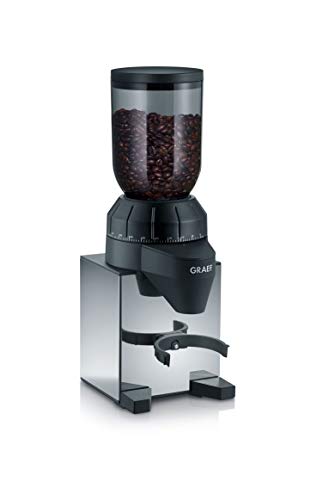
In the product photo, a round, transparent bean hopper with a black lid sits on a black grind ring with a printed scale. Below it comes the head with the outlet and the Graef lettering, and that rests on an angular base of bare stainless steel. At the front, the portafilter holder protrudes from the base as an open fork.
Graef describes the housing on the 2025 product page as stainless steel and aluminium, and in the 2021 version as a high-gloss stainless steel housing. According to the manufacturer, the bean hopper holds 250 g. To remove it, you hold the grind ring, press the hopper down and turn it anticlockwise. Graef mentions no sliding shutter like the CM800’s anywhere for the CM820, and after removal the manual has you transfer the remaining beans to an airtight container so the aroma is preserved.
Graef gives 190 × 130 × 362 mm (length, width, height), Amazon approx. 15.7 × 12.8 × 36.5 cm; we go by the manufacturer’s figure.
As the scope of delivery, the product page lists a ground coffee container, two portafilter holders, a filling funnel and a cleaning brush. The parts overview in the manual counts ten items: lid, coffee bean hopper, grind ring, ground coffee outlet, contact switch, cleaning brush, two portafilter holders, ground coffee container, and the switch with ON, OFF and Auto function.
In detail: conical burrs, 40 settings and a fine adjustment that needs a tool
In a conical burr set, a cone-shaped inner part turns inside a ring. The beans are broken at the top in the wide gap and ground ever finer on the way down, and the narrowest distance between cone and ring determines how fine the grounds end up. In the manual, Graef speaks of an upper and a lower burr. According to the product page, the conical burr is made of stainless steel.
According to Graef, this burr set manages with lower speeds than other burr sets. The product page describes the drive as a “Langsam laufender, aromaschonender 128 Watt Motor” (slow-running, aroma-preserving 128-watt motor). The usual reasoning for slow-turning burrs is that less frictional heat reaches the grounds.
You set the 40 grind settings on the grind ring. For espresso every single one of them counts, because there the machine forces water under pressure through a tamped coffee puck, and even small changes in particle size shift the flow time. With a pour-over dripper or in a French press the coffee bed is loose and the contact time long; a bigger jump matters less there.
In case the scale is not enough, there is a second way to adjust, the fine adjustment on the upper burr. You take it out (as for cleaning), remove the small screws with a screwdriver and turn the burr one position to the right for coarser or to the left for finer. Then the screws go back in and the burr back in its place. The manual advises initially adjusting by no more than two to three positions. Our assessment: this is a basic setting that you make once, not a control for every morning.
The burr set also includes an aluminium paddle wheel and an anti-static insert. According to Graef, both carry the ground coffee to the outlet after grinding. The background is the friction during grinding, which charges the particles electrostatically so that they cling to walls and edges instead of falling.
How does the CM820 grind straight into the portafilter?
According to the manual, you fit the large or the small portafilter holder, choose the grind size, hold the portafilter between the holder and set the switch to AUTO. As soon as you press against the contact switch, grinding starts by itself. Once the portafilter is sufficiently filled, you pull it back and the burrs stop.
The dose therefore varies with your hand. In the manual, Graef advises keeping tamping pressure and dosing constant and only adjusting the grind size to suit. Without a timer, in our view that leaves only a scale under the portafilter.
According to the manual, the small holder has a diameter of approx. 60 mm, the large one approx. 70 mm. Graef does not assign which portafilter belongs in which holder. The common figures of 51, 54 or 58 mm refer to the diameter of the basket, so the two sets of numbers cannot simply be laid side by side. We would measure your own portafilter on the outside of the rim before buying and, in case of doubt, ask Graef customer service.
For filter coffee and French press, you place the ground coffee container under the outlet and switch to ON; the grinder then keeps grinding until you switch back to OFF. How much ground coffee a pot needs is worked out by the brew calculator.
The manual gives no setting numbers per preparation method, only the direction: finer for espresso, medium for filter coffee, coarser for French press. Graef’s reason is that bean variety, room temperature, humidity and personal taste vary too much. The only number is setting 35, which the manual cites elsewhere as an example of coarse. How to approach your own value step by step is described in our guide Adjusting grind size.
CM820 or one of the other three?
| Model | The difference | Price | Our score | Pick this if |
|---|---|---|---|---|
| Graef CM820 (this one) | Contact switch, holders of approx. 60 and 70 mm, no longer listed by Graef | approx. €157 | 8.6 | there is little height free under the wall cabinet and you dose by scale |
| Graef CM800 | same basic technology with contact switch, 350 g hopper with sliding shutter | approx. €139.99 | 8.8 | you can fit the greater height and want to fill in more beans as a supply |
| Baratza Encore ESP | settings 1 to 20 graduated finely for espresso, dosing cup instead of contact switch | approx. €179.95 | 9.0 | you mostly pull espresso and accept the detour via the cup |
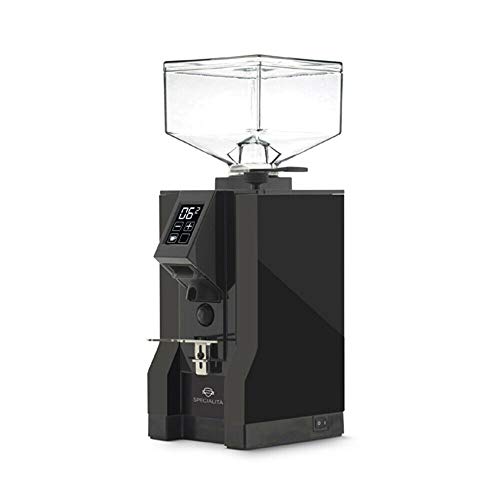
| Eureka Mignon Specialita | 55 mm flat burrs, stepless, two programmable doses | approx. €431.90 | 9.4 | you want to repeat every dose by time and have the budget for it |
The prices are guide values from our price boxes, as of September 2026, and may differ on any given day. Our score reflects our assessment of the manufacturer data; it is not based on measurement.
Which grinder suits your morning?
The obvious alternative comes from the same manufacturer. The Graef CM800 also grinds straight into the portafilter via a contact switch, according to Graef. At approx. €139.99 in our price box it is about €17 cheaper than the CM820, and its bean hopper holds 350 g. In return it is larger, Graef gives 230 × 135 × 397 mm. If space under the wall cabinet is tight, the CM820 gains you three and a half centimetres of height. Graef describes its housing as silver-painted aluminium, that of the CM820 as stainless steel and aluminium. We would reach for the CM800 today if the height fits, simply because Graef still has it in its range.
If every espresso is to start with roughly the same amount without a scale, you need a timer control. It repeats the grinding time, not the weight, so even then the amount stays only approximately the same. The Eureka Mignon Specialita stores two doses on its touch display, according to Eureka, and adjusts its 55 mm flat burr set steplessly. At approx. €431.90 it costs about €275 more than the CM820. Its portafilter fork is suitable for all standard portafilters according to the manufacturer, which also settles the question of fit.
For approx. €179.95, just under €23 more than the CM820, the Baratza Encore ESP comes into question if you pull almost only espresso and want small steps in the fine range. According to Baratza, its settings 1 to 20 are graduated finely specifically for espresso. It does not grind straight into the portafilter, though: the grounds fall into a dosing cup for 54 mm (with an adapter for 58 mm), which you turn over with the portafilter placed on top.
If you grind exclusively for filter and French press, you pay for the two holders and the AUTO position without ever needing them. For those preparations the ON position with the ground coffee container underneath is enough, and you do not use the fine steps in the espresso range either. Which price classes exist for grinders and when a hand grinder is enough is covered in our guide Coffee grinder guide.
Cleaning according to the manual
Graef justifies the care with the coffee itself: old coffee left in the appliance can oxidise and, according to the manual, lead to an unpleasant and undrinkable taste. Depending on use, you should therefore clean the grinder at least once a week, and before every cleaning you pull the mains plug.
You wipe the outer surfaces with a soft, damp cloth; for heavy soiling a mild cleaning agent is allowed. You clean the bean and ground coffee containers in warm water with a little washing-up liquid and then dry both well.
You remove the burrs like this: take off the bean hopper (see Design), turn the grind ring as far to the right as it will go, press the button marked PUSH and keep turning the ring. When the two arrows are aligned, lift off the grind ring together with the upper burr and take the upper burr out of the ring. You clean the upper and lower burrs with the brush supplied. Reassembly is in reverse order: grind ring arrow to arrow onto the motor block, insert the upper burr, turn the ring clockwise to the desired grind size, put the bean hopper on. You check that everything is seated at a coarse setting on the metal ring. If the burr can no longer be pulled out there, it is inserted correctly.
We would stick to what the manual specifies: water only on the two containers, only the brush on the burrs. What generally builds up in grinders and how often a thorough clean is worthwhile is covered in the guide Cleaning a coffee grinder.
Spare parts and customer service
For a model Graef no longer offers, parts supply matters most. Graef still sells the upper burr for €47.99 under item number 145355. When retrieved on 25.09.2026 it was available, and the compatibility list explicitly names the CM820 (CM820EU). It is the part you take out at every cleaning anyway and the one that carries the fine adjustment.
It is different with the lower conical burr. Graef lists it for the CM800, CM802, CM702 and CM900, among others; the CM820 is not on the list. Whether it fits anyway would have to be answered by customer service, whom according to the manual you can reach by email at service@graef.de.
Beyond removing and refitting the upper burr, you should not do any work yourself. According to the safety instructions, repairs may only be carried out by a specialist or Graef customer service, and during the warranty period exclusively by customer service. Defective components are to be replaced only with original spare parts, because only for these is it ensured that they meet the safety requirements.
What Graef does not state
Collected in one place: neither the product page nor the manual gives the diameter of the grinding cones, the speed, the noise level in decibels, the grinding rate in grams per second or the grinding time for an espresso dose, the amount left in the burrs, the capacity of the ground coffee container, the material of the containers and holders, voltage and frequency, the cable length, any cable storage, the country of manufacture and the year of market launch. For weight, Graef’s comparison table has only a dash for the CM820; Amazon gives approx. 1.0 kg. The 12 cups that the same table lists for the ground coffee container belong to the CM802 and CM900, not the CM820. On care, it is missing how the portafilter holders and anti-static insert are cleaned, whether any part may go in the dishwasher and whether cleaning tablets are allowed. It also remains open how far one position of the fine adjustment reaches in relation to one setting on the ring, why and since when the grinder has vanished from the Graef shop, and whether there is a successor model.
Who is it suitable for?
The manual designates the CM820 for household and similar use and gives as examples staff kitchens in shops and offices, farm houses, use by guests in hotels, motels and other residential settings, and bed and breakfasts.
With children in the household, clear rules apply, even though the 2021 product page still advertised the FAMILY LINE as “Kindersicher und kinderleicht” (child-safe and child-friendly). The manual is what counts: children must not use the appliance, the appliance and its cable must be kept out of their reach, and they should be supervised so that they do not play with the grinder. Persons with reduced physical, sensory or mental capabilities or with a lack of experience and knowledge may use it if they are supervised or have been instructed in safe use and understand the hazards. If you want the children in the house to grind their own coffee, the CM820 is therefore the wrong choice.
It is also the wrong choice if you want to automate the kitchen. According to the manual, the appliance is not intended to be operated with an external timer or a separate remote control, and a switchable Wi-Fi socket falls under that, as we understand it. The grinder is connected to a socket with a protective earth conductor; without one, operation is prohibited according to Graef, and in case of doubt a qualified electrician should check the house wiring.