Our price box lists the Emerio CME-122933 at approx. €22.99 on Amazon.de. Among the seven electric filter machines in the Filter Coffee & Pour-Over category it is the cheapest, and at 7.7 it also has the lowest overall score of these seven. In the Amazon catalogue the appliance stood at €24.99 when retrieved on 7 September 2026.
What is written here comes from four sources: Emerio’s product page for the CME-122933, the German user manual as a PDF, the manufacturer’s spare parts shop and the Amazon catalogue including the product photo. Two manual versions are on emerio.eu, and in the German section they have the same content. The manufacturer is Emerio B.V., based in Haarlem in the Netherlands. We have not handled the machine ourselves.
The model designation deserves a second look. Emerio’s category page for coffee machines lists five models, and only one of them carries this name, so the Amazon title can only match this appliance. For the revisions CME-122933.6, .7 and .9 there are manual PDFs on the manufacturer’s server, but the matching product pages return a 404. Everything that follows refers to the version without a dot number, because only that one has a product page that we can hold against the manual.
One switch, one jug, one wire filter
On page 11 of the German version, the manual numbers ten components: upper cover, base plate, on/off switch, water tank with water level indicator, jug, filter chamber, filter holder, reusable wire filter, jug lid and, as item ten, a drip protection function.
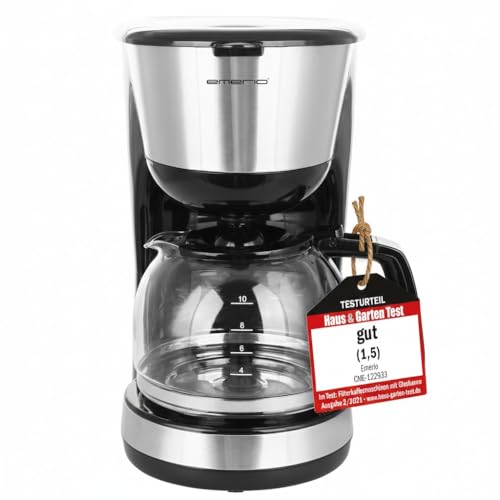
In the catalogue image the upper part is silver at the front and sides and carries the Emerio lettering. The lid on top, the area around the filter and the jug handle are black, and the base has a silver ring. The Amazon text describes this as a timeless design in black with stainless steel accents and lists the colour as black/silver, while Emerio’s own product page leaves the Color field at N/A. For the parts that touch food, the same page names BPA-free material.
The water tank carries the water level indicator, and the Amazon text speaks of an easily legible scale. The product page notes non-slip feet, plus the heating plate under the jug and the illuminated switch. Electrically, the appliance runs on 220 to 240 volts at 50 to 60 hertz and draws 1,000 watts. The manual requires an earthed socket, a check that voltage and frequency match the rating plate, and a level, dry, heat-resistant surface.
Wire filter instead of paper filter
Step 3 of the preparation is to place the reusable wire filter in the filter holder and put that into the tank. So the machine never needs paper. If the filter breaks, you can get it individually from Emerio’s spare parts shop, more on that in the section on care.
What separates a permanent filter from paper is pore size. Paper has an uneven fibre structure with very fine gaps and therefore holds back both the finest ground particles and part of the coffee oils. A woven permanent filter has regular openings, which in such filters are generally larger than the pores in paper. What passes through ends up in the jug: more dissolved oils and more fines. Two practical points follow from this. First, you need a slightly coarser grind than for paper, because fine powder would otherwise migrate through the mesh instead of staying on top. Second, pour out the last centimetres of a jug more carefully, because fines collect at the bottom.
1,000 watts, and what can be read from them
The power rating lets you estimate the heating time. Bringing 1.25 litres of tap water from 15 to 93 degrees takes around 0.11 kilowatt hours. A 1,000 watt heater delivers that energy in just under seven minutes. That is the theoretical floor, and everything the appliance loses to its surroundings comes on top. At 35 cents per kilowatt hour, a value we assume here for 2026, a full jug comes to around four cents of electricity, with keeping warm afterwards on top.
The power rating does not reveal the temperature at the coffee grounds, however. The manufacturer’s text in the Amazon catalogue promises full aroma development thanks to an optimal brewing temperature, but no figure in degrees appears either there or in the manual. For filter coffee, 92 to 96 degrees is the usual guideline. Whether the CME-122933 hits this window cannot be read from 1,000 watts: power says how fast the machine heats, and nothing about how precisely it regulates.
How long does the coffee stay hot?
40 minutes. According to the manual, that is how long the plate keeps the coffee warm, after which the appliance switches off and stops operating. It only becomes hot again if you flip the power switch by hand once more.
A warming plate keeps coffee hot by continuing to heat it. The finished coffee stands on a heating element instead of slowly cooling in an insulated jug, and as soon as the plate is off, the glass jug cools without insulation. If you want to drink the coffee hot after the shut-off, pour it into a thermal flask, which is not part of the scope of delivery here.
The plate is not cold straight away. The surface of the heating element still gives off residual heat after use, says the safety section of the manual. Emerio prescribes two steps for this: the jug should come off the plate about a minute after the last drop, and an empty jug does not belong on the hot warming plate. When pouring, the manual also warns against suddenly tilting the jug sharply, because hot coffee can run out at the edge of the lid.
What the manufacturer does not state
The most conspicuous gap is the size of the appliance itself. emerio.eu gives only the carton dimensions, and the values in the Amazon catalogue correspond, by calculation, to the retail packaging. The weight is similar: under Consumer Packaging the product page lists 6.4 / 7.36 and under Transportation Packaging 1.32 / 1.6, both without a unit, and the two rows look swapped, because a shipping carton does not weigh less than a single pack. The Amazon catalogue gives 2.87 pounds, so around 1.3 kilograms. A manufacturer’s appliance weight cannot be derived from this.
Three questions remain open on the components. What the drip protection function from the component list does is not explained anywhere in the manual, and the term does not reappear after page 11. What the wire filter is made of, whether stainless steel, nylon or coated plastic, and what its mesh size is, Emerio does not write anywhere, although how finely you can grind depends on it. Neither the manual nor the product page names a material for the housing either.
Also left open are the heat-up time and brewing time of a full jug, the temperature of the warming plate, the noise level, the cable length, the cup size behind the ten cups, a dosing recommendation in grams, the energy consumption, the country of manufacture and the year of market launch. None of the sources mentions a descaling indicator or a water filter, and the component list knows only the on/off switch as a control. On top of that comes a contradiction we cannot resolve: the Amazon text speaks of a removable swing-out filter with an integrated drip stop, while the manual describes a filter chamber and a filter holder without ever using the word swing-out filter.
And on the place of use: the manual permits household-like settings such as office kitchens and bed and breakfasts, but excludes commercial use. Where exactly the line between the two runs remains open in Emerio’s documents.
What else is worth considering?
| Model | The difference | Price | Our score | Pick this if |
|---|---|---|---|---|
| Emerio CME-122933 (this one) | Reusable wire filter, a single control | approx. €22.99 | 7.7 | you want to spend as little as possible |
| Braun PurShine KF 1500 | Paper filter no. 4 according to the manual instead of a permanent filter | approx. €29.00 | 7.9 | you would rather keep filter bags on the shopping list than rinse a sieve after every jug |
| Russell Hobbs Textures+ | Digital control with 24-hour timer | approx. €39.99 | 8.1 | you want the machine to start by itself in the morning |
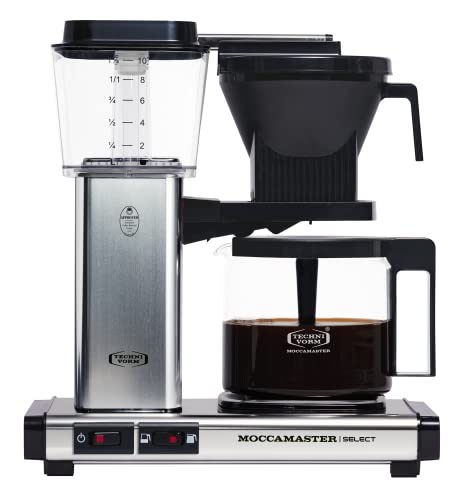
| Moccamaster KBG Select | Manufacturer states a brewing temperature of 92 to 96 degrees | approx. €259.00 | 9.5 | you want to get spare parts beyond jug and filter individually from the manufacturer |
The prices are the guide values from our price boxes, not up-to-the-minute offers. We assign the score in the fourth column editorially, and we have not measured anything on any of the four machines. That all parts are available individually from Moccamaster, according to the manufacturer, is stated on its product page for the KBG Select.
When the Emerio is enough and when you should keep looking
The first question is the quantity in one go. A full jug holds 1.25 litres, and between two runs the manual asks you to switch the appliance off for about five minutes. For two people at the breakfast table that is never an issue. In an office kitchen where eight people line up one after another and some bring a large mug, the second jug may only start after this break.
When do you get up, and should the machine start before that? The CME-122933 has one switch and nothing else. If you want to walk up to a finished jug in the morning, you need a clock in the appliance: the Russell Hobbs Textures+ has a 24-hour timer and costs 17 euros more.
The Braun PurShine KF 1500 costs 6 euros more and works with a paper filter.
How hard is your water? That determines how often you descale. The German Detergents and Cleaning Products Act (Wasch- und Reinigungsmittelgesetz) classes water above 14 degrees of German hardness (°dH, German degrees of hardness) as hard, and there you descale more often than Emerio recommends for average hardness. You manage the schedule yourself. How to find out your hardness is explained in the guide Water hardness and coffee.
At the top end of our catalogue stands the Moccamaster KBG Select, 236 euros more expensive than the Emerio. Spread over five years of daily brewing, that is around 13 cents extra per day. How Moccamaster backs the machine up is covered in the review of the KBG Select.
Our guide Drip coffee maker buying guide takes around 60 grams of coffee per litre of water as a starting point, so for the full jug of this machine that is 75 grams. For other quantities, the brew calculator does the maths for you.
Descaling, cleaning, spare parts
For routine cleaning the wording is unambiguous: “Never immerse the appliance in water or other liquids. Please clean the surface with a slightly dampened cloth.” Pull the mains plug and let the appliance cool down before every cleaning. Harsh or abrasive cleaning agents are ruled out, the cable should not be wound around the appliance, and the machine is stored dry and out of reach of children.
With average water hardness, descaling is done every three to four months with a standard descaler. How often it is really needed depends, according to Emerio, on the water hardness and on how often you use it. What limescale does inside a filter machine and how to spot it early is covered in the guide Descaling and cleaning.
For this model Emerio runs its own spare parts shop. Exactly two items are listed there: the glass jug and the coffee filter, as the shop calls it. The coffee filter is listed at 6.95 euros (retrieved 24 September 2026). For the lid, base plate or switch you will find nothing there.
If more than these two parts breaks, the route goes through customer service. For Germany the manual gives the number +49 (0) 3222 1097 600 and the address info.de@emerio.eu. According to the manual, a damaged mains cable may only be replaced by the manufacturer, its customer service or a similarly qualified person, and Emerio expressly forbids opening the housing yourself, because this can cause an electric shock. At the end of its service life the appliance does not belong in household waste but in the return and collection systems under the WEEE Directive 2012/19/EU (the manual writes “2012/19/EG”).
Area of use and safety rules
Emerio sets out the area of use in the manual itself. According to item 7 of the safety instructions, the appliance is intended for household use and similar settings, and as examples it names staff kitchen areas in shops, offices and other working environments, farms, use by guests in hotels, motels and other types of accommodation, and bed and breakfasts. Item 22 has to be read together with this: the appliance is not designed for commercial use.
In a household with children, the same manual draws a clear line. Children from eight years old may use the appliance if they are supervised or instructed and understand the hazards. Cleaning and maintenance by children likewise only from eight and only under supervision. For everyone younger, keep the appliance and its cable out of reach. Emerio forbids removing the upper cover during brewing cycles because of the risk of scalding, and during operation only handles and knobs are to be touched.
Two conditions from the same safety section matter mainly for second homes and workshop kitchens. An extension cable must be suitable for the power consumption of the appliance, otherwise it can overheat, and the machine must never run unattended while in operation. Anyone who places it at the end of a corridor and runs the cable across the room is working against the manual.
Two more prohibitions from the manual belong here. Only water goes into the tank and no other liquid, and the appliance must never run empty. The jug is built for this machine and must never be used on a hob.