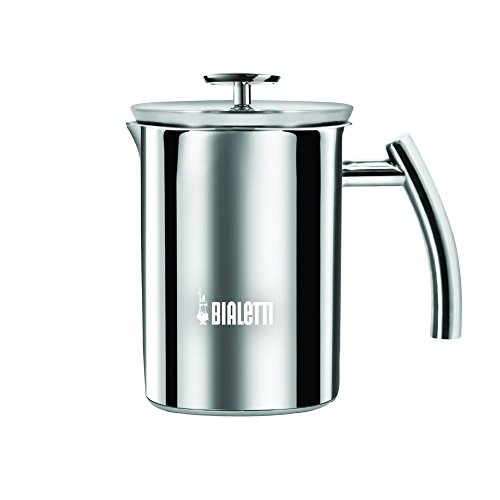
The Bialetti Cappuccinatore has no plug. It is a stainless steel jug with a frothing rod in the lid: you heat the milk on the hob, take the jug off and pump air into it by hand. In our comparison of milk frothers that makes it a special case, because most of the others there stand on a heating base.
Our price box lists it at approx. €35.58 on Amazon.de; the Amazon catalogue gave €35.61 when queried on 7 September 2026. Bialetti sells the model under item number 0003990, Amazon lists part number 4420 for it and gives 25 May 2016 as the release date. The operating instructions, which Bialetti provides as a PDF, are the 01/2017 edition and are set in six languages: Italian, English, French, German, Spanish, Russian.
We have not handled the jug, and we have not frothed any milk with it. What is written here comes from these instructions, from Amazon’s catalogue data and from the product photo.
Jug, lid, frothing rod
The photo shows a round, straight body with a mirror-polished surface. On the left a pouring lip is drawn out of the rim, on the right sits the handle, which attaches at the top of the body and runs free downwards. On top lies a flat lid with a short rod and a round knob rising from its centre. On the front is the Bialetti lettering with the little man.
For the housing, the Amazon text says stainless steel. For the part in the lid, the names change: the instructions speak of a stirring rod and later of a frothing rod with double disc, the Amazon text of a patented double whisk. Each time the rod with two discs is meant, which you move through the milk by the knob; in the photo it sits inside the body.
Converted, the Amazon catalogue gives about 18.5 centimetres in height, 15.0 centimetres in length and 12.0 centimetres in width. Bialetti itself does not confirm these values anywhere. They are overall dimensions, and the photo shows what is inside them: in the length the handle and pouring lip count, in the height very probably the knob. A body diameter cannot be read from them, and we certainly do not calculate a volume from these figures. The weight in the same data set, converted about 46 grams, is implausible for a stainless steel jug with lid and rod. We leave it out.
The procedure according to the instructions
The instructions have seven steps. We give them in full because hot milk and hot metal are involved in three of them:
- Fill the Cappuccinatore with milk up to one third of its capacity.
- Place it on a suitable heat source. A gas flame is turned low so that it does not reach beyond the edge. Electric hotplates and ceramic hobs are set to medium heat. On induction the jug goes on a zone suitable for the size of the base.
- When the milk is hot, take the jug off the hob and place it on a smooth, non-slip, heat-resistant surface. It is held by the handle, because the body of the container can be hot, and with oven gloves.
- Insert the lid without forcing the frothing rod into the milk. Move the knob up and down vigorously while holding the handle firmly, again with oven gloves. Marked with CAUTION: anyone who uses excessive force while frothing risks hot liquid escaping from the container.
- Thanks to the double disc, 10 seconds are enough for a good milk cream, according to Bialetti.
- If you wait a few seconds before pouring, the cream becomes firmer. If you keep whisking, all the milk turns into cream.
- Remove the rod and pour the cream into a cup or glass, using a spoon as an aid so that the consistency is preserved.
Under the heading Advice follow two more sentences. The empty container should not be overheated and the heating should be supervised, and the frothing rod stays out during heating. The lid therefore only goes on the jug after the hob.
That Bialetti calls for oven gloves twice despite the handle, we read as a hint that the handle can get warm too. It attaches directly to the body, and a part connected to hot metal takes heat with it.
In detail: what happens in the milk while pumping
A pump jug works purely mechanically. When you pull the rod up, air from the surface gets under the milk level. When you push it down, the milk has to get past the discs or through them, and large bubbles break into smaller ones. Two discs mean two such passes per stroke. In our reading, that explains why Bialetti expressly attributes the short preparation time to the double disc.
Why hot milk at all? Froth becomes stable thanks to the milk protein: it settles at the boundary between air and liquid and forms a thin skin around each bubble. Warm milk froths up more easily than cold. It still must not get too hot. Our guide to frothing milk sets the limit at 60 to 65 degrees, because above that the taste tips into cooked. A thermometer with a clip on the rim saves you the guesswork.
Step six is also explained by physics. In standing froth, liquid milk drains downwards between the bubbles, leaving drier, firmer froth on top. If you want a thick cap for a latte macchiato, you therefore let the jug stand briefly; if you want runnier froth for a cappuccino, you pour straight away. The spoon from step seven holds back the firm layer while pouring until the liquid milk is in the cup, and then lays it on top.
How much milk fits in one filling?
Bialetti gives 330 ml of milk as the capacity and promises froth for 6 cups, also as a pictogram on the cover of the instructions. According to the instructions, though, you should only fill to one third of the capacity. How the two fit together, Bialetti does not explain.
Two readings are conceivable. If the figure means the total volume of the jug, about 110 ml of milk would go in, and the six cups would refer to the froth, which takes up a multiple of the volume when whisked. If, on the other hand, it means the amount of milk itself, it does not fit the one-third rule. We consider the first reading the obvious one, but it is not certain.
The size entry in the Amazon catalogue makes it rather more confusing: there the size is given as 3 cup, that is three cups, while the Amazon bullet text and the instructions show six.
For your planning that means: do not expect the full nominal quantity to end up as warm milk in the cup. How many cappuccinos one filling yields depends on your cup size and on how much liquid milk you want under the froth. We do not set a cup count of our own against it.
Induction: why we do not follow the Bialetti product page
On the German Bialetti page for item number 0003990 there is a product text that does not fit this model. It describes a non-stick inner coating and lists gas, electric and ceramic as hob types, excluding induction. The French version and an Estonian-English version carry the same text. The Italian page for the same number shows something different again, namely the text of the glass model and a data sheet with borosilicate glass, 1000 ml and a note that the vessel is not suitable for heat sources.
Against that stand three pieces of evidence. The Amazon title expressly says “also induction”, and a bullet point below it names all surfaces including induction. And the instructions, to which both country pages themselves link and whose PDF title is cappuccinatore_acciaio_TR, describe the induction zone in step two. The German page text fits the Tuttocrema in substance, a frother made of aluminium that Bialetti excludes for induction.
We follow the instructions because they are the document for the stainless steel model. It remains tricky all the same: anyone who reads up on bialetti.com before buying finds the opposite of what Amazon and the instructions say.
On 24 September 2026 these pages showed a shop price of €25.90 in the German and €42.90 in the Italian Bialetti shop.
Cleaning, coating, storage
Before use, the jug should be cleaned with water and soap. That is the first of six points that Bialetti lists under precautions. The other five, in the order of the instructions:
- Marks on the metal do not impair functionality according to Bialetti and can in some cases be removed: immerse the jug in hot water with washing-up liquid and rub carefully with a soft sponge, ideally a washing-up sponge made of natural cellulose. For stubborn stains, heat white wine vinegar and then clean the jug normally. Which marks are meant remains open in the German text, because the sentence before it is missing (more on this in the questions below).
- To avoid oxidation, dry all parts well before putting them away. The German section says “old parts”, the English one says all parts; obviously the same thing is meant.
- Not suitable for storing food and not for the fridge.
- In capital letters: no steel wool or abrasives for cleaning.
- Also in capital letters: keep out of the reach of children.
The actual cleaning section has four points. The jug should cool down before washing up, and abrasives or aggressive chemicals are excluded. You clean the frothing rod after every use. The dishwasher is permitted, but Bialetti recommends washing by hand to keep the properties of the coatings unchanged. And for longer durability the jug should be stored carefully, without knocks or scratches to the inner coating.
Which coating? The German and Italian versions speak of coatings (rivestimenti) and an inner coating. The English version says outer materials and outer surface in the same places, so it means the outside. Whether the jug is coated inside therefore cannot be said with certainty from the instructions. We would treat it as if it were: soft sponge, no metal cutlery for scraping out, and dry the mirror-finish outside straight after washing so that no limescale rings remain.
What Bialetti leaves open
Collected in one place so that the rest of the text stays readable. Missing from the instructions and the Amazon text are:
- dimensions from the manufacturer, that is height, body and base diameter
- a plausible weight
- the material of lid, knob, frothing rod, double disc and handle
- a clear statement on whether and where the jug is coated
- a milk temperature in degrees
- the usable milk quantity in millilitres
- the smallest suitable size of induction zone
- information on plant-based drinks, cold froth or microwave use for the stainless steel model
- a country of manufacture
- the scope of delivery beyond jug and lid with rod
- a descaling procedure
- the patent number for the double disc
- a number of strokes or a pace, beyond “vigorously up and down”
What else is worth considering?
Two of the three alternatives have a plug, one is an even simpler pump beaker. All figures come from our own data sheets.
| Model | The difference | Price | Our rating | Choose this one if |
|---|---|---|---|---|
| Bialetti Cappuccinatore (this one) | Stainless steel jug that goes on the hob itself, according to the instructions also on induction | approx. €35.58 | 8.1 | you boil coffee on the hob anyway and do not want an appliance with a cable |
| COVVY manual milk frother 400 ml | Stainless steel pump beaker with double strainer, the catalogue says nothing about heating on the hob | approx. €12.99 | 7.7 | you heat the milk in a microwave or pan and only want a beaker for pumping |
| Philips SENSEO Milk Twister CA6500/60 | electric on a heating base with one button, 120 ml of milk according to Philips | approx. €39.00 | 8.4 | you do not want to occupy a hob zone and froth for two cappuccinos is enough |
| Severin SM 3587 Induktion | 13 programmes, temperature adjustable from 45 to 65 °C according to Severin | approx. €114.00 | 9.4 | you make several milk drinks a day and do not want to hit the temperature yourself |
The prices are the guide values from our price boxes; the rating is our editorial assessment based on the documented data and not a measurement result. How fine the froth from each appliance turns out is not shown by this table, because we have not used any of them.
When the hob jug, when an appliance with a base?
Most in favour of the Cappuccinatore is the case where your coffee is already made on the hob, for example in a Bialetti Moka Express. Then the milk stands on the hob zone next to it, and you need neither a socket nor space for a base on the worktop. The price is a second occupied hob zone at which you stay standing.
This is exactly where the argument for the Philips Milk Twister lies. It costs approx. €39.00, so a good €3 more, runs at the press of a button and switches itself off automatically according to the Amazon text. In return it holds 120 ml according to Philips, and on the dishwasher Philips’ own documents contradict each other. If you pull the espresso on the side in the morning and do not want to stand at the hob, you are better served by it in our assessment.
If you make several milk drinks in a row every day or want to set the temperature as a number instead of estimating it, little gets past the Severin SM 3587 in our comparison. It costs about €78 more than the Bialetti jug and has cold as well as warm froth in its programme.
The COVVY beaker is just under €23 cheaper but needs a second pan or a microwave for heating. If you heat the milk in the microwave anyway, it saves you the detour via the hob.
And then there is a group for whom the Cappuccinatore is the wrong purchase: anyone who owns an espresso machine with a steam wand already has a tool for milk froth, and one that heats the milk while frothing it. For these kitchens a milk jug is the more sensible addition. In our catalogue, for example, there is the De’Longhi milk jug DLSC060 for approx. €16.99.


