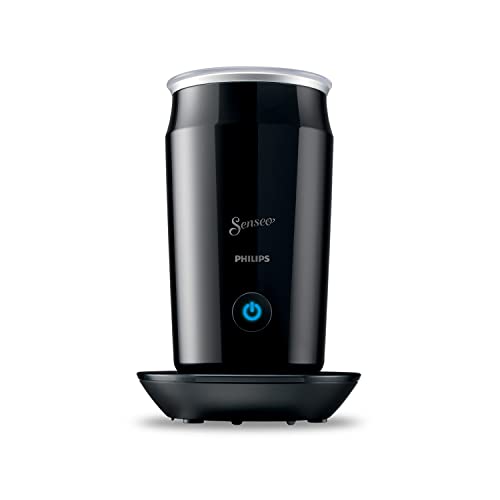
The SENSEO Milk Twister CA6500/60 is a black milk frother from Philips whose jug stands detachably on its own base. It froths milk hot or cold and can also just heat it. Our reference price is approx. €39 (as of September 2026), the price the Amazon.de catalogue showed on 7 September. Of the 16 devices in our milk frothers category, five are cheaper and the other ten more expensive.
The information here comes from manufacturer documents and the Amazon listing. The data sheet for the CA6500/60 carries a publication date of 3 August 2026. The German operating manual has the number 4222.200.0627.7 and dates from 2016; like the support articles on the home.id service platform, it applies to the whole CA6500 type series, not expressly to the /60 variant. In addition there are the EU declaration of conformity of 10 January 2024 and a safety sheet in English and Chinese. Nobody on our team has handled the Milk Twister, and where the sources contradict each other, the text says so.
When the Milk Twister came onto the market cannot be determined clearly from the data. The 2016 manual is set against two later dates: the declaration of conformity gives December 2020 as the month in which the CE mark was affixed to the CA6500 type, and Amazon lists 3 January 2021 as the release date.
Jug, base and a coil with many names
The manual speaks of the heating base, milk jug and lid, plus the whisk coil, which sits on a holder. The other texts use different words for the coil: in the support articles it is called the metal whisk and in one place the metal beater, on Amazon a whisk or magnetic frothing attachment. According to the drawing on page 1 of the manual, you turn it at the holder and pull it off downwards.
In the product photo, the button with the power symbol sits at the front of the round, black jug, beneath the Senseo and Philips lettering. Below it is a flat base that projects beyond the jug on both sides. So the controls belong to the jug, and fittingly the manual mentions contacts on its underside (more on that under cleaning). Amazon describes the base as a cordless 360° pirouette base. You lift the jug off to pour and put it back in any rotational position.
The data sheet gives 12.8 centimetres length and width at 19.4 centimetres height, and the weight is 0.79 kilograms. Because the base is the widest point in the photo, the 12.8 centimetres belong to it. How wide the jug itself is cannot be derived from that figure. According to the data sheet, the main material is plastic.
Electrically, the data sheet gives 420 to 500 watts at 220 to 240 volts. According to the manual, the Milk Twister is only to be connected to an earthed socket, and for safety reasons it rules out a transformer. According to the data sheet it is made in China, and it carries the Philips name under licence. The EU declaration of conformity names DAP B.V. in Drachten, in the Netherlands, as the manufacturer.
Hot foam, cold foam, hot milk
Before first use, according to the manual, you rinse the milk jug, lid and whisk coil with hot water and dry all the parts. The drawing shows the rest in five steps: plug in, remove the lid, fill milk up to the MAX mark, put the lid on, press the button. Inside the jug there is also a minimum mark, which according to the support article you should always fill above so that the foam works.
You decide which preparation runs with the one button. Pressed briefly (the drawing shows 1 second for this), it makes hot milk foam. If you hold it for 3 seconds, the Milk Twister froths cold. For hot milk without foam, you first take out the whisk coil and then press as usual. According to the data sheet, frothing takes 130 seconds, and according to the Amazon text the device switches itself off automatically.
One sentence from the warning chapter of the German manual does not fit with this: “Do not remove the whisk coil, as this may cause damage.” According to our research, the English version words this passage differently: there it is about the coil holder, which is meant to stay on the spindle (coil holder). That the coil itself is removed is shown by the drawing and the support article.
Before lifting the jug off the base, according to the manual you make sure the device has switched off. If you pour straight after heating or frothing, the bottom of the jug is hot.
Not all of the milk turns into foam in the process. The troubleshooting considers this normal and explains it as a balanced ratio of milk to milk foam: you mix the liquid remainder with the coffee, and the foam goes on top as a crown.
In detail: how hot the milk gets and why
The one-button operation does not provide for temperature selection; according to the data sheet, the Milk Twister regulates temperature and speed itself. How hot the milk gets is, of all places, in the troubleshooting, under the problem “The milk is not very hot”. Philips answers there that this is normal. The milk is heated to approx. 74 °C to obtain the best foam and flavour. If it is heated too much, according to the manual the milk proteins break down and burn.
The whey proteins of milk, above all β-lactoglobulin, unfold in strong heat and expose sulphur-containing groups as they do so. This produces volatile sulphur compounds, which are behind the typical cooked taste of strongly heated milk. The foam needs proteins too: whey proteins and caseins attach to the surface of the air bubbles and stabilise them. Fat components, above all free fatty acids, displace them from there and make the foam less stable. That fits Philips’ milk recommendation: in the manual it is low-fat cow’s milk from the fridge, in the support article semi-skimmed cow’s milk at fridge temperature, and as an example of an influence on the foam the manual names the protein content.
Our own guide How to froth milk draws the line lower and advises not taking milk above about 65 degrees. On the Severin SM 3587, according to Severin the temperature can be set between 45 and 65 °C. So Philips heats around 9 degrees above both upper limits.
The manual also mentions a thermostat, and it explains a waiting time. As long as the jug is hot, it does not allow a new run, and the light in the button then flashes. For hot foam or hot milk straight afterwards, Philips requires a cooling pause of a few minutes. It is quicker if you rinse the inside of the jug with cold water. The same flashing appears when the milk you have poured in is already too warm; the manual then advises cold milk or letting the device cool down.
Are 120 millilitres enough for two cappuccinos?
According to Philips, yes: with a capacity of 120 millilitres, the milk foam is enough for two cappuccinos. For a latte macchiato, one filling is, by the guide values in our guide, enough at most for the lower limit, yet Philips lists it among its recipe suggestions anyway.
Each cup gets 60 millilitres of milk, of which part stays liquid. The table in our guide to cappuccino, latte and flat white gives 60 to 100 millilitres of milk per cappuccino, so two cups from one run correspond to the Nespresso recipe at its lower limit. Anyone who calculates with 100 millilitres, like INEI, Lelit or De’Longhi, gets only one cup from 120 millilitres. For a latte macchiato the same table gives 120 to 150 millilitres: the 120 millilitres from the manual of the Nespresso Aeroccino 4 only just fit in the Milk Twister, the 150 millilitres from the Nespresso recipe no longer do.
For three or four cappuccinos you fill twice. Two hot runs together take a good four minutes, with the cooling pause from the detail section in between. If you regularly need four cups in the morning, plan this pause in; with two people it falls away.
Dishwasher or hand wash: Philips contradicts itself
The operating manual is the strictest. Its cleaning chapter reads: “Do not immerse the heating base, the milk jug and the lid in water or other liquids. Do not clean them in the dishwasher either. Never use sharp-edged objects, scouring pads, abrasives or aggressive liquids such as petrol or acetone to clean the appliance.” In the danger notice at the start of the same manual only the heating base and milk jug are named, and in the English version of the cleaning chapter, according to our research, it is likewise only these two parts.
The data sheet, Amazon text and support article read more generously. The data sheet for the CA6500/60 has the line “Dishwasher-safe: Yes”, with no indication of which parts are meant. It describes cleaning as rinsing with clear water, made possible by the non-stick coating and smooth surface, and it calls the housing waterproof. The Amazon text says the whisk and lid are dishwasher-safe. The support article on home.id separates most precisely: you rinse the milk jug under the tap with hot water, the metal whisk, spindle and lid likewise, “or clean all parts in the dishwasher”.
Unaffected by this is a warning about the electrics: “Make sure that no water or damp cloth comes into contact with the contacts on the heating base and on the underside of the milk jug.” According to the manual, you always pull the plug before assembling, taking apart or cleaning the device, and likewise when leaving it unattended.
We follow the manual because it casts the prohibition widest: the English-language safety sheet also excludes the base and jug from the dishwasher, and only the German manual excludes the lid. A lid cleaned too cautiously costs less than a damaged one. So we would not put the lid in the dishwasher but, as the support article describes, rinse it under the tap with hot water without immersing it. You rinse the jug only on the inside; the underside with the contacts stays dry. We would not rely on the waterproof housing from the data sheet here. For the whisk coil, the support article and Amazon text allow the dishwasher, and the manual does not exclude it anywhere.
Care must still not become careless. Thorough cleaning is “extremely important” for reliable performance and good milk foam, says the manual, and the support article advises taking the parts apart regularly.
Milk Twister or one of the other three?
| Model | The difference | Price | Our rating | Choose this if |
|---|---|---|---|---|
| Philips SENSEO Milk Twister CA6500/60 (this one) | Fixed temperature, not selectable | approx. €39 | 8.4 | you froth for two cups at most, using cow’s milk, and want to spend the least |
| WMF Stelio | Housing, according to WMF, in Cromargan stainless steel instead of plastic | approx. €45.99 | 8.6 | a stainless steel housing matters more to you than the lowest price |
| Nespresso Aeroccino 3 | Same 120 ml of milk for frothing, according to Nespresso 9 cm diameter and 450 g | approx. €79 | 8.4 | your worktop space is very tight |
| Severin SM 3587 | 13 programmes with selectable temperature | approx. €114 | 9.4 | you froth soya drink or lactose-free milk, or want to set the temperature yourself |
The prices are the reference values from our price boxes, and the rating is our editorial assessment of the manufacturer’s information and is not based on any measurement. The individual ratings of the Milk Twister are in the overview further down the page.
When the Milk Twister is enough and when another frother is
For three cups in a row, by our calculation even the WMF Stelio is not enough: its MAX mark for frothing is, according to the WMF manual, at 150 rather than 120 millilitres. Anyone who froths for four people every morning gets more milk into one run with the Severin SM 3587: according to the Severin manual it froths up to 350 millilitres of milk, but costs around €75 more. A second round straight afterwards is not something Severin provides for, though; the device must first cool down and be cleaned.
With plant-based drinks, things get thin. The Severin SM 3587 has its own programmes for cashew milk, soya milk and lactose-free milk, although oat is missing from Severin’s list too.
For tight worktop space, the Aeroccino 3, at a diameter of 9 centimetres according to Nespresso, is the slimmer choice, but with the same 120 millilitre frothing volume it costs around €40 more. For where to put it, the English-language safety sheet contains a sentence the German manual does not have: while in operation, the Milk Twister should not stand inside a cupboard.
The manufacturers also differ on rinsing. WMF does not provide for the Stelio jug even under running water, and for the Aeroccino 3 Nespresso rules out immersion and the dishwasher. Severin, by contrast, expressly allows the dishwasher for the milk container, stirring inserts and lid of the SM 3587. If you want to put the milk container in the dishwasher in the evening, the table offers an approval only with the Severin, which no other manufacturer source contradicts.
What running it costs and what Philips leaves open
Running costs arise almost only through milk and electricity. As a rough estimate: taking the highest power figure over the full frothing time of 130 seconds, that is around 18 watt-hours per frothing run, and with two runs a day around 13 kilowatt-hours a year. Filters or descaler appear nowhere in the manual; the only care it knows is cleaning.
Philips sells spare parts and accessories, according to the support article, in its own online shop, with the addition “where available”. The article speaks in general terms of parts for the SENSEO coffee machine; we reached it via the type number CA6500. The manual also refers to Philips retailers and the service centre in each country. For the base this matters particularly, because according to the manual the Milk Twister may only be used with its own heating base. A defective mains cable may only be replaced by a Philips service centre, a workshop authorised by Philips or a similarly qualified person, using an original replacement cable. According to the manual, a worn-out device never belongs in normal household waste if it bears the disposal symbol shown there: then the European Directive 2012/19/EU applies, and the local rules on separate disposal of electrical appliances count.
After the data sheet, manual, support articles and Amazon listing, it remains open how long the mains cable is, how loud the Milk Twister is, how much power it draws when switched off, how the heating base warms the milk (induction or heating element) and whether there is a motor in it. Equally open are the temperature of the cold foam, separate running times for cold foam and hot milk, a minimum quantity in millilitres, a different maximum quantity for heating without foam, the time of the automatic switch-off, the type and position of the non-stick coating, the material of the inside of the jug, a permitted dishwasher temperature, and article numbers and prices for the coil, lid or base.
Where the manual draws limits
According to the manual, children from 8 years of age can use the Milk Twister “if they are supervised during use or have been given instructions on safe use of the appliance and understand the hazards”. The same condition applies to people with reduced physical, sensory or mental capabilities or a lack of experience and knowledge. Children may clean and maintain the device only if they are older than 8 and supervised, and they must not play with it. The device and cable belong out of the reach of children under 8 years.
Philips draws the field of use more narrowly than WMF. The manual says: “This appliance is intended for private household use only. For example, it is not intended for use in staff kitchens of shops, offices, farms or other work environments. Nor is it intended for use in hotels, motels, bed and breakfasts or other hospitality settings.”
For the office coffee corner or the breakfast buffet of a guesthouse, the Milk Twister is therefore the wrong purchase. According to its manual, the WMF Stelio is expressly intended for kitchens for staff in shops, offices and other commercial areas, for farmhouses, for guests in hotels, motels and other residential establishments, and for bed and breakfasts; WMF excludes only purely commercial use.