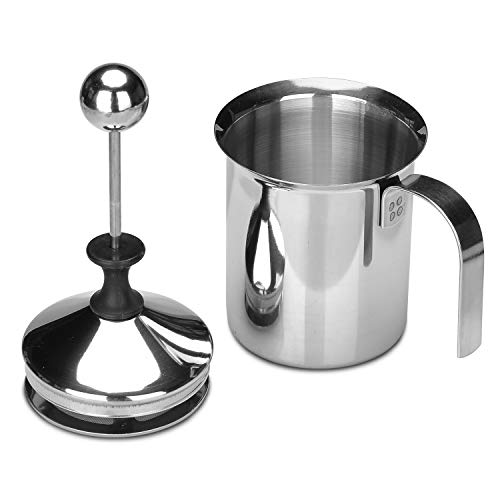
A stainless steel jug and a lid with a rod and ball knob running through it: there is no more technology in the COVVY milk frother than that, and it is operated by hand. You move the rod up and down, a double sieve beats air into the milk, and it does not get noticeably warm in the process.
Our price box lists it at approx. €12.99 on Amazon.de. When we retrieved it on 7 September 2026, the Amazon catalogue gave a price one euro lower, €11.99. In our milk frother category no device is cheaper. The details on the jug itself come from the catalogue entry for ASIN B072Z8FB9P and from the product photo there, and the search for a manufacturer website was our own research. We have not held it in our hands, and we have not frothed any milk with it.
What the catalogue and photo reveal about the jug
On the material, the listing text has half a sentence: “Es ist aus Edelstahl, sicher zu essen” (it is made of stainless steel, safe to eat). The catalogue adds the colour silver, the model number TRTA11A and the part number TRTAV11A.
The photo shows the jug taken apart. On the right stands the body, a round, almost straight beaker with a mirror-polished exterior. The handle is a flat, curved metal band. At the top it sits on a small plate with four round dots, which we read as rivets, and at the bottom it runs out freely without touching the body a second time. On the left lies the lid, domed like a shallow bell. A thin rod with a metal ball as a knob protrudes from its centre, and where it passes through the lid there is a black guide piece. Under the lid rim another disc can be made out. Whether those are the sieves, the photo does not show. On pump jugs of this design they usually hang at the lower end of the rod.
The listing text calls the whole thing a lever and describes the operation in one sentence: pull the lever up and down for about 30 seconds, then the froth is ready.
The sources contradict each other on the dimensions. The listing text says 18.7 x 13.2 x 9.8 cm, without saying which number is height, width or depth. The catalogue fields give 6.89 inches of height and 3.54 inches each for length and width, converted roughly 17.5 and 9.0 centimetres. As an overall dimension that cannot be right for a jug with a side-projecting handle, since the handle clearly stands out beside the body in the photo. Perhaps the line only captures the beaker, perhaps it is rounded. The numbers in the listing text, in turn, are in our reading overall dimensions that include the handle and possibly the rod. The listing text gives the capacity: 400 ml.
In detail: what the double sieve does to the milk
A pump jug works like a small French press that you move faster. On the upstroke, air from the surface gets under the milk level. On the downstroke the milk has to pass, together with this air, through the fine mesh, and large bubbles break into many small ones in the process. A second sieve means a second pass per stroke.
Easier and faster than what, the only performance claim in the listing does not say, but it probably aims at exactly this double pass: “Doppel Mesh macht Schlagsahne Milch einfacher und schneller” (double mesh makes whipping milk easier and faster).
For the hand, a simple rule follows from the principle. Short strokes just below the surface draw in a lot of air, the milk rises, and the bubbles stay large. Long strokes deep in the milk, where the sieve does not reach the surface, bring in hardly any new air; they mainly break up the bubbles that are already in the milk. If you start with the short ones and finish with the long ones, in our assessment you get a finer froth than with uniform pumping. The seller’s time figure serves as a rough framework.
After the last stroke a short pause is worthwhile. In standing froth, liquid milk drains downward between the bubbles, and firmer froth stays on top. For a latte macchiato with a high cap you therefore wait a moment, for a cappuccino you pour straight away. Individual large bubbles on the surface burst if you tap the jug once or twice briefly on the worktop.
Is a hand pump enough for a cappuccino?
For cappuccino and latte macchiato, the two drinks in the product title, it is enough from our point of view. For latte art, rather not. That needs glossy, free-flowing microfoam, and a steam wand produces it most reliably because it rolls the milk in a vortex.
With a latte macchiato the layering is intended: milk at the bottom, espresso in the middle, the froth crown on top. For the cappuccino, our guide to coffee drinks cites Nespresso for roughly equal parts espresso, hot milk and froth. You can hit this ratio with a hand pump too. The table there puts 60 to 100 millilitres of milk per cappuccino, depending on the source. The roughly 130 millilitres that we derive in the FAQ from the Bialetti instructions are enough, by the Nespresso recipe with 60 millilitres, for two cups, and with 100 millilitres for only one.
Which milk is suitable is covered by our guide How to froth milk. Whole milk with 3.5 percent fat gives the more stable froth there; low-fat milk froths up to too much volume more easily but collapses faster. For a pump jug that means: with low-fat milk the froth rises faster, with whole milk it lasts longer.
Warm or cold: what the jug does to the temperature
The jug does not heat; in the photo there is neither a base nor a cable. The froth therefore only becomes warm if the milk goes into the jug already warm, and for that the frothing guide sets the upper limit at 60 to 65 degrees; above that the taste tips into cooked.
An item of information you would need is missing here: which temperature the jug, sieves and the black guide piece tolerate is documented nowhere. The product title does mention cappuccino and latte macchiato, two drinks usually made with warm milk. That is still not an approval for hot milk. We would therefore not pour boiling milk in and would stay with the limit from the guide, which is also the right one for the froth.
Per portion that makes three steps: heat the milk, pump, rinse two vessels. For one cup at the weekend that is no effort. If you make two milk drinks in a row in the morning, you stand at the hob twice, or you warm both portions at once and froth them separately.
Cold needs no detour. Milk from the fridge goes straight into the jug, for an iced coffee with a froth cap, for example.
What COVVY leaves open
No manufacturer presence can be found. At covvy.com there is a page where the domain itself is offered for sale, with a contact form for business enquiries. The search for brand and model number leads to Amazon and to retailers. In the catalogue the record gives BLUEMANGO as the manufacturer, not COVVY, and how the two are connected is not documented.
That leaves a long list open, and we set it out once in full: instructions with notes on safety, cleaning and intended use; whether jug, lid and rod may go in the dishwasher; whether warm milk may go in and up to what temperature; whether the jug may go on the hob or in the microwave; a maximum fill quantity for frothing and a fill marking; the material of the lid, handle, rod, sieves and the black guide piece; the grade of stainless steel; whether the rod can be taken apart and the sieves are removable; whether there is a spring in the mechanism; froth volume and pore size; suitability for plant drinks; warranty and spare parts such as sieves or seals; the scope of delivery; the country of origin and the year of market launch.
On food contact there is only the “sicher zu essen” (safe to eat) from above, without a standard and without a certification note. Anyone selling items with food contact in the EU must in any case ensure, under Regulation (EC) No 1935/2004, that they do not release substances to food in quantities that endanger health. A certification note would have been the simplest proof of that, and its absence does not mean the jug fails the requirements. The word “langlebig” (durable) in the listing text likewise stands without evidence.
What are the alternatives to the hand pump?
| Model | The difference | Price | Our rating | Choose this one if |
|---|---|---|---|---|
| COVVY Manual Milk Frother 400 ml (this one) | Hand pump without heating, needs neither power nor battery | approx. €12.99 | 7.7 | you want to froth without a socket or first want to find out whether you will drink milk froth regularly |
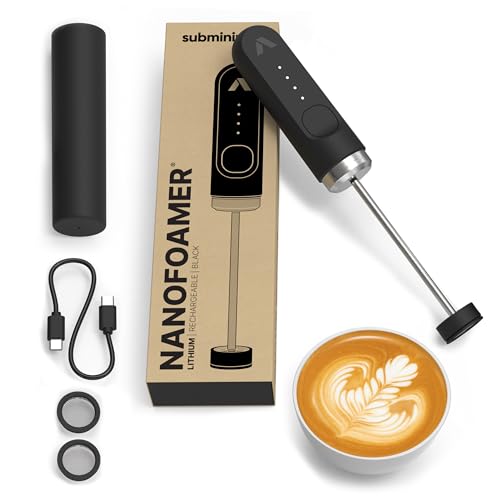
| Powerlix Pro 3-in-1 Handaufschäumer | Battery whisk with USB-C charging, froths directly in the cup | approx. €19.99 | 7.8 | you mostly froth a single cup and charging does not bother you |
| Bialetti Cappuccinatore | Pump jug that, according to the Bialetti instructions, may go on the hob, including induction | approx. €35.58 | 8.1 | you warm the milk on the hob anyway and want one vessel fewer to wash |
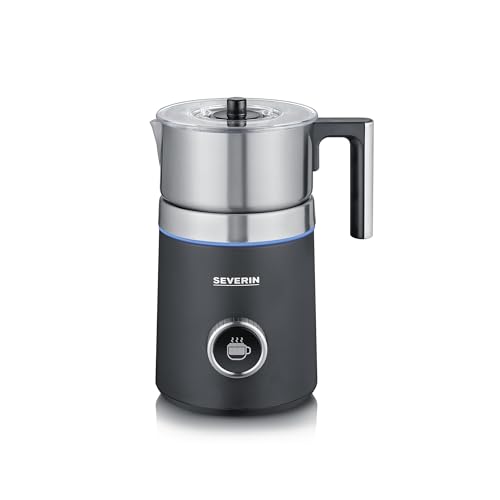
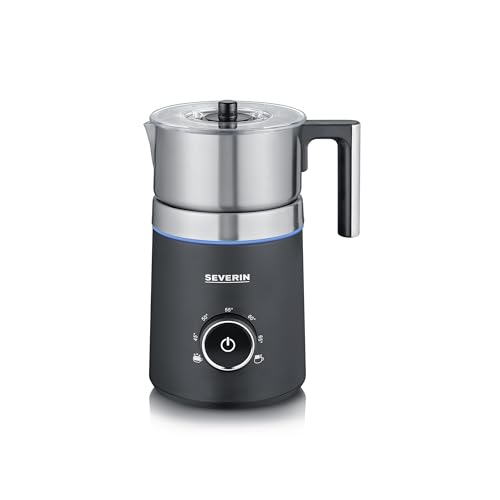
| Severin SM 3587 Induktion | Heats the milk itself, adjustable from 45 to 65 °C according to Severin | approx. €114.00 | 9.4 | you make warm milk drinks every day and no longer want to put a pan beside it |
The prices are guide values from our price boxes and fluctuate on Amazon; the rating is our editorial assessment from the available data and features. The table says nothing about froth quality, since none of the four devices was in our hands. More models are sorted in the best milk frothers list.
Pump jug, battery whisk or induction: what suits your morning
The first question is temperature. The Severin SM 3587 costs around 101 euros more than the COVVY jug, but it heats the milk itself, and the detour via the hob is no longer needed. With its base and cable it needs a spot by the socket.
A battery instead of a jug: the Powerlix Pro 3-in-1 froths directly in the cup, so there is no jug to pour from for single portions. The extra cost is 7 euros, but it does not warm the milk either.
Heating and frothing in the same vessel is the advantage of the Bialetti Cappuccinatore, provided your milk is warmed in a pan on the hob anyway. For that you pay 22.59 euros more and get 70 millilitres less capacity.
Without a socket, the Severin drops out, and so does the Powerlix as soon as its battery is empty. COVVY names “zu Hause, Reisen und Camping” (at home, travel and camping) as places of use. In a camper van or at a tent pitch the gas stove replaces the hob, and the jug itself needs nothing more than your arm.
We can follow the seller less on its target group list. It says: “Geeignet für Coffee Shop, Küche zu Hause , Kaffee Liebhaber und als Geburtstagsgeschenk usw.” (suitable for coffee shop, kitchen at home, coffee lovers and as a birthday present etc.). The kitchen at home fits. We do not see a coffee shop with this jug, because every portion demands its own heating step and half a minute of manual work.
After frothing: rinse while everything is wet
On cleaning, COVVY writes four words: “leicht zu sauber machen” (easy to clean). What follows is therefore our recommendation.
Rinse the jug straight after pouring. Heated milk protein quickly forms a skin on warm surfaces and dries onto the fine mesh of a sieve faster than you would think. The simplest way through the mesh is via the pump itself: warm water with a drop of washing-up liquid in the jug, lid on, a dozen strokes, then the same with clear water. That way the rinse water runs exactly where the milk had to pass before.
Whether the rod and sieves can be detached from the lid or not, pumping with rinse water works either way. Steel wool and scouring cream leave scratches on polished stainless steel surfaces. After rinsing you dry all the parts, otherwise pale limescale marks remain on the glossy body in hard water.
Who does not need the jug at all and who gets the most from it
Anyone with an espresso machine with a steam wand does not need this jug. What belongs under the wand is a milk jug with a spout, such as the NewGF Milchkännchen 350 ml.
Anyone who owns a French press also already has a pump jug in the cupboard. Our frothing guide describes the way: pour in warm milk up to a third and pump with the plunger for 30 to 45 seconds. The COVVY jug is the variant built specifically for it, with no coffee grounds and no coffee oil from the day before hanging in its sieve.
It makes the most sense alongside a moka pot or a capsule machine without a milk system, that is, wherever espresso is made but nothing is there for the milk. Anyone who, by contrast, puts every part in the dishwasher is better off with the Bialetti Cappuccinatore, which the Amazon text explicitly lists as dishwasher-safe. Bialetti’s own instructions still recommend washing by hand.