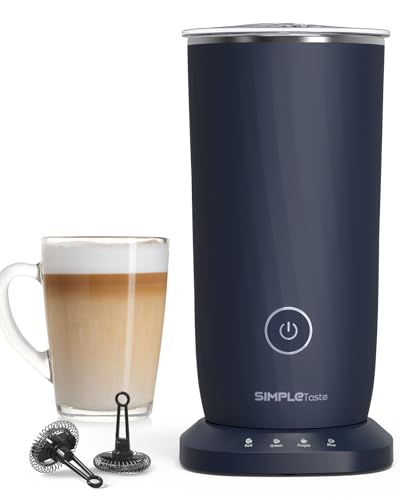
Simpletaste belongs to 1byone Products Inc. of Ontario, California, and this dark blue 4-in-1 frother is a jug appliance for the German market: you place the jug on a corded base station, the jug heats the milk, froths it or does both, and the appliance then switches itself off. Our price box shows approx. €29.99 on Amazon.de, and the Amazon catalogue listed a price of €29.98 when it was checked on 7 September 2026.
One caveat up front. On 24 September 2026, the listing on Amazon read “Currently unavailable”, with no restock date. Amazon points instead to a newer Simpletaste model with an LED digital display (ASIN B0FPLS7V3N), which was in stock at €34.99 at the same time. For that model, the brand owner has only an error page at the German address. Everything here applies to ASIN B0DRVFKK7W. We have not handled any of these appliances ourselves and are comparing what the catalogue, the manufacturer’s page and the manual state.
Manufacturer, manual and two wattage figures
The documents are hosted at 1byonebros.com. There, 1byone Products Inc. describes itself as the supplier of the brands 1byone, Beautural, Simpletaste and Naturalife, and there is a German product page for exactly this ASIN. The title and the five bullet points match the Amazon catalogue word for word. According to the manual, the European authorised representative and importer is Apex CE Specialists GmbH in Düsseldorf, and the title page states Made in China as the origin. Two sites with Simpletaste in their address, by contrast, describe themselves as independent affiliate sites, and some of their figures belong to other models.
You have to piece together which manual belongs to the appliance. The Amazon catalogue gives the model number 706-0001. On the manufacturer’s manuals page there are two EU manuals for 4-in-1 frothers. One, 706DE-0003, describes an appliance with 130 and 300 ml and a different housing. The other, 706DE-0014, listed in its inner section as model MMF-826, matches the listing in fill volumes, colour, programme colours and run times. An online manual collection, incidentally, assigns the number 706-0001 to a battery-powered handheld whisk, which has nothing to do with this jug appliance.
Even 706DE-0014 is not a perfect match, though. Its line drawing places the indicator light on the housing, and the technical data give 400 W at 220 to 240 V and 50/60 Hz. The catalogue text and the manufacturer’s page advertise 500 W. Which figure is right for the appliance as sold cannot be decided from any source. We therefore read 706DE-0014 as the manual for this appliance or for its direct predecessor, and everything we take from it is expressly stated here as a manual figure.
How long you wait is better answered here by the run times in the manual than by the wattage. In practice the contradiction matters only for the cable. The manual permits extension cables but requires their marked rating to be at least as high as that of the appliance. With two contradictory figures, the higher one, 500 W, is the safe figure to plan with.
Four button presses, four colours
The appliance is operated with a single button, called the power/mode button in the manual. You press it until the colour of the programme you want lights up. The completion times come from the programme table in the manual:
- Press once, red: warm, dense foam, 80 to 140 seconds.
- Twice, green: warm, airy foam, also 80 to 140 seconds.
- Three times, purple: heat milk without foam, 150 to 250 seconds.
- Four times, blue: cold foam, 55 to 60 seconds.
Beforehand, you place the whisk on the shaft at the bottom of the jug, pour in the milk and close the lid firmly; according to the manual it must be secured before you start, stays on during the run and only comes off once the whisk has stopped turning. Once you have chosen, the light flashes for 3 seconds, then stays on, and the run goes ahead. At the end it flashes for 5 seconds and goes out, after which the appliance is in standby. The catalogue advertises foam “in just 2 minutes” without naming a programme. That figure lands roughly in the middle of the range for the two warm foam programmes. It does not fit pure heating, whose range lies entirely above it.
On the product photo for the ASIN, the button sits as a round knob with an on/off symbol at the front of the slim, cylindrical body. The indicator dots are below it on the base, four of them, labelled Red, Green, Purple and Blue, in the same order as the programmes. In front of them lie two whisks with a wire spiral, one of which is the spare whisk that the catalogue lists as a variant. The catalogue gives the weight, converted, as approx. 720 g.
On hot chocolate, the documents contradict each other. In the catalogue text, creamy hot chocolate is one of the four programmes. The manual lists as the four modes the two warm foam levels, heating and cold foam; a hot chocolate programme does not appear there at all. If you want hot chocolate, you therefore end up with the purple programme.
In detail: 115 ml of foam from a 240 ml jug
There are two maximum quantities, and the manual takes care that you keep them apart: 240 ml for heating, 115 ml for frothing, warm or cold. The container has three lines for this, two maximum marks with printed symbols instead of letters and one minimum mark. If the milk is outside these limits, it overheats or boils over.
The reason for the smaller foam quantity is rising room. The whisk beats air into the milk, and frothed milk needs considerably more space than liquid milk. A jug filled to the heating mark would have no room left at the top for the foam. For comparison, Severin recommends between 150 and 200 ml of milk for the cappuccino programme of the SM 3587, which is more than the Simpletaste takes in one foam run.
The appliance sets the temperature itself. According to the manual, the milk heats to about 60 to 70 °C, which the manufacturer calls the ideal temperature for milk coffee drinks. Our guide to frothing milk draws the line at about 65 degrees, because above that the protein structure that keeps the foam stable begins to break down. The upper half of the manufacturer’s range therefore lies beyond this limit, and according to the documents nothing can be adjusted.
On the milk itself, the manual has two clear pieces of advice: whole milk with more than 3.0% fat for the best results, and fresh, chilled milk from the fridge for the best foam quality. Added to that is the statement that the quality and stability of the foam vary with the type of milk. Technically this fits together: fat and protein determine how fine the foam is and how long it lasts, and cold milk gives the whisk more time to beat in air before it reaches the target temperature.
Is the Simpletaste enough for two cappuccinos in a row?
Yes, but in two runs. According to the programme table, two warm foam runs take between 2 minutes 40 and 4 minutes 40 together, plus pouring and rinsing. And after the first run, a forced pause may be due.
That is in the troubleshooting section. If the frother does not work after operation, it is too hot according to the manual. How long the lockout lasts otherwise is not stated anywhere; the manual gives as the remedy rinsing the jug cold to lower the temperature.
The order the manufacturer suggests, by contrast, saves time: first froth or heat the milk, prepare the coffee in the meantime, then serve both warm. For two cups this gives the following sequence: first foam run while the machine pulls the first espresso, then rinse the jug cold, second run for the second espresso.
Non-stick coating and cleaning in the wording of the manual
The inside of the jug is coated, and the catalogue calls the coating scratch-resistant. The manual sounds more cautious. Even before first use, it warns that harsh cleaning agents or scouring agents would remove the non-stick coating. Scratch-resistant therefore does not mean scour-proof, and a scouring pad with a rough side is ruled out just like scouring cream.
Because any smoothing over here could cost money, we give the cleaning and care section in full and close to the wording. Four principles come first. The manual recommends cleaning the frother immediately after every use. “Do NOT immerse the milk frother, the base, the cable or the plug in water.” “The milk frother and its accessories are NOT dishwasher safe.” And: “NEVER use harsh cleaning agents or scouring agents.”
Five steps follow:
- Take the frother off the base station and remove the lid and silicone ring.
- Rinse and clean the inside with warm soapy water: “Make sure you do not wet the bottom of the nozzle.”
- Clean the outside with a soft, damp cloth. The housing may be rinsed briefly with a small amount of water, “but not with large amounts of water, under high water pressure or over long periods”.
- Rinse the lid, silicone ring and whisk in warm water, and wash them in soapy water if necessary.
- Do not put the silicone ring, lid and whisk back in until they have dried.
Six pictograms summarise this. Crossed out are rinsing under tap water, immersing in water and the dishwasher; ticked are cleaning the inside, wiping the housing and rinsing the lid and whisk.
Two points are unclear. By “nozzle” the German translation means the frother itself in the two places we compared with the English version, where it says frother. We therefore read the “bottom of the nozzle” as the underside of the jug, with which it sits on the base. And the crossed-out rinsing under tap water fits poorly with step 3 and with a tip further back that provides for rinsing with water and drying after every use. We would take the stricter reading: water only inside the jug, never under the running tap, and only the damp cloth on the outside.
What the manufacturer does not state
Gathered in one place, here is what we did not find in the catalogue, the manufacturer’s page or the manual. Dimensions are missing entirely, neither height nor base diameter, and so there is no footprint and no clearance under a wall cabinet. Still open are the heating principle (induction or heating element), the drive type of the whisk (magnetic or via a shaft), the base material of the jug and the type of coating, such as PTFE or ceramic. For the advertising word quiet there is no decibel figure, and for the title word BPA-free no evidence. Equally unknown: cable length, standby consumption, the millilitre quantity at the minimum mark, a descaling procedure, individually orderable spare parts with prices, the market launch (the field on the manufacturer’s page is empty) and approval marks or a declaration of conformity for this model.
What else is worth considering?
Three appliances from our milk frothers category are close alternatives for a buyer of this Simpletaste, one at the same price and two above it.
| Model | The difference | Price | Our rating | Choose this if |
|---|---|---|---|---|
| Simpletaste 4-in-1 (this one) | Non-stick inner coating, 115 ml foam, 240 ml for heating, nothing dishwasher safe | approx. €29.99 | 8.0 | you froth at most 115 ml of milk per run and wash by hand |
| Rafow 4-in-1 | According to the catalogue text 130 ml foam and 300 ml for heating, non-stick coated stainless steel inside | approx. €29.97 | 7.7 | you want a little more milk per run at the same price |
| Morpilot 4-in-1 600 W | Borosilicate glass jug, 250 ml foam, jug section approved for the dishwasher | approx. €45.99 | 8.2 | you froth for two cups at once |
| Severin SM 3587 | Induction, temperature adjustable from 45 to 65 °C, 13 programmes | approx. €114 | 9.4 | you want to choose the milk temperature yourself |
The prices are the guide values from our price boxes, and the rating is our editorial assessment from the data comparison, not a measured value. The details on the Rafow come from the manufacturer text in the Amazon catalogue, those on Morpilot and Severin from their manufacturers’ figures.
When the Simpletaste fits and when another appliance does
Start with the quantity. For one person with a cappuccino in the morning, one foam run is enough, and that is what the Simpletaste is built for. If you regularly froth for two at once, the Morpilot 4-in-1, with up to 250 ml of milk for frothing, is the obvious choice. In return, Morpilot asks for a pause of about 4 to 5 minutes after every heating run.
Then the sink. If you put milk appliances in the dishwasher as a matter of course, this is the wrong one, because with the Simpletaste not a single part may go in. With the Morpilot the removable jug section is approved, and with the Severin SM 3587 the milk container, whisk inserts and lid are, according to the manufacturer.
The third question is temperature, and plant-based drinks hang on it too. The Simpletaste has a fixed range and no dedicated programme for oat or soy. According to Severin, the Severin SM 3587 can be set between 45 and 65 degrees and has special programmes for cashew milk, soy milk and lactose-free milk.
And if you warm the milk in a pan or the microwave anyway, you may not need a jug appliance at all. The Powerlix Pro 3-in-1 is a rechargeable handheld whisk for approx. €19.99; there you do the warming yourself.
The Simpletaste is not intended for a café or a snack bar. The manual says literally: “This product is approved for household use only and not for commercial or industrial purposes. It is intended only for the applications described in this manual.” Whether a separate frother suits your preparation at all, or rather a machine with a steam wand, is something the coffee finder sorts by budget and need.


