Under the Rafow brand, this milk frother is available on Amazon.de for approx. €29.97 (as of September 2026). The product title there begins with “Milchaufschäumer Elektrisch 4 in 1” (German for electric milk frother, 4 in 1), and no brand name appears in it. Anyone who concludes from this that the device is anonymous overlooks two things: a model number in the catalogue and a brand with its own online shop.
We have not handled the frother ourselves. Our sources are the manufacturer texts in the Amazon catalogue, the product data, the “Functions & technical data” table and the brand content on the Amazon product page (retrieved on 25 September 2026), as well as Rafow’s own product page and a one-page sheet of safety information that Amazon stores as a PDF. What comes from the Amazon page is seller text on a retailer’s page, and that is how we treat it.
Rafow and the N22-B model
In the Amazon catalogue, Rafow is listed as brand and manufacturer, along with the model number N22-B. This is the number to search for if in two years you need a whisk head or the manual. On rafow.com the device is called “Milk Frother Electric 4 in 1, Automatic 300ml Large Capacity”, and the English description there matches the five bullet points on Amazon point for point. Matching the two pages rests solely on these identical texts and quantities.
According to the “About Us” page, the brand was founded in 2018, at first with kitchen utensils, and widened its range to the whole household in 2020. The product page in the Rafow shop has existed since 27 February 2023 and shows a price of US$69.99. This date does not prove a market launch; it only marks the day the shop entry was created. The Amazon page gives China as the country of origin and deep black as the colour.
In our milk frothers category, the Rafow is one of the electric jug devices: a jug on a base, whisk inside, programme selection by button. According to the seller, it is meant for cappuccino, coffee, macchiato, latte and hot chocolate.
Build: jug, base, two whisk heads
Rafow names an ABS housing, a common appliance plastic, and an inner jug in stainless steel with a non-stick coating. The Amazon table sums this up as “stainless steel and ABS”. Rafow also names a double-layer insulated wall, food-safe and, according to the seller, intended for durability and safety. On heating jugs, a double wall is usually meant to keep the outside cooler than the container in which the milk is warmed. The ergonomic handle and the wide opening are also highlighted.
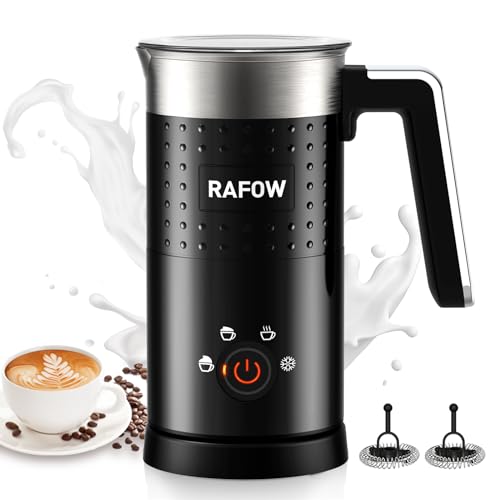
In the product photo the body is round. The upper part is stainless-steel coloured, the rest black with a dot pattern and the RAFOW lettering. The handle sticks out on the right, and on the left a small pouring lip is visible at the rim. At the bottom of the black part sits the only button, a round knob with a power symbol. Four pictograms are arranged around it: two cups with froth heads of different height, a steaming cup and a snowflake. That fits the four programmes Rafow describes. Beneath the body, a slim black base completes the unit.
According to the brand content, the jug gets power through a “Power Base”, the base it stands on. The Amazon table also lists overheating protection.
The catalogue data give 19.8 centimetres in height, 15.0 centimetres in length and 9.9 centimetres in width, converted from 7.8 by 5.9 by 3.9 inches, plus a weight of 780 grams. The length includes the handle sticking out at the side; the round container itself is narrower. The “Functions & technical data” table contradicts this with 15 centimetres of width and 15 centimetres of height. We stick to the catalogue values: in the photo, the device including the handle is about a third taller than it is long, and that is exactly the ratio that 19.8 to 15.0 centimetres gives, whereas the square dimensions from the table do not.
According to the Amazon product data, the box contains the milk frother, two whisk heads, a cleaning brush, a cleaning card and a user manual. Some jug devices have a second, smooth insert that only warms milk. On the Rafow, the two whisk heads are pictured identically in the photo, each with a spiral ring around the disc.
Four programmes on one button
Rafow lists the programmes explicitly: thick hot milk froth, thin hot milk froth, heated milk and cold milk froth. You choose them by pressing the button; the brand content speaks of one-button operation, and the Amazon table accordingly counts four settings.
For run times there is a rough figure and a precise one. The bullet point promises froth in 1 to 2 minutes. The brand content breaks it down: about 2 minutes for thick froth, approx. 2 minutes for thin, approx. 3 minutes for heated milk and about 2 minutes for cold froth. That plain heating takes longest fits with the fact that, without froth, considerably more milk may go into the jug.
Thick and thin froth differ in the proportion of air. By our assignment, a strong cap belongs on the cappuccino, a thin layer in café latte and flat white.
The cold programme is called “milk froth at room temperature” in the brand content. The device therefore does not cool; it whips the milk without heating, and how cold the froth ends up depends on your milk. For iced coffee with a froth cap, we would take the milk straight from the fridge.
Hot chocolate appears in the seller texts only as a drink example, alongside cappuccino and latte, not as a programme of its own. We would use the heated milk programme for it and stir the powder in the cup rather than in the coated jug.
How much milk fits per cycle?
For frothing, 75 to 130 millilitres; for plain heating, up to 300 millilitres. The 300 millilitres in the product name therefore describe the jug when heating, not the froth quantity.
For the upper limit when frothing, the bullet point gives 4.4 ounces and the brand content 4.3 ounces, both times with 130 millilitres next to it. The lower limit comes solely from the brand content. Quantities are measured at markings on the inside of the jug, which according to the seller are clearly visible.
What this means for the cup can be estimated with the quantities from our guide to coffee drinks. There, a cappuccino takes 60 to 100 millilitres of milk depending on the source, a flat white 60 millilitres (Nespresso UK, on two ristrettos), and a latte macchiato 120 to 150. A full load of 130 millilitres is thus enough for two cappuccinos of 60 millilitres each or one of 100, for two flat whites or for one latte macchiato of 120 millilitres. For 150 millilitres the froth programme takes too little, so you go in twice.
That the froth quantity is so far below the jug volume is normal for jug devices. Whipped milk needs considerably more space than liquid milk, and this space has to stay free above the whisk head. Among the jug devices in the table below, the Rafow thus sits between the Simpletaste and the Morpilot: one froths somewhat less, the other considerably more.
In detail: a heater without a degree figure
Rafow does not describe how the N22-B warms the milk. Electric jug devices usually heat in one of two ways. With a heating plate, a heating element sits under the base of the jug and passes the heat to the container from below. With induction, a coil builds up an alternating magnetic field, and the heat arises directly in the metal base, much like an induction hob. Severin uses induction in the SM 3587. For the Rafow, only a manual portal claims this, and its text contradicts itself (more on this in the FAQ on the user manual).
Rafow writes of “advanced temperature control” that switches off as soon as the froth is ready; no figure in degrees appears anywhere. Our guide how to froth milk draws the line at about 65 degrees, because above that the protein structure that holds the bubbles starts to break down. Simpletaste and Severin give figures for their temperatures; the values are in the table below.
Cleaning and placement according to the seller
The care instruction consists of a single sentence, and it appears in the Amazon table: “Nur per Hand mit beiliegendem Reinigungsbürste reinigen” (clean by hand only with the included cleaning brush; the grammar of the German original is faulty). Rafow’s own product page merely mentions that a cleaning brush is included. The dishwasher is thus ruled out.
How much water the jug tolerates is open, and with this device that is a real question. In the photo, the button sits in the black lower part of the body, above the slim base. By our reading, control electronics are therefore in the jug itself and not only in the base. Before the jug goes under running water or soaks, read the cleaning card and the user manual from the box, and do nothing that is not stated there.
For the inner wall, what applies to non-stick coatings in general applies: loosen milk residues with the brush before they dry on, and use neither scouring pads nor steel wool, which can scratch the coating. This recommendation comes from us, derived from the material.
The “Safety information” sheet on Amazon contains, in six languages, a single instruction on use. In German it reads: “Bitte nicht an einer hohen stelle platzieren, um Stürze zu vermeiden” (please do not place on a high spot, to avoid falls). The English version means the same: the device should not stand raised, so that it does not fall. The sheet also carries the French recycling mark: device, accessories, cable and batteries are recycled and belong in the shop or at a collection point.
What Rafow and Amazon leave open
Beyond the points above, all the sources we found lack: the voltage and frequency of the EU device, the cable length and whether the jug can be lifted off the base without a cable, the drive of the whisk heads and whether the two supplied heads have different jobs or one is a spare, and the pause needed between two cycles. Nobody explains what the lights mean either: in the photo the power symbol glows red, and to its left a small orange dot at the height of the cup with the tall froth cap. For material we know only the housing and inner jug; lid, seal and whisk heads are undescribed, and on BPA the seller says nothing.
Also open are the responsible person in the EU, including the manufacturer’s address, and the year in which the N22-B came to market. Watts, manual, warranty and spare parts, certification marks and noise are covered in the FAQ. Some of this is probably in the printed manual; we can only document it once we have it.
Rafow or one of the other three?
These three devices from our catalogue come closest to the Rafow. The Simpletaste costs the same, Morpilot and Severin cost more and take more milk in return.
| Model | The difference | Price | Our rating | Choose this if |
|---|---|---|---|---|
| Rafow Milk Frother 4-in-1 (this one) | four fixed programmes on one button, temperature not stated | approx. €29.97 | 7.7 | you froth whole milk for one or two cups and do not mind the exact final temperature |
| Simpletaste 4-in-1 | manual with temperature (about 60 to 70 °C) and run times, froths up to 115 ml, heats up to 240 ml | approx. €29.99 | 8.0 | you want to know, at the same price, how hot the milk gets, and can manage with a little less milk per cycle |
| Morpilot 4-in-1 600W | borosilicate glass jug, up to 250 ml froth and 500 ml heating, dishwasher-safe | approx. €45.99 | 8.2 | you regularly make milk for three or more people or want to put the jug in the dishwasher |
| Severin SM 3587 | induction, temperature adjustable from 45 to 65 °C, up to 350 ml froth, stainless-steel jug dishwasher-safe | approx. €114 | 9.4 | you want to choose the milk temperature yourself and will spend much more for a device with a documented temperature |
The prices are guide values from our price boxes. For the Rafow, the value corresponds to the Amazon catalogue of 7 September 2026, for the Severin to the Amazon catalogue of 6 and 7 September 2026. For Simpletaste and Morpilot we do not know the retrieval date of the price box. The rating is our editorial assessment of the manufacturer data and says nothing about froth quality. The best-of list compares all devices in the category.
When the Rafow fits and when another device does
The deciding factor is usually the quantity of milk. From three cappuccinos at once, we would reach for the Morpilot 4-in-1, which froths up to 250 ml and so almost twice as much.
In our price box the Simpletaste 4-in-1 costs two cents more and froths 15 ml less per cycle (115 instead of 130 ml). Its manual gives about 60 to 70 °C, so the upper half of that range lies above the 65-degree line from our guide. You thus know the range, but it cannot be set on the Simpletaste either.
In our catalogue the Severin SM 3587 is around €84 above the Rafow, which is almost four times as much. Anyone who has to bring milk to a particular temperature, for example lukewarm for a small child, is in our assessment right only with it: for infant formula it has, according to Severin, a programme of its own at around 37 degrees, though according to the manual you should still check the temperature yourself before feeding. With four fixed programmes and no known final temperature, the Rafow hits such a value only by chance.


