Orbegozo simply calls the KF 200 a Cafetera italiana, an Italian coffee pot. It is an aluminium moka pot for the hob, designed for two cups. Among the 17 moka pots in our catalogue it is the cheapest at approx. €11.37 on Amazon.de according to our price box, and in our rating it scores 8.0 out of 10. The Amazon catalogue listed a price of €12.11 on 7 September 2026.
On the product page Orbegozo provides two documents: a one-page data sheet for the KF 200 and a series manual that covers several of the brand’s aluminium ranges. Almost everything below on use, cleaning and safety comes from that manual, taken from the Spanish and English versions.
Six parts according to the exploded drawing
The drawing in the manual numbers six items. At the bottom is the lower chamber (1), the water reservoir. On top of it sits the funnel (2) for the ground coffee, listed in the Amazon title as a removable filter. Under item 3 Orbegozo groups the filter plate and gasket, both of which sit in the upper chamber. Item 4 is the outlet through which the coffee enters the upper chamber, item 5 is the safety valve, and item 6 is the upper chamber itself, where the finished coffee collects.
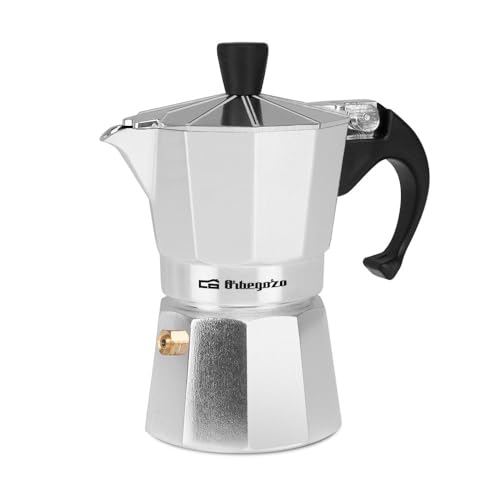
The product photo shows the eight-sided shape familiar from moka pots. The facets run across the lower and upper chambers, with a smooth band between them carrying the Orbegozo lettering. The handle and lid knob are black, and the valve on the lower chamber is brass-coloured. The only material information is “Cafetera de aluminio”, and it applies to the pot as a whole.
The manufacturer describes the handle as ergonomic, intended to give a good grip and to keep you from burning yourself while handling the pot. According to the product description, the valve is meant to prevent accidents, and the interior is said to be easy to clean. That is the whole feature list. A stovetop pot has no plug and no electronics, and the KF 200 adds nothing more.
Does the KF 200 work on induction?
You should assume not. The pot is approved for gas, electric and glass-ceramic hobs, as stated on the product page and in the Amazon bullet points. Induction appears in no source, and aluminium is the wrong material for a standard induction hob.
An induction hob does not heat the glass plate but the base of the pan. A coil beneath the glass builds up an alternating magnetic field, which generates eddy currents in the pan base. Only ferromagnetic metal such as steel or cast iron warms up noticeably, because there are additional losses from the constant reversal of magnetisation and the electrical resistance is higher. Aluminium conducts electricity so well and is so weakly magnetic that a standard induction hob generates hardly any heat in it. Many hobs therefore do not recognise the pot as a pan at all and do not switch on. A few hobs work at a higher frequency and can also heat aluminium; Orbegozo does not approve the KF 200 for those either.
In the manual, under “Apto para” (English “Suitable for”), there are four symbols, none of them crossed out: glass-ceramic, electric, gas and dishwasher. The manual covers several series, so the symbols are not an individual approval for the KF 200. What the dishwasher symbol means and what it does not is covered below under cleaning.
On the hob: the seven steps from the manual
Before the first coffee, you unscrew the upper chamber from the lower chamber and take out the funnel. Then you check that the filter plate sits in the upper chamber, inserted so that its concave side is visible, and that the gasket holds it in its groove; after that, both parts come out. Step two: rinse all parts in hot but not boiling water and put the upper chamber back correctly on the lower chamber.
Brewing starts at step three. You fill the lower chamber up to the level of the safety valve, with cold, lukewarm or hot water; the manual allows all three and prefers none. Step three also includes inserting the funnel. In step four you fill it with ground coffee without pressing it down. In step five you screw on the upper chamber, turning the body of the pot, not the handle. Our reading of this: if you turn the handle, you put all the force on its fixing.
Step six regulates the heat, and the next section is devoted to it. Step seven rules out two things: according to the manual the pot is not suitable for keeping coffee warm or reheating it, and heating it empty damages its base.
Our guide to moka pots explains the basic technique across manufacturers. The brew calculator works out how many grams of grounds belong in the funnel once you have measured the actual amount once with a measuring cup.
In detail: steam pressure, low flame, loose grounds
A moka pot works without a pump. The water in the lower chamber heats up, steam forms above it, and the pressure in the closed space pushes the water up through the riser tube of the funnel, through the ground coffee and the filter plate into the upper chamber. The safety valve is the limit: if the path through grounds and filter becomes blocked, the steam escapes there instead of building up further.
This explains step six. Orbegozo calls for constant low heat, and on a gas hob the flame must not extend beyond the base of the pot. After a few minutes, according to the manual, the coffee has risen to the lid. The warning that goes with this is unmistakable: on a medium or high setting, or without supervision, the pot can be damaged.
Aluminium conducts heat quickly, and a two-cup pot holds little water to absorb it. Anyone who turns the hob up to save time ends up in exactly the situation the instructions warn about. A flame licking up the side also heats the walls and the base of the handle instead of the base of the pot. This explanation is ours.
The loose grounds from step four follow the same logic. A compacted puck puts up more resistance to the steam, and the pressure in the lower chamber rises before anything arrives at the top. Grind size belongs here too, and on this point the manual contradicts itself. The recommendations at the end list four points: grind the coffee fresh, use a medium grind and not too fine, store coffee dry, and keep an opened pack tightly closed in the fridge so that the aroma is preserved. The cleaning section, by contrast, demands “solamente café grueso molido”, that is only coarsely ground coffee, and rules out instant coffee and other extracts.
We would start with a medium grind, because that statement appears in the more detailed recommendations, and go coarser if the coffee rises only hesitantly.
Cleaning, and what the dishwasher symbol means
The pot is washed after every use; Orbegozo expressly recommends this. The manual divides its advice into five points. First, you separate the upper and lower chambers only once both have cooled down, as the pot is hard to unscrew when hot. Second, no strong cleaners and no abrasives that could damage the surface; wash with hot water, and if the outside needs more, you may polish it with a chrome care product. Third, discolouration builds up over time, which the manual calls unavoidable, and the English version adds deposits in the lower chamber, especially in areas with hard water. A mixture of water and vinegar can loosen these stains. Fourth, dry all parts thoroughly and store them separately so that air can reach them. Fifth, coffee does not belong in the pot for long periods; after drinking, it is cleaned and dried.
How hard your tap water is and what that means for deposits is covered in the guide water hardness and coffee.
On the dishwasher: the symbol under “Apto para” is not crossed out, so according to the series manual the dishwasher counts as suitable. The product page and data sheet for the KF 200 say nothing on the subject. We still advise washing by hand, for a chemical reason: dishwasher detergents are alkaline, and aluminium reacts to alkaline solutions, so the surface turns matt and dark. This fits with the fact that the cleaning text of the same instructions mentions only hot water.
For maintenance the manual gives three points. Before each use, you check that no part is missing and everything is assembled correctly. At regular intervals you inspect the funnel, filter plate and gasket. And if the thread between the upper and lower chambers is worn, you should replace the pot.
Safety instructions, in full
Here are the manual’s safety instructions, followed by its two warnings. Packaging material (plastic bags, cardboard, polyethylene) must be kept out of the reach of children, as the film presents a suffocation hazard. The pot is used only for its intended purpose and set up in a dry place. While it is in operation it is not left unattended, and children do not use it. Children are supervised so that they do not play with it. Beware of burns from steam. The pot is never used without water. It stands on a table or a level surface. It is not used outdoors. People with reduced physical, sensory or mental capabilities or without experience, children included, use it only under the supervision of a responsible person. And you should keep the instructions. Of the two warnings, the first concerns the heat setting (see above), and the second states that incorrect use carries a risk of injury.
Some points read as if taken from a template for electrical appliances. A table as the place to set it up fits poorly with a pot that stands on the hob. The instructions are nonetheless binding.
What Orbegozo does not state
On capacity, only the two cups are firm. No millilitre figure appears on the product page, in the data sheet or in the manual. Dimensions are missing just the same. The Amazon catalogue lists 19.7 by 18.9 by 3.9 inches, around 50 by 48 by 10 centimetres, which for a two-cup pot is an obvious catalogue error, as is the energy efficiency class A+ in the same listing, which is meaningless for a stovetop pot with no mains connection. The weight of 0.48 pounds, around 219 grams, likewise comes only from Amazon, and whether it includes the carton remains open. The base diameter is also open, that is, the question of the smallest cooking zone the pot fits.
Also open are the material of the handle, knob, funnel and filter plate, the wall thickness of the aluminium, a brew time in minutes, the pressure in the lower chamber and the value at which the valve opens. On descaling, it stays with the water and vinegar mixture against stains, with no product and no interval. The scope of delivery beyond the pot, possible colour variants and the year in which the KF 200 came onto the market also remain unclear. The 20.09.2022 in the Amazon catalogue is a catalogue date, not a documented market launch.
Correction note: earlier versions of this page gave 1943 as the year of the brand, 50 millilitres per cup without a source, the pot as not dishwasher safe, hot water “just below” the valve as a recommendation, and the discolouration in the lower chamber as a protective patina that should be left in place. All five points have been corrected above according to the company page and the manual.
What else is worth considering?
| Model | The difference | Price | Our rating | Choose this one if |
|---|---|---|---|---|
| Orbegozo KF 200 (this one) | Aluminium, 2 cups, for gas, electric and glass-ceramic according to the manufacturer | approx. €11.37 | 8.0 | you cook for yourself on gas, electric or ceramic and want to spend as little as possible |
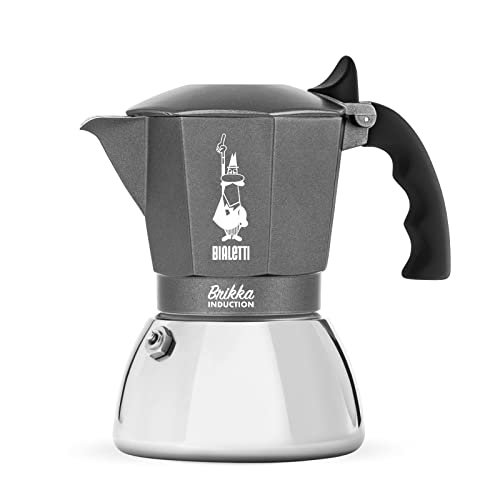
| Bialetti Moka Induction | Also 2 cups, but the boiler has steel on the outside, which according to Bialetti makes it suitable for induction too | approx. €26.14 | 8.7 | you have an induction hob or will soon get one |
| Florina Grande | Same aluminium design, but 6 cups | approx. €17.90 | 7.8 | your budget is tight and you serve more than one person per brew |
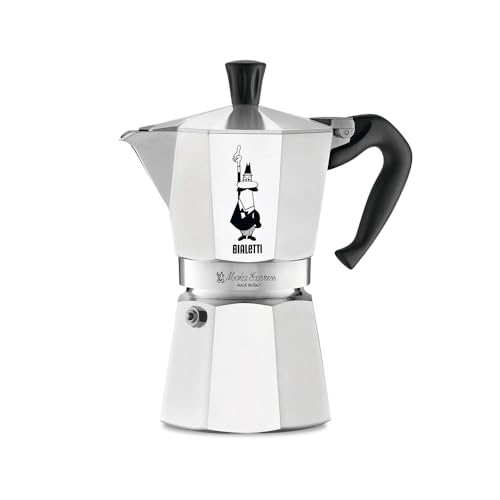
| Bialetti Moka Express | Aluminium, 6 cups, Bialetti sells the gasket and filter for this size as a separate set | approx. €28.87 | 9.4 | you want to reorder spare parts specifically by model |
The prices are the guide values from our price boxes and change constantly; the rating is our editorial assessment. The table does not answer which of the four pots makes the better coffee; for that we would have had to brew them side by side and taste them.
When the KF 200 fits and when another pot does
First, the hob. On a standard induction hob the KF 200 barely warms up, as described above, and it is not approved for it anyway. The Bialetti Moka Induction is the same size and costs €14.77 more.
Then the quantity. In our assessment two cups are enough for one person; if two of you have breakfast together, you brew twice. For €6.53 more, the Florina Grande gives you the same design with six cups. Filling a large pot only halfway to brew a single cup is at least not what the Orbegozo manual intends: it asks for water up to the valve level.
When it comes to reordering parts, the field separates most clearly. Orbegozo sends you to the retailer, with no part number. If you want to reorder the gasket specifically, the Moka Express costs €17.50 more. In return, Bialetti sells its own replacement set of gasket and filter assigned to the 6-cup size. The set costs €7.99 in the Bialetti shop. With the KF 200 we calculate differently: if the thread wears, Orbegozo asks for a new pot anyway, and no pot in our catalogue is cheaper to replace.
The KF 200 is wrong for three groups. Anyone looking for a pot for a camping stove would be buying against the instructions, which rule out outdoor use. Anyone who puts the pot on and leaves the kitchen is acting against the supervision Orbegozo demands twice, and a stovetop pot does not switch itself off. And anyone who wants to avoid aluminium in contact with coffee needs a stainless steel pot, because Orbegozo specifies the KF 200 as an aluminium pot. The brand does not need to be changed for this: with the KFI 260 Orbegozo offers a stainless steel pot for two cups that, according to the product page, also works on induction.