A milk jug with a scale inside and a latte art pen with it, together for approx. €11.04 on Amazon.de according to our price box: that is the offer, and hardly more can be documented than what it says. NewGF has no website of its own. What is written here therefore comes from two sources: the Amazon catalogue entry for ASIN B0CYC715S4, retrieved on 7 September 2026, and the listing photo, which we looked at enlarged. We have not held the jug in our hands, and we have not frothed anything with it.
What the catalogue says and what the photo shows
The entry gives the model and part number MFB12, size 350 ml, colour black, quantity one, product group household goods. The listing text gives 304 stainless steel as the material, and NewGF describes the construction as heat-resistant. The weight appears as 0.3747858454 pounds. The many decimal places point to an automatic conversion from roughly 170 grams, and there is no measuring precision in it.
The dimensions are thin. Height, length and width are all three given as 3 inches, i.e. 7.6 centimetres each. Handle and spout stick out to the side, so a jug cannot have the same measurement in all three directions. We read the line as a rounded placeholder and have therefore not carried it over into our data sheet above.
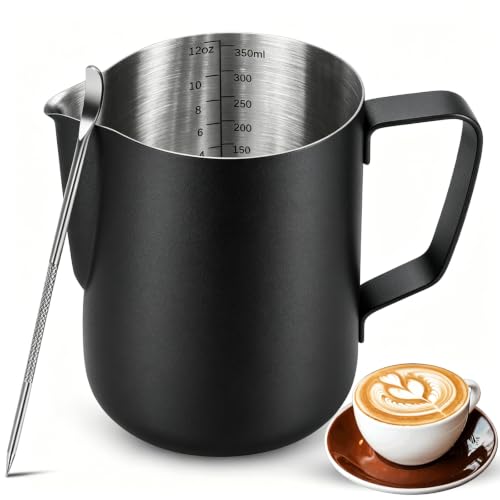
The photo contributes more than the table. On the outside the body is coated black; inside, the photo shows brushed stainless steel with a slight sheen. On the inner wall there is a vertical line with cross marks: to the right of it the millilitre values 150, 200, 250, 300 and 350, to the left the ounce values 4, 6, 8, 10 and 12. The steps are 50 millilitres or two ounces, and that is where a small imprecision lies, because two ounces are about 59 millilitres. At the top the scales meet, as 12 ounces are about 355 millilitres. Further down they diverge: 6 ounces correspond to about 177 millilitres, but on the photo the number sits almost level with the 200. For measuring, therefore, always use the same scale, most simply the one in millilitres.
The body is cylindrical with almost straight walls, and the base edge is rounded. According to the listing text the spout tapers narrow and conical; on the photo it is short and pointed, and the rim rises towards it. The handle is a flat black bracket with an angular line, attached at the top and bottom, with a clear gap to the wall. The pen lies beside it: a thin, shiny metallic rod, flattened at one end and pointed at the other, with a knurled section in between for gripping.
A brand without an address
We looked for a manufacturer website and found none. newgf.com answers with a redirect to a parked sales page at GoDaddy, and newgf.us does not even resolve in DNS. Searching for the brand and for the model number MFB12 ends up at retailers, at Amazon, eBay and smaller shops, and at other brands with similar names.
That has consequences for you. Online there is no manual with safety notes, permitted cleaning and intended use to be found, nor a quotable warranty statement or a spare parts list. Whether the packaging contains a leaflet, we do not know. If something goes wrong, you turn to the retailer you bought from: the statutory two-year warranty (Gewährleistung, the seller’s legal liability for defects) is directed against the seller anyway.
For this text that means: every sentence about material and features rests on the listing text, every sentence about shape and surface on the photo. Everything else is general knowledge about milk and stainless steel, and where it is our recommendation, we say so.
Is the jug suitable for latte art?
By its design, yes. A narrow, tapering spout focuses the stream of milk, and that is exactly what fine lines need.
Sage UK also advises a narrow spout, for better control, as quoted in our guide Learning latte art. The claim that a wide, flat lip is more forgiving at the beginning could not be documented there. For a first heart without side-to-side movement, the guide’s assessment is that the shape matters less than the foam anyway.
The second route to a pattern is the pen. When pouring, the picture comes from the stream itself; when drawing afterwards, it only comes later: the drink is already in the cup, and you pull lines with a point through the boundary between light foam and dark crema. The pointed side draws the line, and the flat side can pick up and move dabs of foam. A requirement is a surface that holds: if the foam is coarse-pored or too liquid, the line closes up again immediately, and a drawn picture does not last long either.
Our assessment of this is mixed. At the start the pen delivers a visible result without you having to master the pouring stream. In return it trains none of what matters later: guiding the jug and pouring from the right height.
How far to fill the 350 millilitres
The number on the top mark is the nominal capacity, not the filling quantity. When frothing you draw air into the milk, the volume grows, and anyone who fills to the 350 mark has the foam on the worktop. Our guides How to froth milk and Learning latte art set the limit with Sage UK and Lelit at half: cold milk goes into the jug up to half at most, so with a nominal capacity of 350 millilitres, at most around 175.
The value of the scale lies less in the exact number than in repeatability. If you pour in the same amount of cold milk twice, you get a similar result with the same steaming time and can improve deliberately instead of guessing anew with every attempt. NewGF justifies the scale in the listing text in exactly this way, with portion control and consistent results.
304 stainless steel, and what the black coating has to do with it
The material statement is the most reliable technical information in the whole listing. 304 is an austenitic chromium-nickel steel with around 18 percent chromium and 8 percent nickel, also sold as 18/8. In air the chromium forms a wafer-thin passive layer that protects the steel from corrosion and rebuilds itself after a scratch. For the same reason 304 is found in sinks, pots and vacuum flasks.
This layer is vulnerable mainly to chlorides, i.e. salt and chlorine-containing cleaners, and to moisture that stands for days. The black outer skin is a second matter, and what it is made of is among the open points further down. Paint and vapour-deposited coatings tolerate heat and alkaline cleaners to different degrees, and dishwasher detergents are both: hot in use and strongly alkaline.
On cleaning the listing offers a single sentence: the steel offers durability and easy cleaning, and that ensures hygiene and longevity. No washing procedure can be derived from praise of a material, so what follows is our recommendation: rinse milk residue out with warm water straight after pouring, before the protein dries on. On the black outside use neither steel wool nor scouring cream (see above). Dry it after rinsing, otherwise light limescale marks remain with hard water.
Why minutes matter here comes down to milkstone. Heated milk protein coagulates on the warm wall and is deposited together with calcium phosphate from the milk itself, and hard water makes the deposit worse. Once it has dried on, it can hardly be removed with washing-up liquid alone and holds on to odours.
What NewGF does not state
Bundled together, because the list is longer than the data sheet. Open points: all dimensions beyond the rough catalogue value, i.e. height, diameter at the top and bottom, and the footprint; the wall thickness; the gap between brim-full contents and the usable volume up to the top mark; the way the scale was applied; the structure of the black coating; the material of the handle and whether it is hollow; the material and length of the pen; whether jug or pen may go in the dishwasher; whether the jug may go on a hob or on induction; a maximum permitted temperature; food-law evidence such as LFGB or FDA; warranty, spare parts and a replacement pen; the country of origin and the person responsible for placing it on the market in the EU; the brand’s full range and whether the 600 millilitre version also carries the model number MFB12.
Of these points, the food-law one sounds the driest. Anyone who places articles in contact with food on the market in the EU must, under Regulation (EC) No 1935/2004 (which applies in the EU), ensure that they do not release constituents into food in a quantity that could endanger health. LFGB is the German Food and Feed Code (Lebensmittel- und Futtermittelgesetzbuch), which many sellers invoke with a compliance note, and FDA is the responsible US authority. Such a note would have been the simplest evidence. That it is missing from the listing, however, does not mean that the jug fails the requirements.
What else comes into question?
The table contains one real competing jug, plus two items with a completely different job that only compete for the same accessories budget.
| Model | The difference | Price | Our score | Choose this if |
|---|---|---|---|---|
| NewGF Milk Jug 350 ml (this one) | Scale inside and latte art pen in the set | approx. €11.04 | 7.9 | you are frothing for the first time and want a guide when filling |
| DeLonghi Milk Jug DLSC060 | Same nominal capacity, without pen, but manufacturer country pages with material and cleaning information | approx. €16.99 | 8.3 | you want a manufacturer address in case of a complaint |
| Vicloon Tamper 51 mm | Not a jug: works on the coffee grounds before extraction instead of on the milk afterwards | approx. €10.79 | 8.0 | your portafilter is 51 mm and you are still pressing with the machine’s plastic stamp |
| Normcore WDT Tool V2.1 | Category winner of the comparison, distributes the coffee grounds in the basket | approx. €25.99 | 9.4 | your espresso runs through unevenly, because no milk foam will rescue that |
The prices are guide values from our price boxes, and the scores are our editorial assessment from the available data and features, not from any series of measurements. What the table leaves out is build quality in detail, because we did not have any of these items to hand. You will find all models of the class in the category Barista accessories, and the ranking in the best-of list Barista accessories.
350 or 600 millilitres, and when another item takes priority
How do you froth? This first question has nothing to do with the jug itself. Without a steam wand on a portafilter machine or bean-to-cup machine, a jug gets you little. A bean-to-cup machine with a milk tube froths inside the machine, an electric frother brings its own container, and then the jug is left at most with the role of a serving jug.
How many cups at once? Our latte art guide works with Lelit’s 100 millilitres of milk per cappuccino and the rule of filling the jug to half at most: a 350 millilitre jug is therefore enough for one cup, and for two cappuccinos from one frothing batch you need, by calculation, a nominal capacity from 400 millilitres. The listing text speaks generally of single or shareable portions for the product line. If you make two cappuccinos one after the other, you froth twice with the 350, and the second cup gets its texture from a batch of its own. For that case the listing carries a 600 millilitre version. 600 millilitres correspond to about 20 ounces. If the figure 20 ounces appears together with 350 millilitres, it does not fit this jug, because 350 millilitres are about 12 ounces.
Black or silver? The product description at Amazon lists both finishes, and the catalogue entry identifies the item behind our price box as the black one. Price and score on this page therefore apply to that version, and our remarks on the black outer skin concern only it.
And the last question: is a jug really your next purchase? If your espresso runs through unevenly, then in our assessment a tamper or distribution tool improves the drink more clearly than any milk foam. Which accessories help in which order is sorted by our guide to Barista accessories essentials.
Who is it suitable for?
You are right here if you are just learning to froth with a steam wand and want a tool that does not hurt when it gets scratches while you practise. Beyond coffee, the listing text names two further uses: hot chocolate and matcha latte. Both need the same movement in the jug, and with matcha the steam wand only takes care of the milk, while you still mix the powder separately.
It is the wrong choice for anyone who wants to heat milk on the hob: for that you buy a milk pan whose manufacturer explicitly names the hob types. And for anyone who already pours rosettas confidently. They need neither pen nor scale and would pay here for two items that stay in the drawer.