A milk jug is the item in barista accessories where it is hardest to explain why it carries a model number at all. It is a stainless steel cup with a handle and a spout. De’Longhi still sells it separately, as the DLSC060, and names its own espresso machines and bean-to-cup machines as the matching devices.
On Amazon.de the jug costs approx. €16.99 (as of September 2026), and the catalogue lists it there as a milk jug for manual frothing. That is exactly its job: you hold it under a steam wand and froth the milk by hand. We did not have the jug in hand and have not frothed any milk with it. What is written here comes from the country sites on delonghi.com, from the Amazon catalogue data retrieved on 7 September 2026, and from the product photo in the Amazon listing.
What De’Longhi and the Amazon catalogue state
On its German site De’Longhi lists the item as a milk frothing jug (350 ml) and files it under coffee accessories. Four details are given there: holds up to 350 ml, jug of polished stainless steel, colour stainless steel / silver, and an ergonomic handle that, according to the feature bullet, sits well in the hand. As its purpose the manufacturer names silky smooth milk foam for cappuccino, caffè latte or latte macchiato, and promises that the container will turn you into a milk foam artist.
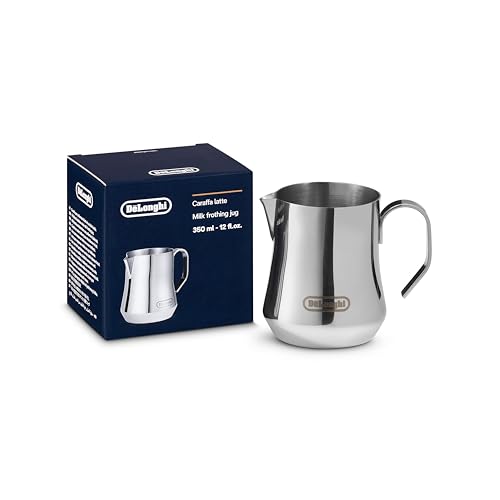
The US version gives the capacity as 12 oz. On the finish it contradicts itself: the description says brushed stainless steel, the feature list says polished. The product photo shows a mirror-like finish on the outside with a De’Longhi logo in an oval.
The numbers come from the Amazon catalogue: model and part number DLSC060, quantity one, size 350 ml, colour stainless steel, product group household goods. Dimensions are listed there too, namely 1.55 inches in height, 1.55 inches in length and 0.004 inches in width. Four thousandths of an inch is a tenth of a millimetre, so this is a database error, and we adopt none of the three values, even though a dimensions line would look better on the data sheet than a blank. The same record gives a weight of 0.366 pounds, around 166 grams. Because the dimensions beside it are obviously wrong, we read this figure only with reservations as well.
Is the spout good enough for latte art?
De’Longhi’s country sites answer this differently. The US version lists a narrow spout to create latte art, so a narrow spout, explicitly for latte art. The New Zealand version describes the same model as well-weighted, with an ergonomic handle and wide spout, so with a wide spout. The German site only promises in general terms that the milk is easy to pour and can be shaped into milk foam works of art.
In the product photo we see a short pouring lip drawn out of the rim, and not a long drawn-out tip like many latte art jugs have. The body is narrower at the top and widens towards the bottom, and the handle is an open loop that ends free at the bottom.
For pouring, the general rule is that a tapering spout bundles the stream narrowly and allows the fine lines of a rosetta. Sage UK advises a narrow spout for better control in its latte art blog. You often read that a wider, flatter lip is more forgiving at the start, but we found no source for it. For a first heart that needs no side-to-side movement, both designs are suitable in our assessment. Anyone working specifically towards rosettas and fine patterns would, in our assessment, get there faster with a long-spouted latte art jug than with the short lip the photo shows.
Why a 350 millilitre jug should not hold 350 millilitres of milk
When you froth, you draw air into the milk, the volume grows, and anyone who starts brim full ends up with foam on the worktop.
Then there is the movement. The foam only becomes fine-pored when the milk rolls after the air has been drawn in, that is, when it turns in the jug and breaks the coarse bubbles into fine ones. De’Longhi gives no fill height, yet whether that turning has enough room above the milk surface depends on exactly that.
A rule of thumb widespread among baristas is to fill the milk to just below the base of the spout, that is, up to where the pouring lip grows out of the rim. Anyone who takes cold milk straight from the fridge also gains time: the longer the milk takes to warm up, the longer you can draw in air and let it roll before the target temperature is reached.
How the sequence of drawing in air and the rolling phase works in detail is covered in our guide on how to froth milk.
The jug wall as a thermometer
The most concrete operating tip for this item comes from De’Longhi on the US site: the temperature can be felt on the underside of the jug while frothing. That is one reason milk jugs are made of metal. Stainless steel conducts heat many times better than plastic, and the thinner the sheet, the faster the heat arrives on the outside. A heavy, thick-walled pot, by contrast, shows the milk temperature with a delay, and it is easy to steam for too long.
Your hand on the base of the jug thus becomes a measuring device. The common barista rule of thumb is: as soon as the jug outside is just too hot to hold for long, the milk has reached roughly 60 to 65 degrees. It should not get much hotter, because above that the protein structure that carries the foam gives way. If you prefer to see a number, hang a separate milk thermometer on the rim.
In the end the order matters: first turn off the steam, then take the jug away. If you pull the wand out of the milk with the valve open, it splashes over the rim.
Care after frothing
What is written here is our recommendation from general knowledge about milk and stainless steel. Leftover milk does not go back under the wand after pouring: milk that has been frothed once can hardly be built up into fine foam a second time, so for the next drink you take fresh milk. You wipe the steam wand on the machine with a damp cloth in the same go and let a little steam through so that no milk dries on inside.
Even stainless steel has its limits. Scouring cream, steel wool and abrasive sponge sides leave fine scratches on a polished outer surface that stay visible in the light. Chlorine-containing cleaners attack the protective surface layer and can trigger pitting corrosion. And anyone who leaves the jug standing wet after rinsing gets pale limescale rings in hard water, which can be dissolved with a little diluted citric acid. A tea towel straight after rinsing saves you that.
What De’Longhi leaves open about the DLSC060
Bundled together, because the list is longer than the data sheet. Missing are: height, diameter and any other dimension; the wall thickness; the grade of stainless steel, that is, whether 18/8, 304 or something else; a statement on markings inside; a recommended fill quantity; spare parts or accessories such as a lid; the EAN.
Online, De’Longhi provides no instructions for the DLSC060. German support reports that no manuals are yet available for this product. Whether a leaflet is included in the box, we do not know. For a sheet-metal jug with no moving parts that is forgivable. But it also means there is no manufacturer guidance online on safety, temperature limits and suitability for the hob. On cleaning, only the dishwasher statement from the US and New Zealand sites exists (see FAQ); all other care tips in this text are our recommendation.
What else comes into question?
Besides the one real competing jug, the table has two items that do a completely different job and only compete for the same accessories budget. Whether a jug should be the next item on your worktop at all is often the more important question.
| Model | The difference | Price | Our rating | Choose this if |
|---|---|---|---|---|
| De’Longhi DLSC060 (this one) | Accessory from the machine maker, according to De’Longhi intended for its own espresso machines and bean-to-cup machines | approx. €16.99 | 8.3 | you have a De’Longhi with a steam wand and froth the milk for each drink separately |
| NewGF milk jug 350 ml | Same volume, according to the listing text with a measuring scale inside, in a set with a latte art pen | approx. €11.04 | 7.9 | you are frothing for the first time and want a scale when filling |
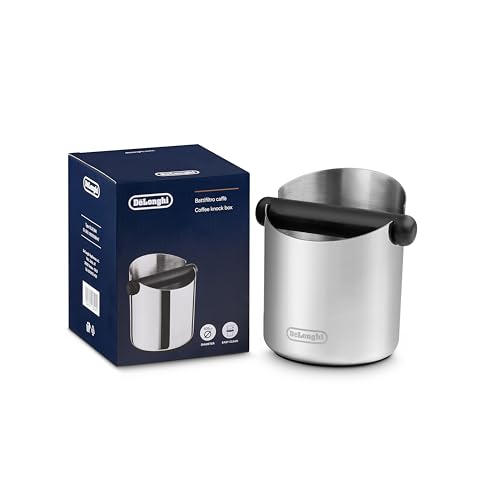
| De’Longhi knock box DLSC084 | Not a jug: a container for the coffee puck, also from De’Longhi | approx. €20.99 | 8.8 | you drink your espresso black and still knock the portafilter out over the bin |
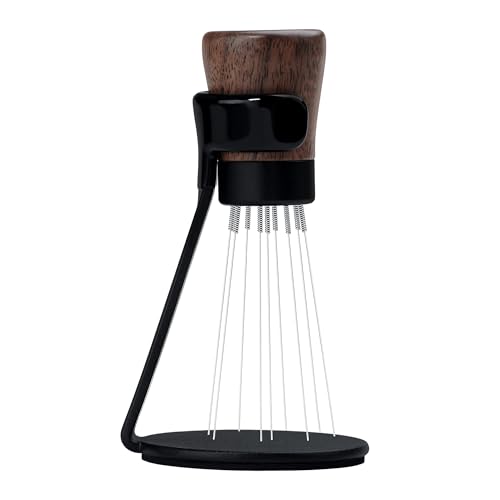
| Normcore WDT tool V2.1 | Steps in one stage earlier, when distributing the coffee grounds in the basket | approx. €25.99 | 9.4 | your espresso runs through unevenly, because milk foam will not rescue that |
The prices are guide values from our price boxes, the ratings are our editorial assessment from the available data and features, and they do not come from a series of measurements. You will find all items in this class in our category Barista accessories, and the ranking in the best-of list Barista accessories.
When this jug, when another
Five questions decide it, and the first has nothing to do with the jug itself.
Does your machine have a steam wand? If not, you hardly need this jug from our point of view. On the US site De’Longhi does call it an indispensable accessory for every owner of a manual or automatic espresso machine. But anyone who operates a bean-to-cup machine with an automatic milk system and milk container lets the machine froth by itself, and anyone with an electric milk frother froths in its container.
How many cups do you froth at once? Our guide Latte art for beginners works from the half-full rule of Sage UK and Lelit and Lelit’s 100 millilitres of milk per cappuccino: a 350 millilitre jug holds 175 millilitres when half full and is enough for one cappuccino, while for two from one frothing batch it takes, on paper, a nominal volume of 400 millilitres or more. Anyone who wants two cups at once froths twice in a row with it, and on the second pass the still-warm wall shortens the time to roll. In that case a larger jug is the better purchase. De’Longhi itself lists the DLSC069 with up to 500 millilitres, which is more than the DLSC060 and above this calculated lower limit.
How confident are you when filling? For the NewGF jug in the table, the Amazon listing text names a measuring scale inside, plus a latte art pen, and it costs just under six euros less.
Do you not yet have a tamper and a distribution tool? Then these items improve your espresso more clearly, from our point of view, than a new jug. Which accessories help in which order is sorted out by our guide to barista accessories essentials.
And do you want to warm milk on the hob? Then the DLSC060 is the wrong purchase. It is meant for frothing under a steam wand, and De’Longhi nowhere says whether it may go on a hotplate or on induction. For the hob you buy a milk pan whose manufacturer explicitly names the hob types.