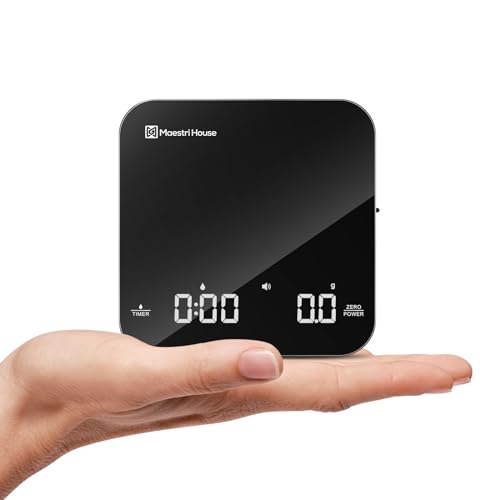
Maestri House sells this scale under several names. In the German Amazon listing it is called S2 Mini Coffee Scale with Timer, on the manufacturer’s site S2 Glass Surface Digital Espresso Scale, and the cover of the instruction manual shows two identifiers side by side, the model number K112 and an S1 G. Every time it is the same device: a square glass plate with 105 millimetre sides that displays to 0.1 gram and counts the shot time. On Amazon.de it costs approx. €29.99 (as of September 2026); in the manufacturer’s shop it is listed at US$36.99.
Behind the brand is a company that dates its own founding to 2020 and gives its address as Houston, Texas. In the manual it describes itself as a supplier of coffee equipment for enthusiasts that is meant to be aesthetically appealing and functional. The same manual is available as a PDF on the manufacturer’s download page, with an English and a German section.
We did not have the scale on our worktop. Every figure in this text comes from the German instruction manual for the K112 model, from maestrihouse.com or from the German Amazon listing including its catalogue data, retrieved on 7 September 2026. Prices and ratings in the table further down come from our own catalogue.
A glass plate, 105 millimetres square
The manual gives 105 x 105 x 19 millimetres, and the catalogue data of the German Amazon listing, at 10.49 x 10.49 x 1.98 centimetres, arrives at practically the same values. The product photo shows a flat plate with rounded corners, without a rim and without a separate weighing pan, resting on the palm of a hand.
On the unit’s own weight the sources differ: 300 grams in the manual, 0.75 pounds and therefore around 340 grams on the product page, 0.7275 pounds and therefore around 330 grams in the Amazon catalogue. Forty grams of difference changes nothing about the weighing and nothing about the weight in your backpack; it only shows how carefully the data sheets are maintained.
The weighing surface is borosilicate glass, the rest is ABS plastic, and the Amazon catalogue lists black and silver as colours. The LED display sits under the glass and only becomes visible when it lights up; Maestri House advertises this as a hidden display with touch-sensitive controls. According to the manual, five digits are the maximum.
On the left of the display the time runs, on the right the weight is shown, and below them are the two button areas TIMER and ZERO/POWER. Besides the power and tare button on the glass, the instructions name a rocker switch on the back for switching on. With the rocker switch at ON, the scale calibrates itself according to the instructions and sets the display to zero.
In detail: what 0.1 gram changes in the recipe
An espresso recipe consists of three numbers: how much ground coffee goes into the basket, how much espresso should run out, and how long it takes. The first two make up the brew ratio. With an 18 gram dose and 36 grams in the cup, that is 1:2.
Try calculating with an error of one gram. 18 becomes 19 grams, the ratio slips to 1:1.9, and the error is a good five percent of the dose. A scale with whole grams as its step does show the change from 18 to 19, but nothing in between: everything from 17.5 to 18.4 grams appears as 18 on the display, so the blind range is almost a whole gram wide. With a display step of 0.1 gram this blind range shrinks to a tenth of that, and that is exactly what the figure in the data sheet aims at. In the manual it appears in the specification table as “accuracy value 0.1g”. Resolution and accuracy are still two different things: the display step says how finely the scale computes, not how close it is to the true value.
At the lower end, the measuring range starts at 0.5 gram according to the Amazon listing, at the upper end it stops at 2,000 grams. With espresso, both ends are far from everyday use. Which brew ratio suits your bean and your basket is worked out by the Brew Calculator.
The timer, two modes and a limit at 9:59
Manual or automatic, both are possible. You switch on the automatic mode by holding the timer button for two seconds; a water drop then appears on the display as an indicator. After that the time starts with the liquid flow, and the English part of the instructions immediately adds that, depending on how stable the flow is, the start can come in slightly delayed.
The upper limit is 9:59, that is nine minutes and 59 seconds. An espresso is finished long before that, and so is a pour-over, depending on the recipe. For cold drip, which drips over hours, the display is too short; there a second clock keeps the time.
The second number that limits the process is five minutes: that is how long the scale waits without use before it goes into sleep mode. What counts as use is left open by the instructions. If you dawdle between two pours with a pour-over, or only grind the beans once the dripper is already standing, keep this in mind.
Power: 500 mAh, USB-C and a power adapter that is missing
Inside the housing is a lithium-ion battery with 500 milliampere hours, charged via a Type-C port at 5 volts and 1 ampere. According to the manufacturer’s advertising, one charge should last up to 90 days.
When the battery runs low, the display flashes; when it is empty, LO appears on the display. The cable should have been connected before that, because the instructions explicitly rule out operation while charging. If it sits unused in a drawer for a longer time, the instructions advise connecting it to the cable once a month.
The box contains the scale, a silicone pad, a USB-C cable and the manual. A power adapter is missing, and since 5 volts at 1 ampere is no special demand, any phone charger in the household will do.
Waterproof? The manufacturer says both
This is the most uncomfortable point about this device, and it cannot be smoothed over. The German instruction manual states word for word: “The electronic scale is not waterproof. Do not wash it with water and keep the charging port dry.”
On the product page, the same manufacturer advertises the same scale with a borosilicate glass surface that is said to be waterproof and easy to clean. The Amazon listing also promises waterproofing, and the word turns up a third time for the supplied silicone pad.
Our assessment: when in doubt, the instructions apply. They come with the device, they are the document a service case would rely on, and they are the more concrete of the two sources because they say what not to do. For cleaning, they name exactly one method: before first use, according to the manual, the scale should be cleaned with a clean cloth. In practice that means: wipe with a clean cloth, do not wash with water, keep the charging socket dry.
With the silicone pad it is about more than water anyway. For the bare glass surface the manual gives -10 to 60 degrees Celsius; with the pad in place it is -20 to 100 degrees. Those extra 40 degrees at the top are the real reason for the pad: freshly brewed coffee is hotter than 60 degrees, and the cup or carafe passes the heat downwards. For the removable pad, Maestri House names four properties: waterproof, non-slip, scratch-resistant and heat-insulating. The first of these is subject to the same reservation as above. In the manual, the manufacturer advises using the pad in any case because it protects the surface and the internal parts. Anyone who takes it off because the bare black plate looks better removes exactly this protection.
What Maestri House does not state
Some things remain open, and some of them matter when buying. There is no figure for the charging time of the 500 mAh battery, nor for charge cycles or for whether the battery can be replaced at all. Only the outer dimensions are documented, not the area that is actually usable for weighing, and whether a 58 millimetre portafilter stands on it securely is not stated by the manufacturer anywhere. There are likewise no details on the height under the brew group, the digit height on the display, a backlight, the refresh rate of the display or the weight change at which the auto timer kicks in. Nobody describes the underside and its feet; only the silicone pad is explicitly non-slip, and whether this pad may go in the dishwasher remains open. Nothing appears on the measurement deviation at 2,000 grams, on calibration, on CE or RoHS documentation (the manual only contains the disposal notice under WEEE) or on the country of production. Spare parts are not listed in the shop, neither as a pad nor as a cable nor as a battery. None of the sources mentions Bluetooth, an app or data export, but the manufacturer has not expressly ruled them out either. And the manufacturer’s site is English throughout; German is only found in the rear part of the manual.
What else is worth considering?
Three items from our catalogue realistically sit alongside this one in the decision, and only one of them weighs.
| Model | The difference | Price | Our rating | Choose this if |
|---|---|---|---|---|
| Maestri House S2 (this one) | 0.1 gram up to 2,000 g, timer up to 9:59, 105 mm square | approx. €29.99 | 8.6 | almost only espresso goes on the plate and space is tight |
| Bagail coffee scale | 3,000 g maximum load at the same resolution, larger footprint | approx. €39.99 | 8.4 | a single scale should cover espresso and the filter carafe |
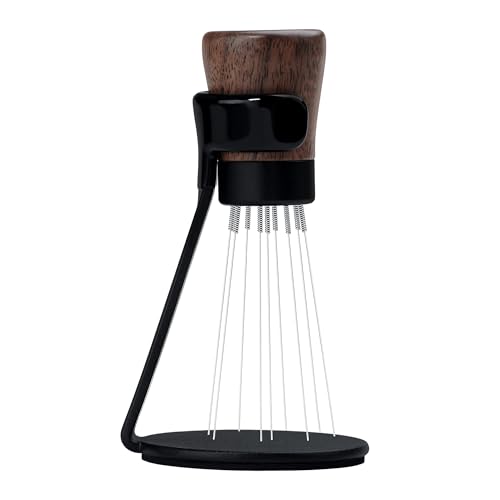
| Normcore WDT tool V2.1 | Not a measuring device: only distributes the grounds in the basket | approx. €25.99 | 9.4 | you already have a precision scale and your shot runs unevenly |
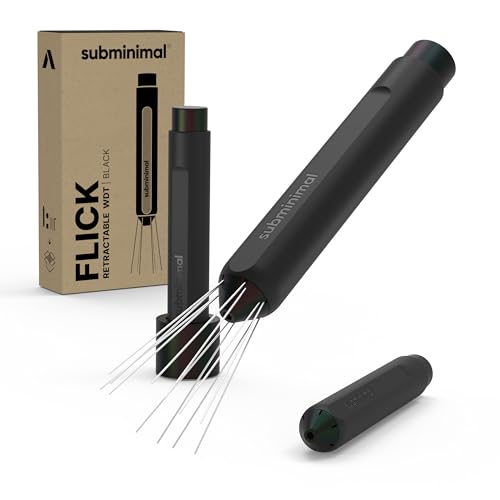
| Subminimal Flick | Needle tool with retractable needles, same price range | approx. €29.95 | 9.1 | your recipe is settled and only the distribution in the basket is missing |
The prices are guide values as of September 2026, the ratings our editorial assessment based on the available data and features. What the table does not do: it does not compare measured values. Nobody has put the four items side by side on a measuring rig. The whole area is gathered in the best-of list Barista accessories.
When this scale, when a larger one
The first question is the preparation method. For espresso, the upper limit of 2,000 grams is so far away that it never gets in the way: portafilter, cup and coffee together stay well below it. With filter coffee, more than the coffee sits on the plate, and the water weighs the most. If you regularly brew a pot for several people, you end up at the limit, and then the Bagail with its 3,000 gram maximum load is the more suitable purchase, even though at approx. €39.99 it costs ten euros more.
The second point is space. 105 millimetres square is little, 19 millimetres of height costs hardly any clearance to the spout, and together the two decide whether the scale lives permanently on the drip tray or wanders into the drawer after every shot. This decision is not just a matter of taste: if you put the scale away after every shot, you switch it on again the next morning via the rocker switch and first wait for the self-calibration.
Third point, easily overlooked: how wet does it get in your kitchen? If you hold the portafilter and the milk jug under the tap after every shot and rinse the accessories along with them, a scale that according to the instructions must not be washed becomes a daily annoyance.
The fourth point is the question of power. A built-in battery that is charged rather than replaced saves buying batteries and costs independence: if the scale is empty, only the cable helps. With replaceable batteries you would be ready again in the same minute, but you buy cells regularly.
That leaves the order within the budget. Around €30 is not a small item on the accessories shelf, and for the same money you get a distribution tool. What comes first depends on what is already there. Our guide Barista accessories: the essentials puts the precision scale with 0.1 gram at the start, because without it every later change to the recipe stays approximate.
Who is it for?
With a bean-to-cup machine the task shrinks. Dosing, distributing and tamping are done by the brew group, and you cannot get at the grounds at all. What remains is weighing the beans, if you want to know how many grams per cup go through the grinder, and for that you need neither 0.1 gram resolution nor a timer. With capsule and pod machines, even that falls away.
For the portafilter machine, on the other hand, the automatic mode is built. The instructions devote a chapter of their own to the espresso machine, and there is the sentence that matters: when the machine stops letting coffee run into the cup, weighing and timing stop. With a pour-over you pour yourself, in surges with pauses in between, and such a clear stop signal is missing. In our category Barista accessories, the S2 therefore sits next to the distribution tools as the device that makes the rest verifiable in the first place.
It is wrong anywhere the weighing result has to stand up in front of someone else. If you sell coffee by weight, you need a verifiable measurement result. If you drink it, you do not.