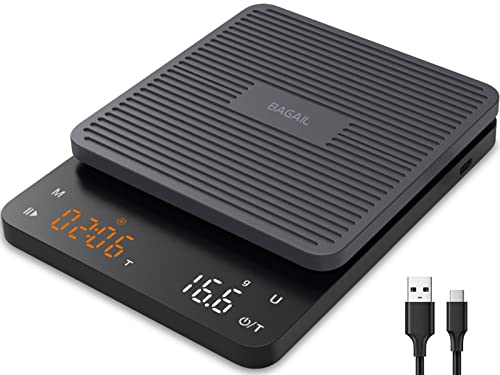
Bagail describes itself as a supplier of travel and household accessories. The coffee scale with model number SC01 is sold there under the brand BAGAIL Basics, and according to the Amazon catalogue it is manufactured by Diyouth. For approx. €39.99 (as of September 2026) you get a flat black plate with a timer, a USB-C socket and a removable silicone mat. The manufacturer is clear about what it is meant for: on the product page the large platform is in the foreground, and the scale is classed as a scale for pour over. Bagail does mention espresso on the same page, but attaches a condition: if you want to use the scale for it, you should measure your machine first. That very condition decides the purchase.
Platform, silicone mat, control strip
The weighing platform is made of ABS, heat-resistant according to Bagail. On top lies a removable silicone mat, which the manufacturer lists as waterproof, non-slip, scratch-resistant and heat-insulating. In the product photo it is finely ribbed and covers almost the entire top. A narrow strip along the front edge stays free, and that is where everything you operate sits: the display and four fields, labelled M, a start-pause symbol, U and a symbol combining on-off and T.
In the same photo, the display itself shows two lines one above the other, the time on top, the weight below with the unit beside it, and the two lines light up in different colours. Separate lines are more than cosmetics: scales with a single line make you switch between weight and time, and if you have to do that in the middle of a pour, you are one hand short. Here both values are shown at the same time.
On dimensions, the sources contradict each other, of all places at the point that matters when buying. The German product description gives 16.5 x 13 x 3 centimetres at 360 grams and promotes this as compact. The English manufacturer page works in inches: 6.7 x 5.1 x 1 inches, converted roughly 17 x 13 x 2.5 centimetres, at 0.8 pounds or roughly 363 grams. The Amazon catalogue, in turn, lists 6.69 x 5.12 x 1.38 inches, so roughly 17 x 13 x 3.5 centimetres. Footprint and weight are close together; the height varies between 2.5 and 3.5 centimetres.
You have no choice of colour: in the manufacturer’s shop, black is the only variant.
In detail: 0.1 gram step size, 0.3 gram accuracy
Two numbers sit directly next to each other on this scale, and they do not mean the same thing. Bagail writes that the device responds sensitively to any increase of 0.1 grams, and in the same sentence that it delivers accurate readings from 0.3 to 3,000 grams. The first figure is the step size of the display, the second the range for which the manufacturer promises accuracy. Anything below 0.3 grams on the display is therefore a reading without a promise.
This is not a special case of this scale but the normal case for kitchen scales in this price class: the smallest displayable step and the smallest guaranteed load are two different things, and manufacturers like to print the first one large and the second one small. For coffee the difference rarely matters. An espresso dose is in the range of 16 to 20 grams, around 30 to 45 grams end up in the cup, and a hand filter recipe runs between 15 and 60 grams of ground coffee and a few hundred grams of water. All of that is far above the lower limit. If you work in the tenths range, though, for example when weighing a calibration weight or a tiny addition, you leave the range Bagail stands behind.
The upper limit is set at 3,000 grams. Together with the 0.1 gram step, that gives 30,000 display steps, calculated from the two manufacturer figures. This is where the actual compromise of this design lies: the same weighing sensor has to resolve an 18 gram dose and carry a filled pot. A pure espresso scale with a maximum load of 2,000 grams has it easier here, but a full server overhangs its edge.
Where the scale stands also feeds into this result. The third-party portal manuals.plus advises placing it on a stable, level surface and checking before each weighing that the display reads zero. This advice is not a quirk of the portal, it follows from the design: under the platform a weighing sensor translates a tiny deformation into an electrical signal, and that deformation turns out differently if the housing wobbles on an uneven worktop or sinks into a soft surface. With a step size of 0.1 grams, little is needed to shift the zero point.
According to the manufacturer, the timer runs along automatically so that a brewing recipe can be repeated in the same sequence. What that is worth in everyday use depends on your recipe: if you add 300 grams of water in three pours, you mainly need the time between the pours; if you set up a French press, you need it in one piece. The brew calculator works out which target values make sense for your coffee-to-water ratio, and how the individual steps at the hand filter fit together is covered in the guide Pour-over filter coffee.
Does the scale fit under your portafilter?
You have to measure that yourself, and Bagail says the same: if you want to use the scale for espresso, you should measure your espresso machine beforehand so that the scale fits in. At 16.5 centimetres long and 13 centimetres wide, the footprint is rarely the problem. The height is.
The bottleneck is between the portafilter spout and the drip tray, and this dimension differs from machine to machine. Every centimetre the scale adds is lost to the cup, and between the 2.5 centimetres of the manufacturer page and the 3.5 centimetres of the Amazon catalogue lies exactly the centimetre that can decide whether a cappuccino cup fits. You can gain room in two ways: with a flatter cup, or by taking out the drip grate and putting the scale directly into the tray.
At the hand filter the calculation turns around. There, the surface area is the reason to reach for this scale. A V60 server, a Chemex or a French press stand centrally on 16.5 x 13 centimetres, whereas on the 105 by 105 millimetre glass surface of the Maestri House they overhang the edges.
Power comes from a built-in battery
Inside the housing sits a lithium battery with 300 milliamp hours, charged via USB-C. Bagail puts the runtime at 30 days with use of ten minutes once a day. That is roughly five hours of operation per charge, and with this figure you can extrapolate your own rhythm: if you brew in the morning and evening and let the timer run each time, you get about half of the 30 days. This conversion comes from us, not from the manufacturer.
Two further statements on the power concept appear only at manuals.plus, and one of them is unusable. For the same model the portal lists 600 milliamp hours, that is, twice the manufacturer’s figure, with identical charging time and identical runtime. Two capacities that are supposed to lead to the same 30 days cannot both be right, and we calculate with the manufacturer’s 300. The second statement is usable: the scale switches itself off when idle. For your runtime the threshold is not a side issue, because a shutdown after two minutes and one after twenty differ by a multiple of the brewing time, and the seconds between two pours are exactly the pause in which an impatient auto-off strikes.
Replaceable batteries are not provided. That has two sides. You never have empty AAA cells in the house, and a leaking cell cannot corrode contacts here. If the battery weakens after a few years, however, the whole scale is up for discussion, because a replacement battery is not listed on any of the three manufacturer pages.
Bagail lists the scale and a Type-C charging cable as the scope of delivery. In the product photo exactly this cable lies next to it, USB-A on one end, USB-C on the other. According to this list no power adapter is included, so you need a free USB port or an existing charger. The manual portal, which is explicitly not a manufacturer document, additionally lists the silicone mat and an instruction manual as package contents. For the mat this matches the manufacturer’s shop, since Bagail requires it before every weighing.
Heat: the silicone mat is not an extra
Bagail warns against placing hot objects directly on the scale and requires the silicone mat to be laid on before weighing, otherwise damage to the device may occur. Anyone who puts a freshly brewed server on the bare ABS plate is therefore acting against an explicit requirement, not against a well-meant care tip.
Why the manufacturer insists can be explained from the design. ABS is a thermoplastic that softens with heat, and the weighing sensor underneath responds to temperature with a shift of the zero point. A mat that Bagail itself calls heat-insulating keeps both away from the electronics. In practice this makes the mat a wearing part: it lies between the hot pot and the sensor, and it is the part you take off for cleaning.
A note from manuals.plus points in the same direction: store the scale cool and dry, and place it neither next to an oven or hob nor in direct sunlight. This is the statement of a manual portal, but it matches the design, since a lithium battery and a load cell both cannot tolerate permanent heat.
What Bagail does not state
Bagail has no data sheet, nor a support area with documents, and the factual basis shows it. The following remain open: the usable weighing surface in millimetres, display type and display size, the assignment of the four control fields, the auto-off time of the energy-saving function, the calibration procedure including the required calibration weight, repeatability and linearity, an ingress protection rating for the housing, operating and storage temperature, the country of manufacture, the year of market launch, spare parts for mat, cable and battery, and the dimensions and dishwasher suitability of the silicone mat itself. Non-slip feet on the underside are likewise undocumented; according to Bagail’s statements, it is the mat on top of the platform that is non-slip.
These gaps are the reason why we remain cautious on build quality. They do not say that the scale works badly, but that much simply cannot be checked before buying. What could be evaluated was five product bullets in the German listing and three pages in the manufacturer’s shop, plus a manual portal that contradicts the manufacturer on battery capacity and warranty period.
What else comes into question?
| Model | The difference | Price | Our rating | Choose this one if |
|---|---|---|---|---|
| Bagail coffee scale SC01 (this one) | 3,000 g capacity on 16.5 x 13 cm, built-in battery | approx. €39.99 | 8.4 | you want to weigh the espresso dose and the full filter pot with one device |
| Maestri House mini coffee scale | 2,000 g on a 105 x 105 mm glass surface, same 0.1 g step | approx. €29.99 | 8.6 | the scale has to fit between spout and cup every day |
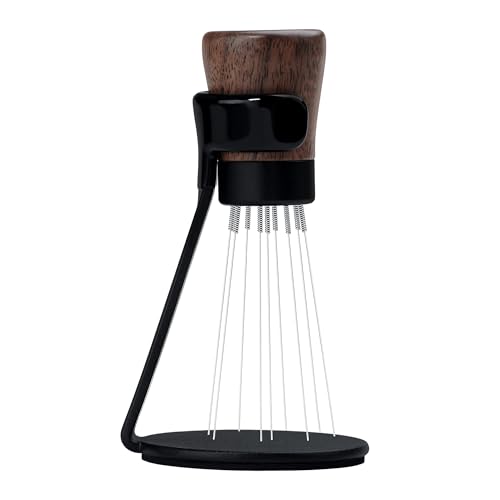
| Normcore WDT tool V2.1 | distributes the ground coffee with 50 mm long needles, measures nothing | approx. €25.99 | 9.4 | your dose is already on a scale and the shot still varies |
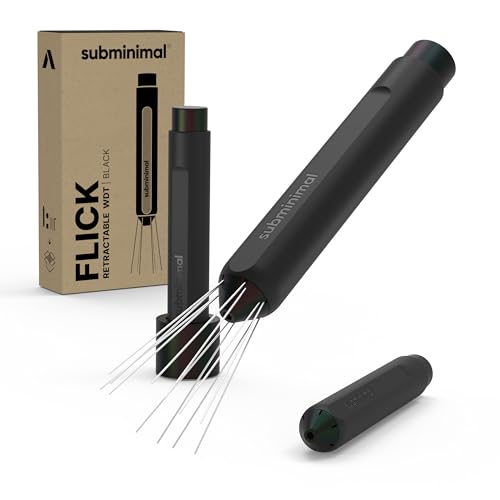
| Subminimal Flick | needles retract into the 110 x 18 mm aluminium body | approx. €29.95 | 9.1 | your budget is a one-off around €30 and the worktop is full |
The table compares prices as of September 2026, which can change at any time. The rating column is our editorial assessment based on the available data and features. Nobody has measured anything on these four devices, and we certainly have not. There is a reason why two distribution tools stand next to two scales: in the barista accessories category, the three alternatives lie between €25.99 and €29.99, and anyone who spends this sum once decides between weighing and distributing.
Espresso, filter or both: when this scale fits
Three questions decide it, and the first is the method of preparation. If your coffee comes from a hand filter, Chemex or French press, the scale works in the direction Bagail built it for: the server stands centrally, and the capacity carries pot and water together. If it comes from a portafilter and the scale is meant to go in the drip tray, the purchase decision hangs on the dimension you take yourself beforehand, and when in doubt the flatter competitor wins.
The second question is the worktop. 16.5 x 13 centimetres are permanently occupied as long as the scale stays put. At 360 grams you lift it away with one hand, and because the cable is only needed for charging, it is not tied to a power socket.
The third question is your expectation of paperwork. Anyone who reads a data sheet before buying, looks up a calibration procedure or needs a written commitment from the manufacturer will not find it here, and this is the point where we would hesitate. For around €40, a scale may be a consumer item where you accept that. If you treat it as a measuring instrument and log values, you are better off buying one class higher.
Our assessment: for the household where an espresso runs on weekdays and a whole pot at the weekend, the combination of fine step and 3,000 grams of capacity is the more practical choice, as long as the scale does not have to go under the portafilter every day. If it does, take the tape measure, and if the height does not suffice, buy the smaller Maestri House and live with 2,000 grams of maximum load; you save ten euros in the process. And if your dose has long been fixed but your espresso still runs differently every time, no scale solves that problem. Then the money belongs in a distribution tool, and in our comparison those are the two lower rows of the table. Our best-of list Barista accessories gives a broader overview of the category.
There is one group for whom the scale is the wrong purchase: anyone who fills or sells coffee commercially by weight. That calls for a verified (legal-for-trade) device, and whether this scale carries an approval for official verification is not documented in any of the sources evaluated.