With the Aeroccino 4, the whole reason to buy hangs on one button. On its German product page, Nespresso lists four recipes, including two kinds of hot milk foam, and leaves open what separates one from the other. The instruction manual, which is available as a PDF download from the same page, tells them apart by consistency: the instructions distinguish the two foam types by consistency.
Four buttons on the black ring
On the product page the device is called “Aeroccino4”; in the Amazon catalogue it appears as “NESPRESSO Aeroccino 4 elektrischer Milchaufschäumer silber” (electric milk frother, silver), with Nestlé Nespresso S.A. entered as the manufacturer. The manual gives the model number Aeroccino 4 4194 and version number 1.0, and the file name of the PDF linked by Nespresso gives 4 October 2021. If you find an older manual online, it is best to check this number: an earlier Nespresso document on the Aeroccino 4 gives 4192 for Europe and a switch-off only after nine minutes. The price is approx. €89 (as of September 2026), which is how Nespresso Germany lists it, and the same figure was in the Amazon.de catalogue on 7 September 2026.
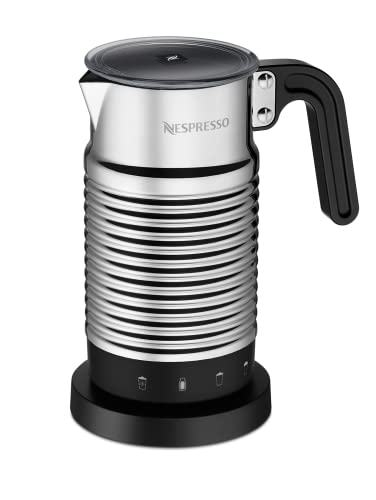
The product photo shows a round milk jug, horizontally ribbed at the bottom and smoothly polished at the top, with a black handle and a pouring lip opposite. It sits on a black base, on whose ring four small cup symbols stand side by side. The manual also describes exactly four buttons: cold foam, hot milk and two for hot milk foam. When all four light up, the device is ready for use according to the instructions. For all preparations together there is a single stirring tool, which Nespresso calls the whisk, and it writes: “One single whisk meets all your wishes.”
Airy or dense: the difference is in the manual
The German product page puts it briefly: “4 recipes: 2 kinds of hot milk foam, hot milk and cold milk foam”. If you read only that, you know exactly as much after the sentence as before it. The instruction manual, by contrast, names item 8 in its parts and button overview “Hot milk foam for cappuccino (airy foam)” and item 9 “Hot milk foam for latte macchiato (dense foam)”. That answers the question: the fourth preparation is not a new drink but a second foam density for hot milk.
The recipe table in the same document turns this into concrete quantities. For a cappuccino, Nespresso provides 40 millilitres of coffee and 60 millilitres of milk foam; for a latte macchiato, 40 millilitres of coffee and 120 millilitres of foam. The airy foam thus belongs to the smaller quantity, the dense foam to the larger one. Both buttons froth and heat in one run.
The cold milk foam button only froths, without heating. Nespresso assigns it the iced cappuccino and the iced latte macchiato, the latter with three large ice cubes, 40 millilitres of coffee and 120 millilitres of cold foam. The hot milk button only heats, without frothing, and is intended for hot chocolate and caffè latte, which the table specifies with two times 40 millilitres of coffee. Which drink needs which button is therefore in the manual rather than in the marketing. The differences between the milk coffees themselves, that is between cappuccino, latte macchiato and caffè latte, are explained in our guide to coffee drinks.
A note for anyone reading on Amazon rather than at Nespresso: the manufacturer’s product text there lists only three options, “With just one press of a button you choose between hot foam, cold foam or hot milk”. The device still has four buttons; that is how they appear in the button list of the manual.
Construction: seven parts, three weight figures
The Aeroccino can be taken apart into a manageable number of individual parts. The overview in the manual lists lid, seal, whisk, spring, milk jug, lower connector and base plug.
Nespresso gives 10 centimetres in diameter and 17 centimetres in height. That dimension describes the round body, and the photo shows clearly that the handle and pouring lip stick out to the side beyond it. For the worktop you should therefore allow somewhat more than ten centimetres, and in the same photo the base protrudes a little all round beyond the jug it carries. The Amazon catalogue also lists 19.0 by 13.0 by 9.0 centimetres. These figures are very probably packaging dimensions, because a width of 9 centimetres would be narrower than the jug itself.
The weight gets confusing. The product page says 1.03 kilograms, the manual around 0.85 kilograms, and the Amazon catalogue 1.543 pounds, so around 0.70 kilograms. Two of the three figures are in Nespresso’s own documents, the third in the catalogue data that the manufacturer supplies to Amazon, and between the highest and the lowest there is almost a third. We have not handled the device and do not re-weigh anything, which is why the range is given here instead of one figure. In the data table further down, which allows only one value per field, we use the 1.03 kilograms from the product page, because that is the figure Nespresso publishes for this device.
In detail: 410 to 490 watts and 80 seconds
The electrical data is in the manual, not on the product page: 220 to 240 volts, 50 to 60 hertz, 410 to 490 watts for the European version. For a device with a heating element that is little; a typical kettle draws roughly four times as much. It only has to warm up one cup’s worth, though, not a litre.
Hot and cold milk foam each take roughly 80 seconds according to the instructions, hot milk roughly 150. The button you pressed flashes during that time and then stays lit, which is the only feedback during preparation. You can cancel at any time by pressing the flashing button again or by lifting the jug off the base. After one minute without use, the Aeroccino switches itself off.
Two fill levels are marked in the jug. The lower one, “Max foam” at 120 millilitres, applies to hot and cold milk foam. The upper one, “Max milk” at 240 millilitres, is only for hot milk. For the minimum there is a rule instead of a number: fill in enough milk to cover the whisk. If you pour in more milk for frothing than the lower mark allows, you risk, according to the troubleshooting section, that it overflows.
What else is worth considering?
| Model | The difference | Price | Our rating | Choose this if |
|---|---|---|---|---|
| Nespresso Aeroccino 4 (this one) | Two separate buttons for airy and dense hot foam | approx. €89 | 8.7 | you want to switch between cappuccino and latte macchiato foam |
| Nespresso Aeroccino 3 | Only one button for hot foam, no stated dishwasher approval | approx. €79 | 8.4 | one foam type is enough for you and you wash up by hand anyway |
| Severin SM 3586 Induktion | Induction base, foam up to 350 ml instead of up to 120 ml | approx. €99.99 | 8.9 | you want to froth more than 120 ml of milk at once |
| Severin SM 3587 Induktion | 13 programmes, including three for plant-based and lactose-free milk | approx. €114 | 9.4 | you mainly froth soy, cashew or lactose-free milk |
The prices are indicative figures from September 2026 and change faster than this page. The rating in the fourth column is our editorial assessment based on the manufacturers’ data sheets, not a measurement result.
Which milk, and how many cups in a row?
One large milk drink per run. Two figures stand behind that, and they measure different things: the MAX mark for frothing limits the milk poured in to 120 millilitres, while the recipe table specifies 120 millilitres of finished foam for a latte macchiato and 60 for a cappuccino.
Foam has more volume than the milk it comes from, and how much that is depends, according to the manual, on the type of drink and its temperature. Whether one filling is therefore enough for two cappuccinos is not a fixed quantity. In between there is also the cleaning that the manufacturer requires after every use. According to Severin, the two induction jugs in the table froth up to 350 millilitres instead of 120 and heat up to 700.
On milk, Nespresso is clearer than you would expect from a capsule manufacturer. Soy, almond and oat drinks are expressly permitted, with the note that plant-based drinks contain allergens, namely gluten, almond and soy. Excluded are fortified milks, milk powder and flavoured milk, with which the device simply does not work according to the manual. Incidentally, Severin does not list a dedicated oat programme for the SM 3587 either; its three milk programmes are tuned to cashew, soy and lactose-free milk. In the Aeroccino, the plant-based drink runs through the same process as cow’s milk anyway. What happens in the jug during frothing and why temperature matters so much is explained in our guide to frothing milk.
With placement, it is not only the footprint that counts. The manual prohibits operation in a cupboard, requires distance from radiators, hobs and gas burners, rules out use outdoors, and wants the underside of the device and the area under the base kept dry, especially the connection area. A damp corner next to the sink is therefore the wrong place. The cable has its own rules: do not pull it over sharp edges, do not trap it, do not let it hang down, keep it away from heat and moisture, and pull on the plug rather than the cable to disconnect. Overflowing milk should not land on the plug, and according to the manual the device should never run unattended.
Cleaning: immediately after every use
“Clean the appliance immediately after each use”, says the manual, and with milk that is no formality. Beforehand, the milk jug should be carefully lifted off the base and rinsed with cold water, which cools it down and, according to the instructions, avoids burns. Then it is taken apart: seal out of the lid, whisk out of the jug, spring off the whisk.
From there Nespresso offers two routes. Route A is the dishwasher, into which all parts except the base may go at a maximum of 70 degrees. Route B is hand washing with a gentle detergent for the inside of the jug, seal, lid, whisk and spring. For better cleaning results the manufacturer expressly recommends the machine route. It adds two restrictions: the temperature of your dishwasher’s main cycle should be checked before use, and the jug must not be placed directly over the spray arms, because that can damage the inner coating. After both routes, drying is done with a clean cloth or kitchen paper, after which the parts are put back together.
In both cases the base stays out. It is cleaned only with a damp cloth after the plug has been pulled, and never immersed. The reason is given right next to it: “Electricity and water can cause a fatal electric shock.” If the lower part of the milk jug is wet, it must be dried before it goes back on the base, and before the next use the plug and recessed areas should be clean and dry.
One statement is easily overlooked: after a fall, the device is, according to the manual, no longer dishwasher safe. It should then no longer be used anyway.
What Nespresso does not state
A whole series of details is missing. What the milk jug is made of is not stated in any of the sources; the manual speaks only of an inner coating, without naming it. To what temperature the milk is heated remains open; only the duration is given. Also without a value: noise level, country of manufacture, energy consumption per preparation, colours other than silver, and the height, diameter and weight of the base separately from the jug. How airy and dense foam are technically produced, whether through speed, duration or temperature, is not explained by the manufacturer anywhere. And spare parts for whisk, spring, seal or lid are not listed publicly anywhere; Nespresso’s spare parts page requires a login.
Repairing it yourself is not intended anyway. The manual expressly prohibits opening the device and justifies this with dangerous voltage inside. Defective devices are to go to the nearest authorised service workshop for inspection, repair or adjustment, and for improper repairs Nespresso accepts no liability according to the instructions. Accessories are also narrowly defined: the frother may be operated only with the supplied base, and accessory parts that Nespresso does not recommend for the device can, according to the manual, lead to fire, electric shock or personal injury. For the end of its service life the instructions refer to a collection point and, for details, to the local authorities.
Who is it suitable for?
The manual describes the intended use more broadly than you might expect: households and similar settings, staff kitchens in shops, offices and other working environments, plus use by guests in hotels, motels and other residential establishments and in bed-and-breakfast establishments. A small guesthouse is therefore expressly in the list, a commercial coffee bar is not.
In a household with small children, a second look at the safety instructions is worthwhile. Children from eight years old may operate the device only under supervision, the device and cable belong out of reach of younger children, the lid must stay closed during preparation or there is a risk of scalding, and the surface of the heating element can be hot after use. For people with lactose intolerance, Nespresso recommends using a second device rather than using the same jug for both.
The Aeroccino 4 is wrong for anyone who needs three or four milk drinks in a row in the morning, and for anyone who wants to set temperature or foam density themselves. This device can do neither. More milk per run and a selectable temperature are offered, for example, by the induction frother SM 3586, with up to 350 millilitres for frothing and 45 to 65 degrees, although it too has no setting for foam firmness. Which other designs exist and what distinguishes them is covered in the milk frother overview, and if you are unsure about the design, our coffee finder will lead you to a recommendation in two minutes. If the profile does fit, though, with an iced latte macchiato with cold foam in the evening and a cappuccino with airy foam in the morning, both come out of the same jug.


