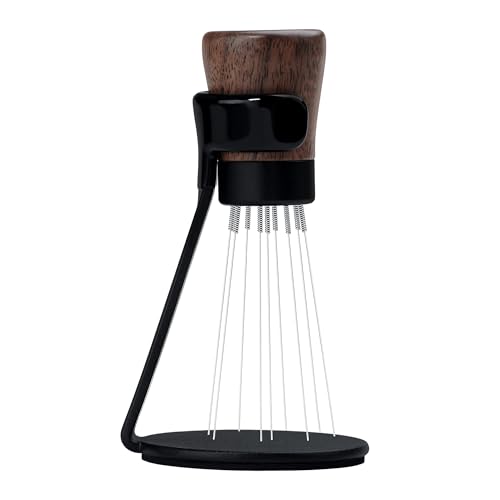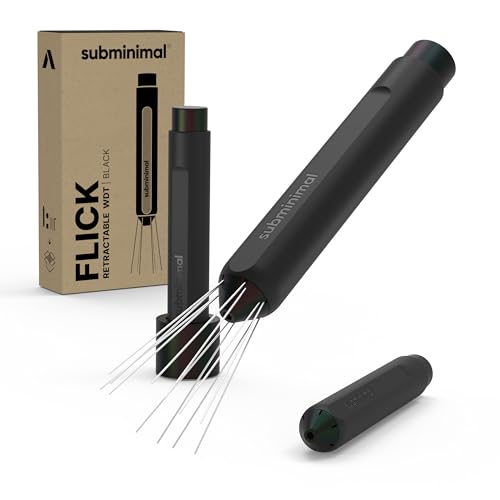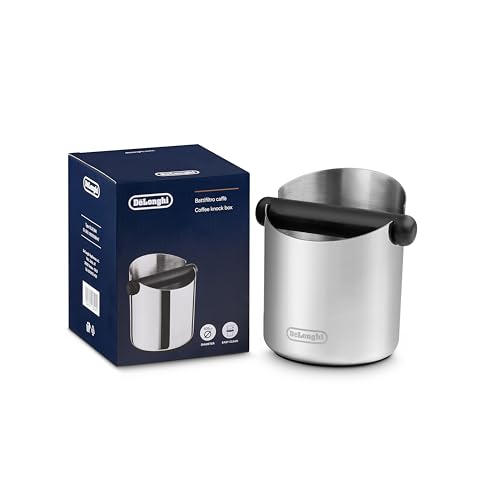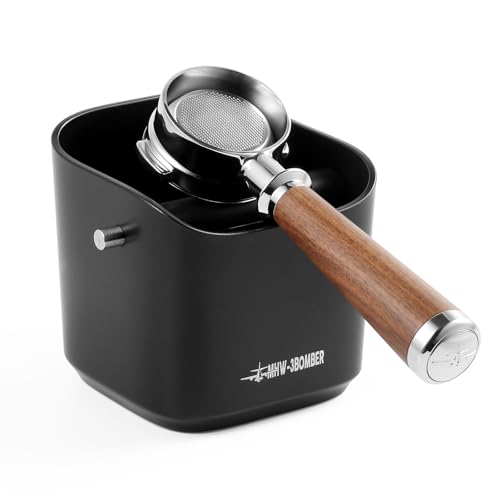
Knock boxes differ in one point you can check before buying: whether a capacity is stated or not. MHW-3BOMBER supplies a number. The GB5967B even carries it in the product name: on the brand’s international shop it is called Coffee Espresso Square Knock Box 1200ml, and on the German-language brand site simply Quadratischer Abschlageimer (square knock bucket).
On Amazon.de the box costs approx. €27.99 (as of September 2026). We have not had it in our hands: nothing weighed, nothing knocked out. The figures and materials below come from the brand’s shop, from the German-language brand site mhw3bomber.at, from the Amazon catalogue data of 7 September 2026 and from the seller’s product photo. One thing belongs right at the start because it defines the character of the article: the specification table in the brand shop lists the stainless steel SUS304, and anyone who reads only that line takes the GB5967B for a metal box. The body is plastic.
What the brand states and what the Amazon catalogue adds
On mhw3bomber.com there is a single sentence on the material, and it names ABS and a long service life. The German-language brand site, as the only source, offers a specification table, where three materials stand side by side: ABS, silicone, SUS304. The Amazon listing assigns them, if only partly: ABS plastic for the body, plus a metal knock bar and a protective rubber sleeve around it.
The specification table supplies the numbers: 1200 millilitres capacity, 435 grams weight, black/white as the colour, and the barcode 6972653794305. The Amazon catalogue knows the same box under the part number GB5967B and the model GB59, size 1.2L, colour black, quantity one piece, product group household goods. The item dimensions are given there in inches, 5.12 x 5.12 x 3.94, which converts to roughly 13.0 x 13.0 x 10.0 centimetres. These catalogue figures are what we calculate with here.
The shape is square, and the listing text advertises it as plenty of volume on a compact footprint. At the top the opening is cut at an angle, which according to the seller is meant to stop coffee grounds splashing out. The product photo shows the black body with rounded corners and the knock bar across it, with its mount sitting in the side wall. If you are looking for the portafilter with a wooden handle lying on the bar in the picture: it is probably there only for illustration.
On its company page the brand names Zhongshan in Guangdong province as its base. According to its legal notice, the German-language site mhw3bomber.at is run by WANFU Trading GmbH of Gerasdorf in Austria, so a distributor under the brand domain. We therefore attribute statements from there to the brand shop and not to a manufacturer’s datasheet.
In detail: where the blow goes
After the shot, an espresso puck sits firmly in the basket, because it was compacted under pressure and the residual water holds it against the basket wall. When you knock out, you bring portafilter and puck down together and stop the portafilter abruptly on the bar. The puck does not join in the braking, comes loose and falls. The kinetic energy released in the process has to go into the construction.
Two components absorb it. The bar takes the blow directly, which is why metal belongs there. The body then only has to hold the grounds and stay where it is. Whether it does depends on the grip downwards, which is the product of weight force and friction coefficient. The 435 grams are one factor, the base the other: according to the seller, non-slip silicone is meant to provide a secure stand and protect the worktop. Silicone grips a smooth worktop noticeably better than hard plastic, and that is exactly why it sits down there and not the bare ABS body.
According to the listing text, the metal bar comes with a protective rubber sleeve, and it has a job that rarely appears in datasheets. The rim of a portafilter is a machined surface that seals against the gasket in the brew head. If you strike metal on metal there every day, you are working on exactly that surface. A soft layer in between absorbs the shock before it reaches the edge.
That leaves the height. Ten centimetres is low: the only other knock box in our catalogue, the De’Longhi DLSC084, comes to 14.1 centimetres according to the same Amazon catalogue data. Low means two things here. The lever between the point of impact and the base stays short, so the box tips less easily than a tall body. And you do not lift the portafilter as far, which is kinder to the wrist over time. The opening cut at an angle works in the same direction, because you get to the bar at a flatter angle.
What the manufacturer does not state
Gathered together so that it is not scattered through the text. For dimensions, the brand’s own external dimensions are missing, as are the internal dimensions, the width of the opening, a millimetre measurement for portafilters, the height of the bar above the base and the wall thickness of the body. For material and use, there is no temperature resistance, no statement on food safety or BPA, no scope of delivery, no year of market launch, no decibel value for the advertised quiet knocking out, and no assignment of which component is made of the SUS304 named in the table. There is no instruction manual or datasheet for this box on any domain of the brand, and the guide section there covers only electronic devices such as the coffee scale.
An open contradiction comes on top. Some retailers show a height of 13 centimetres, while the Amazon catalogue converts to around 10. Only the catalogue figure is documented. We calculate with it, even though the other would look rounder in a datasheet table.
Does a 58 mm portafilter fit over the opening?
Probably yes, but it is not guaranteed. The brand shop writes that the box is suitable for most espresso machines and for small and large cups, which stays at the level of a description of the design. What you have to calculate with is 13 centimetres of outer width from the catalogue.
The wall thickness comes off this outer width. What remains is an opening narrower than 13 centimetres, so allow for some margin.
The basket diameter is the wrong measure anyway, because the portafilter does not rest anywhere and is not clamped in. What counts is the width across the spouts. A double spout hangs below the basket and needs room when you put it on, whereas a bottomless portafilter does not have this problem.
You can settle this before buying with a ruler. Measure your portafilter across the spouts rather than across the basket and hold the result against the 13 centimetres from the catalogue. If you stay well below, it fits. If you land just under, it will be tight, because the opening does not have the full outer width.
Cleaning: the wording counts
Both brand sites say the same thing, and it is exactly one sentence: wipe with a damp cloth and leave to air dry. The seller gives no dishwasher approval, neither on the product page nor in the listing. That fits the material. ABS stands for acrylonitrile, butadiene and styrene, an impact-resistant, dimensionally stable thermoplastic that tolerates heat less well than stainless steel. What a metal body shrugs off in a wash cycle can lead to warping in plastic over time, and once warped, a socket for the knock bar sits differently than before.
The knock bar is a different matter. The Amazon title lists it as removable, and the listing text names quick rinsing under water, without any complicated disassembly, as an advantage. That makes sense, because the mount in the wall is the place where fine grounds settle and stay damp. The difference between the two statements is notable: for the bar the seller names rinsing under water, for the body only the cloth.
The manufacturer’s FAQ still draws a line. It asks you not to take the product apart yourself in a warranty case. Removing the bar is expressly intended in the listing text and does not fall under that, and we would not take the box apart any further.
The grounds themselves belong in the organic waste, not the sink. Together with fat, coffee grounds settle in the trap and build up a plug over the months. On the compost heap they are usable as an additive, but in a thick layer directly around the bed, less so.
Price, where to buy and running costs
On Amazon.de the box is approx. €27.99 (as of September 2026). In the brand’s international shop it costs US$28.00, in the German-language brand shop €28.00 including VAT. There, €10 shipping per order to Germany and Austria is added, and the shop delivers free across the EU only from €100 order value. For a single box that means €38.00 at your door, a good ten euros above the Amazon price. Buying direct therefore only pays off if more goes into the basket anyway.
After that the box costs nothing more. There is no filter, no descaler and no cleaning agent that the seller prescribes. The knock bar and the silicone base are not in the brand shop’s range as individual items, though. If one of the two parts breaks, the box is a case for the warranty or for the recycling centre.
If it comes to the warranty, there is one item that the manufacturer’s FAQ clearly regulates: the customer bears the return costs, unless the fault lies with the manufacturer or the goods were defective from the start. For an item around €28, postage eats a good part of the purchase price. According to the FAQ the promise applies only to the first buyer with proof of purchase anyway.
What else is worth considering?
In our catalogue this box is set against exactly one other knock box. The other two rows of the table do a different job. They are included anyway because your accessories budget is only spent once: in practice the choice is not between four knock boxes but between these four items.
| Model | The difference | Price | Our rating | Choose this if |
|---|---|---|---|---|
| MHW-3BOMBER GB5967B (this one) | 1200 ml stated, ABS body with removable metal bar | approx. €27.99 | 8.5 | you pull four or more espressos a day |
| De’Longhi DLSC084 | Stainless steel body, capacity without a figure on the product page | approx. €20.99 | 8.8 | you want metal on the worktop and make one or two shots a day |
| Normcore WDT-Werkzeug V2.1 | Works on the ground coffee before the shot rather than on the waste after it | approx. €25.99 | 9.4 | your espresso runs through unevenly and the budget stretches to one item |
| scarlet espresso Tampermatte | Natural rubber mat for tamping, does not catch any grounds | approx. €14.99 | 8.6 | what you lack is grip when tamping rather than a target for knocking out |
The prices are guide values as of September 2026, and the ratings are our editorial assessment based on the available data and features, nobody measured them. What the table is not suited for: it does not answer which of the two containers takes more grounds. The whole class is in our best-of list for barista accessories.
When this box, when another
Four questions decide it. None of them is how well the container is made.
How often do you pull shots? With one to two espressos a day, it is not the volume that determines when you empty it but hygiene, and then the capacity goes unused. From four or five shots the picture turns around. At five pucks a day, the 15 from the listing text are used up after three days, so the capacity limit roughly coincides with the interval at which the grounds have to go for hygiene reasons anyway.
How much space is free next to the machine? A footprint of around 13 x 13 centimetres and a height of about 10 centimetres is the value to hold against your free corner. A square footprint wastes less area in a corner than a round one. Whether the box fits under your machine’s spout is something only a folding rule can tell you.
Do you want metal, or is plastic enough? The price hangs on that. The De’Longhi DLSC084 has a stainless steel body and costs approx. €20.99, while here you pay €7.00 more for ABS with a metal bar. If the container is in front of your eyes every day, you will decide this more by the kitchen than by the technology.
And in what order do you buy accessories? The Normcore WDT-Werkzeug V2.1 costs approx. €25.99 and works on the ground coffee before the shot, so it changes the extraction. A container for the grounds does not improve a single espresso. If your shot still runs through unevenly, we would pick the tool first and buy the box later. Which parts help in which order is sorted in our guide to the barista accessories essentials.
Who is it for?
Two groups can save themselves the money. A bean-to-cup machine produces no puck that anyone would need to knock out, because the machine throws the spent grounds into its own container inside the housing. With a French press, pour-over and a Karlsbad-style dripper, the grounds are wet and loose and are rinsed out or go in the bin with the paper. In both cases the box just stands around.
That leaves the portafilter. The seller names clean, controlled knocking out of espresso pucks as the purpose, and home, office or café bar as places of use. For the first two the capacity is enough. For a counter in continuous operation it gets tight in our assessment: anyone who pulls 15 pucks by midday empties daily. In our barista accessories category, the GB5967B is therefore the box for a household with two coffee drinkers on one machine and a size too big for a single-person household.